The United States, along with the emerging Global South and declining Western powers represented by the European Union and Canada, are all seeking to steer the future international order toward pathways they can more effectively shape and control.
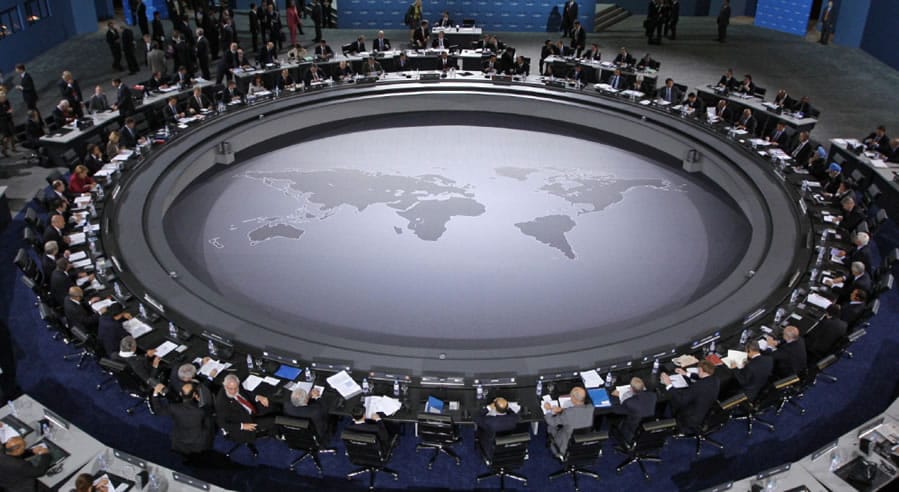
Amid the current proliferation of geopolitical conflicts, the Russia-Ukraine war drags on and the deadlock in the Iran-Israel-U.S. confrontation persists. Although the intensity and geographical scope of these two wars do not match those of the past two world wars, their depth and disruptive impact on the postwar international order are, in historical terms, rare in the past century.
Against this backdrop, the actors shaping global governance are undergoing a process of reconfiguration. The United States in the Trump 2.0 era, along with an emergent Global South and a declining Western power base represented by the European Union and Canada, are all seeking to steer the future international order toward pathways they can more effectively shape and control. These three blocs are engaged in a dynamic of both competition and cooperation, collectively driving the global governance system toward what may be described as an era of great-power-centered governance.
Trump’s shock wave
As a deconstructive force within the postwar international order, Donald Trump’s MAGA-driven approach has delivered systemic and structural shocks to global governance. In just over a year after Trump’s return to the White House, a series of anti-establishment and unconventional policy moves have come close to reshaping long-held international perceptions of American values and foreign policy strategy.
In the realm of global economic and trade governance, Washington has disrupted supply chain systems worldwide through extensive “reciprocal tariffs.” In non-traditional security governance, the United States announced its withdrawal from 33 UN bodies and 35 non-UN international organizations, significantly slowing the global sustainable development agenda. In traditional security governance, the U.S. abducted Venezuelan President Nicolas Maduro, worked closely with Israel in targeting Iran’s top leaders and issued threats to take control of Cuba and the Panama Canal. Collectively, these developments have contributed to a renewed prominence of rules of the jungle in contemporary international relations.
A further striking feature of this deconstructive trend is the shifting role of alliances that had long served as pillars of U.S. global governance. Under Trump’s transactional style of diplomacy, traditional allies are no longer privileged partners. Instead, countries that were once considered strategic or ideological competitors—most notably China—are increasingly viewed by the administration as necessary interlocutors in addressing global challenges, despite Beijing’s rejection of any notion of a G2-style joint domain.
Following Trump’s recent visit to China, Beijing proposed a new framing of the bilateral relationship as a “constructive relationship of strategic stability.” While Washington attached conditions emphasizing “fairness and reciprocity,” it nonetheless signaled a degree of acknowledgment and acceptance of this conceptual framing. If the U.S. follows through on the understandings reached at the leader level, bilateral relations could enter a new phase characterized by managed competition with pragmatic cooperation.
That said, it is undeniable that while the Trump administration has significantly deconstructed elements of the postwar international order, it has simultaneously begun constructing selective components of an alternative, interest-driven framework aligned with its MAGA agenda. For instance, the establishment of the Board of Peace, involving multiple countries, reflects an attempt to shape governance over key geopolitical hot spots and, in some respects, to partially substitute for the role of the United Nations in traditional security management. Likewise, the formation of a critical minerals alliance of resource-rich states is aimed at consolidating influence over global mineral supply chains and pricing mechanisms, thereby enhancing control over resource governance.
Whether this unconventional approach to global governance will be a lasting feature of the evolving international system remains uncertain. Both the dismantling of postwar institutions and the selective construction of new, interest-based arrangements will ultimately be tested at two key political junctures: the U.S. midterm elections and the end of Trump’s presidential term.
The BRICS factor
As a key constructive force in global governance, BRICS, which represents major emerging countries, faces both a rare strategic opportunity and a set of new challenges. The Trump administration’s withdrawal from multilateral frameworks and its partial disengagement from the postwar international order have created governance vacuums in some areas. For BRICS, which seeks to rebalance global governance, this provides an invaluable window of opportunity to position itself as a new center of agenda-setting in global affairs.
In the field of global security, BRICS has leveraged its Middle East and North Africa consultation mechanisms to explore pathways to political settlement that take into account regional realities and balance the interests of all parties involved in conflicts. However, as BRICS is an emerging actor in global governance, this mechanism alone is insufficient to meet the broader demands of traditional security governance.
Following U.S. military actions in Venezuela and subsequent threats that Cuba could be “next,” a previously relatively stable Latin America has increasingly become a hotspot of geopolitical competition. Against this backdrop, the establishment of a BRICS Latin America consultation mechanism and a corresponding mechanism for addressing conflicts in Africa could bring new opportunities for cooperation. Such initiatives would help articulate a distinct BRICS approach to managing geopolitical tensions and contribute to the development of a more inclusive architecture of global security governance for the sake of common, comprehensive, cooperative and sustainable security.
At the same time, the challenges in BRICS cooperation should not be underestimated. External pressure comes primarily from the United States, where the Trump administration has increasingly portrayed BRICS as an anti-U.S. bloc, prompting some countries to hesitate over potential participation.
More significant, however, are the internal frictions within an expanded “greater BRICS.” In recent years, BRICS foreign ministers have failed to issue joint statements on multiple occasions, reflecting underlying divergences. Last year’s impasse was linked to disagreements between Egypt, Ethiopia and other members over UN Security Council reforms, while this year tensions were exacerbated by military conflict between the UAE and Iran and disputes triggered by India’s perceived alignment with Israel. Similarly, recent BRICS consultations on Middle East affairs were unable to produce a unified position.
After the U.S.-Israel strikes on Iran, some scholars within the member states have even argued that BRICS cooperation should extend into the military domain to safeguard the group’s dignity and enhance its collective security capabilities. Such proposals, however, have sparked concerns that BRICS military cooperation could evolve into a parallel confrontational structure against the West.
This highlights a broader structural challenge to multilateral platforms: an imbalance between membership expansion and consensus-building, which leads to fewer agreements and limited implementation of many initiatives. BRICS is no exception. If it is to become a central pillar of global security governance in the future, it will require greater political coordination and more sophisticated institutional design to manage internal divergences and prevent fragmentation.
Seeking more influence
As traditional actors in global governance, Europe and Canada—long closely aligned with the United States and active across international affairs— now find themselves in a more awkward strategic position. Their ideological alignment with Washington is no longer as cohesive as before, and defense cooperation has been effectively downgraded. More troubling for them, even territories such as Greenland (belonging to Denmark) and parts of Canada’s own sovereign space have been subjects of U.S. strategic interest.
Amid the intensifying “great power triangle” dynamics of the U.S., China and Russia, Canadian Prime Minister Mark Carney has described Canada and European countries as “middle powers.” Yet Europe remains the birthplace of modern global governance concepts and is a long-standing advocate of “effective multilateralism.” In the context of profound global transformations, the European Union is unwilling to be sidelined or marginalized and instead seeks to regroup in order to restore its former centrality in international affairs.
To this end, EU High Representative for Foreign Affairs and Security Policy Kaja Kallas has said that China, the United States and Russia are seeking to divide the European Union and that by acting as a single united force the EU can negotiate as an equal power with other global superpowers. However, given the domestic constraints faced by EU member states, as well as by the United Kingdom and Canada—each grappling with its own internal political and economic challenges— aspirations for collective strength and strategic autonomy remain far easier to articulate than to realize.
In sum, while there is no consensus on how to define the current era, it is increasingly evident that the world is entering a phase of great-power governance characterized by both cooperation and competition. Under the pull of major powers, various actors in global governance are being reconfigured through fragmentation and re-integration. Amid the profound transformations of the postwar international order, global governance is increasingly defined by a dynamic of intensified interaction and strategic balancing among major powers.
