
Economic warfare in Europe has stranded Russia in the global market, but has yet to produce a reduction in its ambitions. Yet the EU is seeking to expand penalties with no clear outcome in hand.
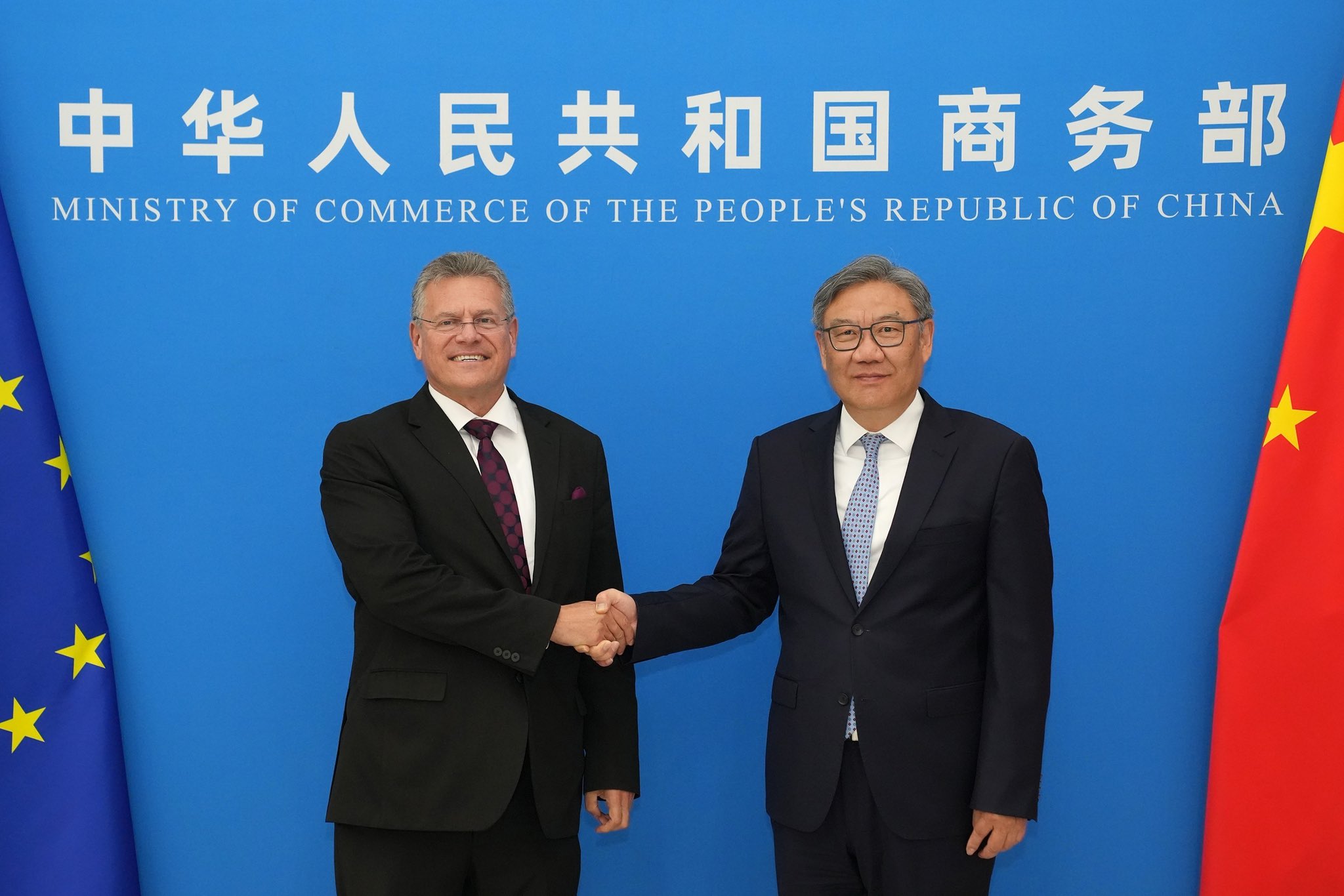
EU trade commissioner Maroš Šefčovič said he and China’s commerce secretary Wang Wentao had made a “crucial first step” towards rebalancing EU-China trade relations after their talks in Beijing on Oct 9, 2026.
Sanctions imposed in response to a war ultimately face one decisive test: whether they help end it. After four years and twenty-one packages against Russia over Ukraine, Europe can point to mounting economic costs without being able to demonstrate a corresponding change in Moscow’s conduct.
On 23 July, the EU added fourteen entities based in mainland China and Hong Kong to restrictions targeting alleged support for Russia’s military-industrial complex. Beijing answered within a day by placing fourteen European entities under export controls, prohibiting Chinese exporters—and foreign actors handling Chinese-origin goods—from supplying them with controlled dual-use items.
The identical number of targets conceal an asymmetry. A Chinese company denied European dual-use goods may be able to find substitutes elsewhere; a European manufacturer dependent on Chinese-controlled inputs may have fewer alternatives.
Indeed, European firms caught by Beijing’s Announcement No. 30 were soon asking whether they could still obtain the materials their production depended on and whether suppliers further down the chain could continue selling to them at all.
That episode exposes a larger difficulty. The EU’s turn toward Chinese firms is evidence that Brussels is reaching the limits of the targets it can hurt without generating opposition among its own member states. The fallback creates a new exposure: retaliation that can return the costs of Russia sanctions directly to European companies and, through them, to the governments whose unanimous support every subsequent package requires.
Sanctions have raised Russia’s procurement and transport costs, restricted access to Western technology, forced it to sell oil at a discount and damaged its longer-term economic prospects. What they’ve not done is compel Moscow to end or reduce the war, nor moved Beijing’s policy toward Russia by a single inch.
Demertzis and Brookings reach the same weakness by different routes: measures have arrived in stages, allowing Moscow time to adapt, while enforcement gaps, energy exemptions, third-country rerouting and a shadow fleet operating around the oil-price cap have diluted the effect each successive package was intended to produce.
Twenty-one packages in, costs to the EU states continue to scale while leverage does not. Still, Brussels is now preparing to scale again: 1,600 additional individuals and entities allegedly linked to Russia’s military-industrial complex could be proposed, increasing the existing list by about a third. The size makes the question sharper: will another tranche generate leverage that more than twenty previous packages did not, or simply extend a campaign whose marginal returns are becoming harder to identify?
This is where China enters.
The fourteen mainland Chinese and Hong Kong companies were among fifty-one entities added to a list subject to tighter restrictions because of purported support for Russia’s war economy or circumvention of existing controls. Their coercive effect therefore depends on whether the targeted firms need European-origin inputs that cannot readily be replaced.
The political attraction of such listings is easier to see. Chinese companies are often simpler for 27 governments to agree on than targets with powerful constituencies inside Europe. No member state has a national champion behind the Chinese company; fewer domestic lobbies are waiting outside ministries; and the listing can still be presented as action against a declared “systemic rival.” The July measures themselves were calibrated: major Chinese actors were omitted because member states feared retaliation.
That is what sanctions saturation begins to look like. As politically easier targets become scarcer, pressure shifts toward the names nobody around the Council table feels compelled to defend. Sanctions are moving toward the targets political agreement can still reach.
The mismatch runs deeper. Europe built much of its external influence through market access, regulation and standards. That model is strongest when access to the single market is the prize and substitution is costly. It is less suited to a contest in which power can run through control of individual technologies, minerals and components embedded inside another economy’s production chains.
China’s retaliation reverses the direction of European regulatory power. Brussels restricts access to European technology; Beijing asks which European firms depend on Chinese inputs and restricts those instead. Aggregate market size becomes less important than control of the component the other side cannot easily replace.
Washington adds another layer of coercive power that Brussels cannot reproduce. The U.S. can combine tech controls with the reach of the dollar system and secondary sanctions. Europe retains some leverage through its own market and technologies, but not the same financial reach. Against Chinese intermediaries that can replace European suppliers, EU restrictions can therefore impose compliance and commercial costs without producing the behavioural effect Brussels wants.
Beijing’s July response demonstrated the difference in another form: speed. While an EU sanctions package requires unanimous agreement among all 27 member states through extended negotiations, a Chinese export-control listing can be issued through a rapid executive decision. China responded in less than 24 hours; Beijing gave EU officials only about one hour’s warning before announcing its retaliation.
Combined with control over critical inputs, that institutional asymmetry produces escalation dominance. Beijing can identify exposed European entities, prepare its response and activate it before Brussels has begun negotiating its next collective move. The damage can then be concentrated on companies with the least room to adjust.
The exceptional-authorisation clause in Announcement No. 30 adds another lever. An exporter can apply to MOFCOM for permission to proceed in individual cases. That discretion allows Beijing to present the restrictions as calibrated rather than indiscriminate while encouraging affected firms to seek relief through national governments. A retaliatory list can therefore become a wedge between companies and Brussels, and between member states and the institutions that placed those companies in China’s crosshairs.
The political effect is more consequential than the numerical symmetry. The costs Beijing imposes land on member states, each dispute activates domestic lobbies, and each government has to explain the damage to voters—who never approved the exposure in the first place.
The ultimate vulnerability is unanimity itself. Every EU sanction package depends on all governments agreeing. Once retaliation becomes predictable, capitals can look ahead to which of their companies, universities or suppliers might appear on Beijing’s next list. Each exposed constituency creates an argument for an exemption, a narrower designation, a delay or a veto before the next package even reaches agreement.
In other words, China’s answer to the twenty-first package does not have to block the twenty-second to matter. It only has to raise the domestic price of voting for it.
A retaliation doctrine, if Brussels had one, would price that exposure before every vote: which targets carry real coercive weight; which European industries would absorb the response; which components have no reliable second supplier; and which companies would turn to national governments once the bill arrived.
Brussels has never produced a package-by-package account of what these measures achieve. Such scrutiny could expose an uncomfortable reality: the listings may impose greater costs on European firms than the coercive pressure they generate against Russia, while sanctioning a Chinese company can serve political leaders by parading resolve through another package, even when the coercive objective is vague or the expected leverage negligible.
Twenty-one packages in, Brussels is preparing another major expansion while the war continues and retaliation is beginning to travel back through Europe’s own dependencies. The danger is no longer confined to the companies caught in the exchange: once Beijing can turn supply-chain exposure into pressure on the unanimity behind EU sanctions, retaliation begins to erode Europe’s ability to agree to the next package.
