
For the second consecutive year, ASEAN stakeholders prefer China over the United States as a strategic partner, driven by China's dominant economic presence, infrastructure investments, and growing trust. U.S. standing has eroded due to policy unpredictability under the Trump administration, climate withdrawal, and declining reliability as a partner.
For the second time, China has edged out the United States as ASEAN’s preferred partner, a trend that hints at the shifting sands in how Southeast Asian stakeholders view the two great powers. According to the annual State of Southeast Asia Survey Report by Singapore’s Institute of Southeast Asian Studies (ISEAS) Yusof Ishak Institute, published on April 7, (52%) of respondents said they would align with Beijing over Washington (48%) if forced to choose. A review of the key risks identified by respondents helps explain this evolving take on the U.S.-China contest for regional influence.
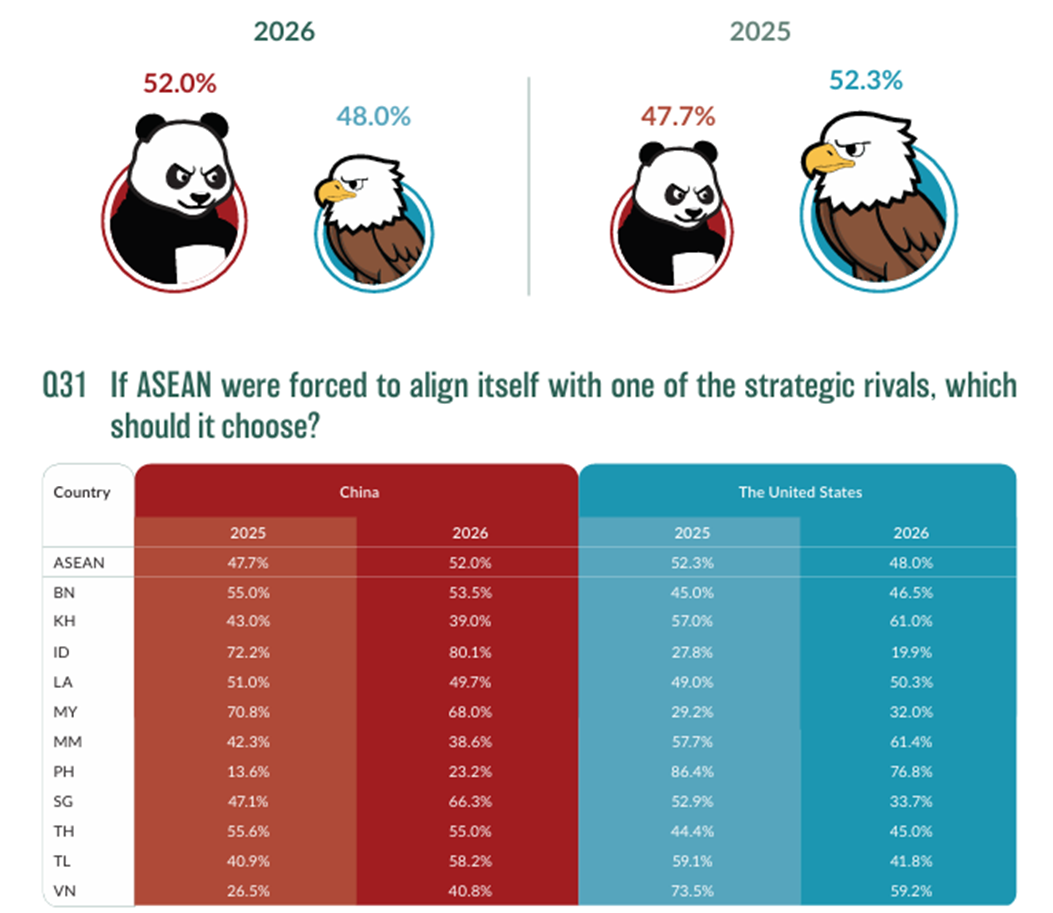
From pg. 51 of 80 of 2026 ISEAS Yusof Ishak Institute State of Southeast Asia Survey
Leveraging economics to become a favored strategic partner
In this year’s survey, China kept its position as ASEAN’s most influential economic (55.9%) and political-strategic (40%) partner. Beijing also emerged as the partner with greatest strategic relevance (9.1 out of 11), followed by Washington (8.6). In forecasting ties with major powers, more ASEAN respondents had high expectations for improved relations with China over the next three years (55.6%) than with the U.S. (32.8%). The economic part is easy to explain. China has been ASEAN’s largest trade partner for 16 consecutive years since 2009. Since 2019, ASEAN has also become China’s top trade partner, reinforcing economic linkages between the two sides. The upgrading of the ASEAN-China Free Trade Agreement last year to cover digital and green economy and supply chain connectivity is bound to deepen this economic interdependence.
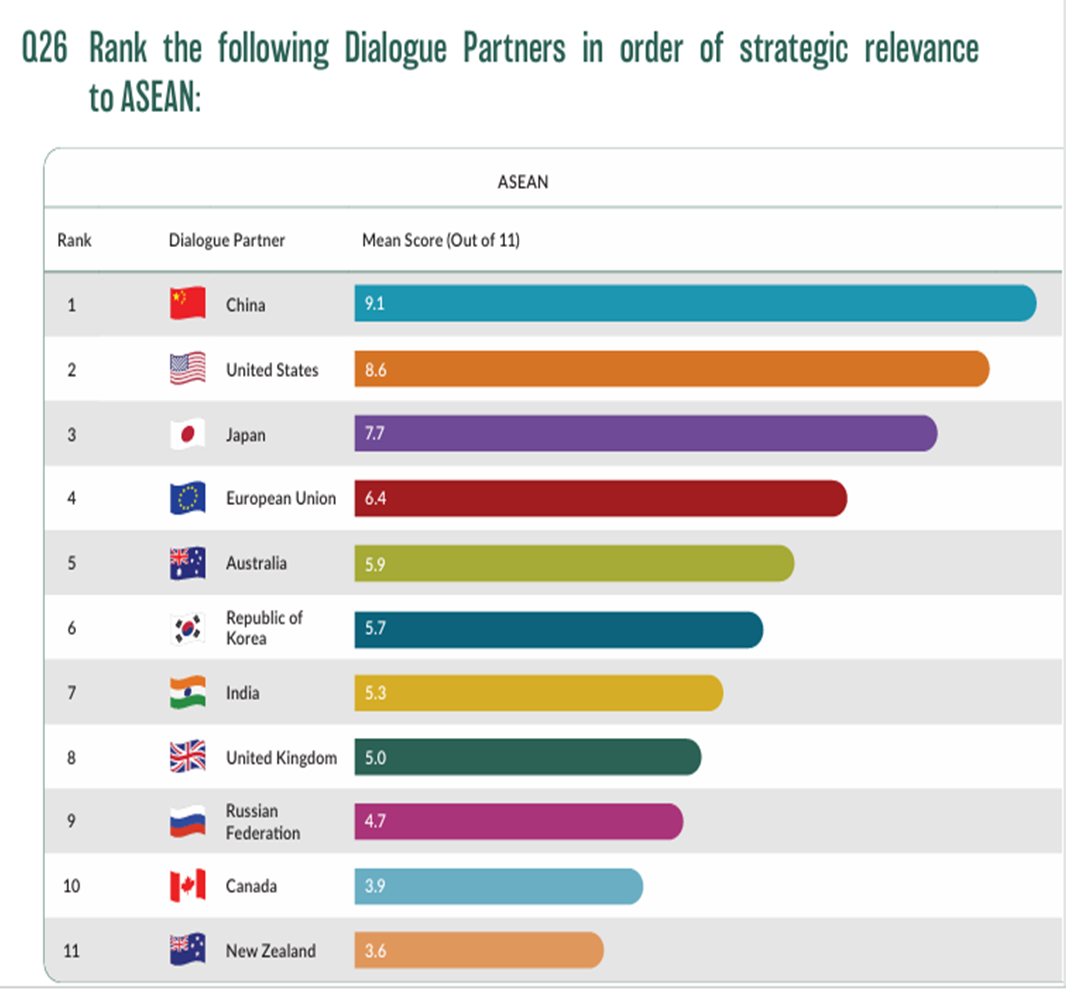
From pg. 42 of 80 of 2026 ISEAS Yusof Ishak Institute State of Southeast Asia Survey
ASEAN countries and China are also part of the world’s largest free trade area, the Regional Comprehensive Economic Partnership. RCEP, which entered into force in 2022 and will be due for a general review next year, is looking to elevate its standards and expand. Hong Kong, Sri Lanka, Chile, and Bangladesh seek membership in the trade bloc. China also applied to join other regional trade pacts in which several ASEAN countries are already members, such as the Comprehensive and Progressive Trans-Pacific Partnership (Brunei, Malaysia, Singapore, Vietnam) and the Digital Economy Framework Agreement (Singapore). Survey respondents ranked ASEAN as a leader in championing global free trade (25.5%), followed by China (21.3%). In sharp contrast, the US prefers bilateral trade deals and employs tariffs to pressure trade partners to negotiate. The poll ranked the U.S. a distant fourth (14.8%) after the European Union (19.2%) in promoting trade liberalization.
Furthermore, compared to China’s Belt and Road Initiative, which is now in its 13th year and has already delivered concrete projects like the Laos-China railway, Jakarta-Bandung high-speed railway, and Phnom Penh-Sihanoukville Expressway, among others, U.S. alternatives like the Blue Dot Network or the Indo-Pacific Economic Framework have yet to make their presence felt in the region. New Chinese pitches, such as the Global Development Initiative, also received unanimous support from ASEAN, given China’s success in poverty alleviation and in achieving many United Nations Sustainable Development Goals ahead of the 2030 schedule.
China is a major force in deepening regional connectivity through cross-border railways, highways, ports, grid, and digital infrastructure. It supports the transition to green energy and industrial upgrading of its ASEAN neighbors. The Beijing-based Asian Infrastructure Investment Bank is one of the financiers of Laos’ Monsoon Wind Farm, Southeast Asia’s largest, which began commercial operations last year and now transmits clean energy to Vietnam. State-owned PowerChina led the construction with wind turbines supplied by Shanghai-based Envision Energy. China plays a big part in the rise of Laos as the region’s battery, exporting renewable energy to its neighbors, and a land link connecting mainland ASEAN to China. It powered Indonesia’s shift from a raw nickel ore exporter to a critical mineral processor. Beijing was also quick to dispatch relief and financial assistance to ASEAN countries visited by calamities from the earthquake in Myanmar to typhoons in the Philippines and Vietnam last year. Chinese carmakers are ramping up production of electric vehicles (EVs) and batteries in Southeast Asia, pushing the region’s shift to modern green transport
Beyond economics, China is also active in mediating conflicts, pursuing sustained shuttle diplomacy to defuse the Cambodia-Thailand border clash last year. Trilateral foreign minister meetings were held in Anning (August 14) and Yuxi (December 29), both in Yunnan province, in 2025. Complementing these official meetings, China Foreign Affairs University hosted the first trilateral Track 2 dialogue on February 10 this year in Beijing.
Policy reversals and unpredictability undermine appeal
ASEAN respondents identify climate change and extreme weather events (60.0%) as the region’s top challenge this year. Economic competition between major powers ranks only second (51.7%). The U.S. exit from the Paris Climate Agreement, introduction of incentives for oil and gas expansion, while terminating subsidies on EVs, dented its role in global climate change conversations. Curtailment of humanitarian and development aid further diminished the U.S.’ profile. Meanwhile, China’s massive new energy capacity, robust portfolio of overseas projects in renewables and EV and battery production, and increasing climate change aid, especially to Global South countries, enhance Beijing’s position.
ASEAN elites also identify US leadership under President Donald Trump (51.9%) as the top geopolitical concern. It scored higher than global scam operations (51.4%) and aggressive behavior in the South China Sea (48.2%). This is a reverse order of 2025, when maritime tensions ranked first. To view the U.S. as a source of geopolitical risk is a turning point. It undermines Washington’s position as a defender of the so-called “rules-based order.” The capture and trial of a sitting leader of a sovereign country, Venezuelan President Nicolas Maduro, and oil blockade of neighboring Cuba generated unease among ASEAN countries. The use of force or threats to use force to effect “regime change” is disturbing, as it may set precedent for rival powers or other countries at odds with their neighbor. The destruction in Gaza and U.S. failure to rein in its ally Israel also fueled resentment in Muslim-majority ASEAN countries like Indonesia and Malaysia. Designs over the territory (Greenland) of a fellow NATO ally (Denmark) also raised concerns over the U.S. treatment of allies and friends.
Nevertheless, the U.S. continues to have the upper hand over China when it comes to trust. But the ISEAS survey made some interesting insights. First, while ASEAN respondents have more trust in America (44%) than China (39.8%), trust in the latter has increased from last year (36.6%), while the former’s number declined (from 47.2%). Second, distrust of both powers has also become comparable – the U.S. got 35%, while China got 34.5%. Third, for the first time since the survey was conducted in 2019, more respondents have expressed trust (39.8%) than distrust (34.5%) of Beijing. Finally, while the survey cited the same factors to explain trust and distrust of the two competing powers, the differences in the numbers could be telling. ASEAN respondents see China as having more vast economic resources and a strong political will to provide global leadership (47.8%) than the US (32.5%).
That said, respondents also shared greater concern over Beijing’s use of economic and military power to threaten an ASEAN country’s interests and sovereignty (43.8%) than that of Washington (35%). It goes without saying that with greater power comes greater responsibility, restraint, and reassurance. Of the things China should do to improve relations with ASEAN, the resolution of territorial and maritime disputes peacefully in accordance with international law ranks highest (35.1%). This is followed by a desire to see Beijing respect the sovereignty and not constrain the foreign policy choices of its Southeast Asian neighbors (25.5%).
Indeed, parsing the survey results offers clues about Southeast Asia’s thinking, giving powers keen to influence the region a chance to adjust and recalibrate.
