
Within the broader Asian framework, China counts among Australia’s most important bilateral relationships. Stability and predictability in China-Australia ties are crucial for reducing systemic friction and improving overall governability.
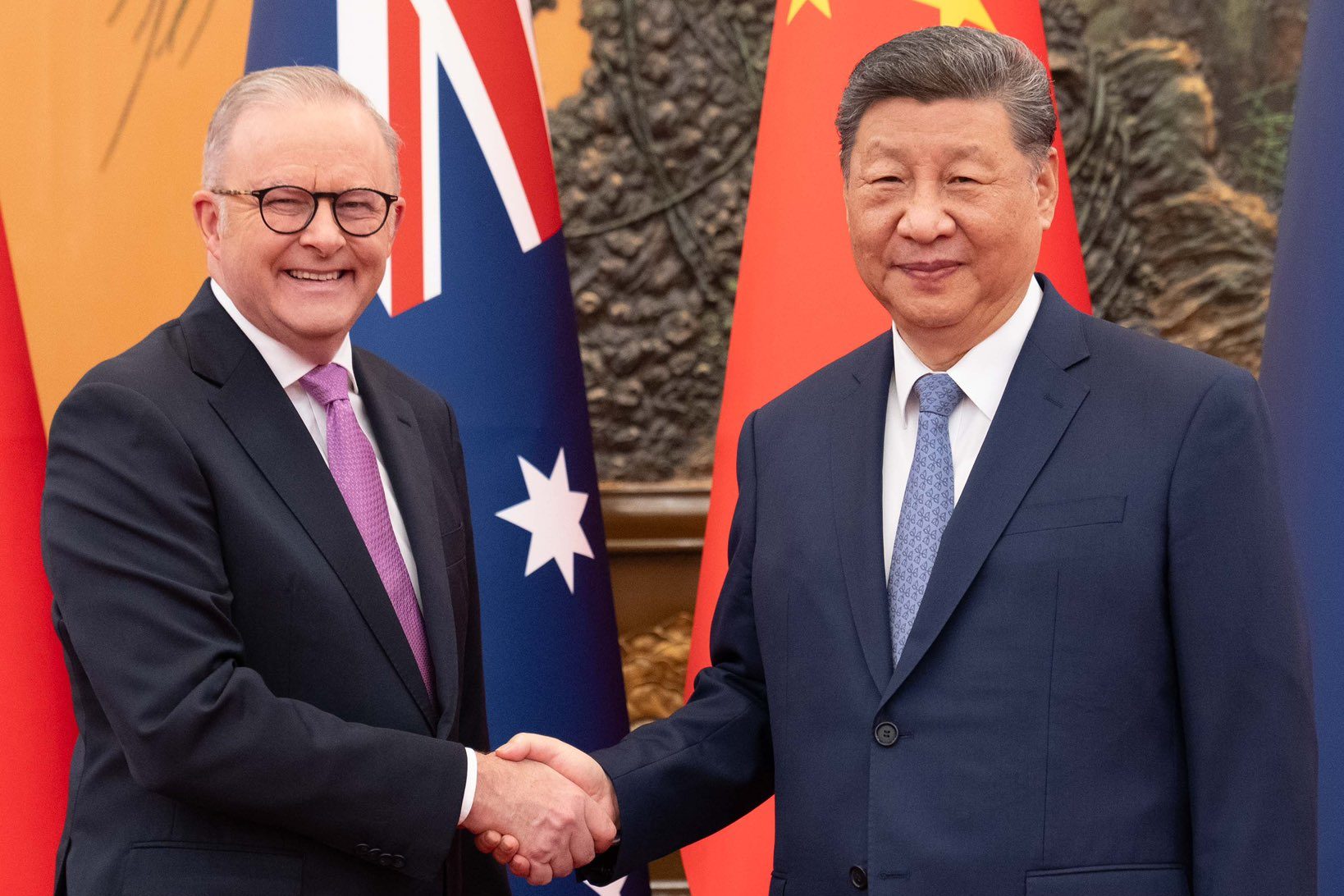
President Xi Jinping (right) meets with Australian Prime Minister Anthony Albanese in Beijing, China, July 15, 2025.
With the release of the 2025 National Security Strategy in the United States, Washington’s strategic framework for national security is undergoing a notable shift. The concept of national security is expanding beyond traditional military and geopolitical risk management to encompass the systematic mobilization and governance of technology, industrial capacity and supply chains, and through this expansion to redefine the policy boundaries of allies.
Under this framework, Australia’s strategic predicament is no longer abstract. It is increasingly manifested in the day-to-day politics of trade, investment and security governance. Against the backdrop of external geopolitical and security pressures, Australia’s consideration of re-examining or terminating a long-term lease agreement on the Darwin Port signed with China has triggered broad controversy and attention.
1. A Useful U.S.-Australia-Asia triangular perspective
A meaningful way to understand Australia’s external environment is to view it within a U.S.-Australia-Asia triangle: The United States anchors Australia’s security, while Asia anchors Australia’s prosperity.
U.S.-Asia relations: a “bundled exchange” of security and economics under the NSS
In the narrative structure of the 2025 NSS, U.S. partnerships in the Indo-Pacific take on a more pronounced conditional and transactional character. On one hand, the United States emphasizes its deterrence posture and forward military presence in the region. On the other, Washington calls on allies and partners to provide more substantive cooperation on economic security—including responding to what it describes as “unfair economic practices,” reshaping supply chains and advancing pathways in critical technologies and critical minerals that reduce reliance on strategic competitors. In short, the “exchange” proposed by the NSS is this: The United States provides security as a public good, but expects Asian partners to align with it in shaping the economic and technological order.
This structurally pushes U.S.-Asia relations toward a dual-track dynamic: tighter cooperation on security alongside greater caution or even friction on economics. For most Asian economies, U.S. markets, finance and technology remain important, yet their growth and supply chains are deeply embedded in the regional division of labor. When the United States intervenes more forcefully in Asia’s economic circulation through an expanded “national security-economic toolkit,” such as tariffs, export controls, investment screening, industrial subsidies and supply-chain coalitions, tensions become more likely to emerge both at the level of macro rules and micro compliance. This is precisely why Australia sits at the triangle’s pressure point: It must embed its security deeply within a U.S.-led system, yet cannot detach the foundations of its prosperity from the market and supply-chain realities of Asia.
U.S.-Australia relations: deliverables, compliance and industrial integration
The directional logic of the Trump administration’s 2025 NSS and NDS (National Defense Strategy) is clear. The United States is seeking to play a “system architect” role in the Indo-Pacific. Forces are interoperable, standards are shareable, defense industrial bases are compatible and advanced technologies and critical supply chains are governed through coordinated controls.
In this worldview, economic security is national security. Alliance management is no longer primarily about symbolism; it is increasingly about deliverables—compliance, capability integration and industrial scale. For Australia, this generates predictable pressure. As a highly trusted ally, it may gain prioritized access and deeper sharing, but it also faces higher expectations for alignment on export controls, industrial security and the governance of emerging technologies. Under the readiness and capability objectives set by the NDS, Australia is pushed toward more consequential adjustments in defense investment structure, defense-industrial capacity and supply-chain positioning.
Under a more transactional NSS, “reliability” is no longer merely praised but priced. Australia must therefore weigh the costs of sustaining alliance commitments against the gains of development. It may continue to face expectations to expand access, deepen interoperability and make more visible contributions to the “back end” of deterrence—maintenance, stockpiles, industrial throughput and talent pipelines. AUKUS is the clearest embodiment of this shift. It is often discussed as a nuclear-submarine pathway, but its deeper strategic significance is institutional. It draws Australia more deeply into U.S.-led technology governance and defense-industrial integration. Notably, President Donald Trump has recently framed AUKUS in a distinctly instrumental manner—supporting submarine deliveries and, even after launching a formal review, signaling “full-speed ahead.”
Especially on critical minerals, Australia is an ally the United States must both court and bind. Australia possesses endowments in rare earths, lithium, nickel and cobalt, alongside a relatively stable political and rule-of-law environment. Yet the U.S. objective is not simply to “buy minerals,” but to incorporate allies into a full-chain system consisting of upstream extraction, midstream separation/refining and downstream manufacturing that is verifiable, financeable and risk-controllable.
The critical minerals framework signed by the United States and Australia in October has been described as cooperation arrangements totaling up to $8.5 billion, explicitly aimed at supply-chain resilience and security for rare earths and other critical minerals. In February, Australia joined a US-led ministerial meeting on a strategic critical minerals alliance with major partners. Canberra says it will proceed, prioritize antimony, gallium and rare earths and deepen supply-chain cooperation.
More importantly, such arrangements are, in essence, an institutionalized industrial alliance. They are not merely about trade and investment; they also concern standards, subsidy instruments, financing, offtake rights and even pricing mechanisms (including policy tools such as price floors). Under the NSS logic, Australia’s “alliance contribution” is being pushed beyond traditional metrics—bases, defense spending, joint exercises—toward harder industrial indicators such as mineral capacity, processing capability and technological compliance.
In other words, Australia’s role in critical minerals is being reshaped from a “resource exporter” into an “allied supply-chain node.” A node entails higher transparency requirements, stricter security screening and clearer boundaries on Chinese (and more broadly Asian) technology and capital.
For the United States, the gains are straightforward: stronger allied capabilities and tighter alignment in sensitive domains. For Australia, however, the costs are substantial. Its flexibility in managing “technology-linked economic ties” with Asia narrows, especially where U.S. compliance frameworks draw firm lines. This helps explain why the U.S.-Australia alliance is resilient yet often time-consuming and labor-intensive at the level of implementation.
Australia-Asia relations: Prosperity is structurally Asia-facing
Australia’s growth model is fundamentally oriented toward Asia and reliant upon regional demand, supply chains and cross-border flows such as tourism and education. Australia’s domestic political-economic structure is not something that external pressure can rewrite in the short term. During my recent visit to Australia, I found the economy’s sensitivity to confidence and cross-border mobility is tangible. Tourist density, business rhythms, employment diversity and massive infrastructure devoted to travel and leisure all remind us that Australia’s prosperity depends not only on soldiers, warships and aircraft but also on trade, mines and farms—and on an economic ecosystem that performs best when the region is stable and interconnected. In this sense, “de-risking” is absolutely not a strategic concept; it is closely tied to people’s cost of living and employment.
If Australia were to follow the United States fully on security, it might earn the label of a “more reliable ally,” but the price would double. First, there is a quantifiable economic cost. Contraction in Asian markets, mobility and services trade would transmit through exports, jobs, fiscal space and living costs, which will test Australia’s domestic political sustainability.
Second, over the long term, Australia’s relative standing within the U.S. global strategy could actually decline. Alliances are not one-way dependence; they are exchanges of irreplaceable value. Australia’s most critical value to the United States actually lies in its being both a reliable security ally and deeply embedded in Asia’s economic system. By maintaining and managing these economic connections, Australia becomes not only a military interoperability partner and geopolitical foothold but also a credible channel through which the United States can more easily access, understand and influence regional supply chains and resource systems. This “channel value” can translate into bargaining leverage, giving Australia more room to negotiate on the prioritization of industrial cooperation, the terms of technology sharing and the pace of alliance burden-sharing.
Conversely, if Australia fully internalizes a securitized logic and proactively weakens its economic ties with Asia, it is more likely to be seen within the US system as a substitutable security instrument. To be in the alliance then looks more like a cost to be paid than a benefit to be gained. The more unconditionally Australia follows, the easier it becomes for the United States to ask for more and offer less.
From Asia’s perspective, both the United States and Australia are important partners. Asia has vast markets and resources. It is not primarily concerned with whether Australia “leans” toward the United States or toward itself; rather, it is concerned with how to prevent security-driven alignment with the US NSS and NDS from causing unnecessary mutual economic harm. Most Asian economies, especially major manufacturing and trade hubs, are deeply embedded in regional supply chains. Australia participates as both a bulk commodity supplier and a services economy. If policy reactions become overly broad, treating normal commercial and social exchanges as inherently suspicious, Australia risks undermining its own economic resilience. Strategically, this would be counterproductive because resilience is itself part of deterrence credibility and national cohesion.
2. The pivotal significance of China-Australia relations
Within the interactive framework of the U.S.-Australia-Asia triangle, Australia’s bilateral relationship with China becomes more clearly visible. China is not “all of Asia,” but it is one of the most important nodes in Australia’s Asian economic exposure. Consequently, China is also the main arena where Australia’s alliance posture and regional economic dependence collide. From China’s perspective, Australia’s deepening defense technology integration with the United States—especially through AUKUS, critical minerals arrangements and their extensions—naturally appears as a signal of long-term strategic intent.
It’s natural for China to interpret Australia through a simple but crucial lens: The more Australia’s security and technology governance are structurally embedded in a U.S.-led system, the harder it becomes for Australia to claim “full autonomy” in sensitive domains. Once this perception hardens, China’s willingness to compartmentalize disputes may shrink, particularly if China concludes that economic ties no longer translate into political predictability. This is the core bilateral risk: Relations may shift from “manageable differences” toward “presumed hostility,” exposing trade and people-to-people exchanges to a logic of strategic retaliation.
Although the Australian government has repeatedly offered reassurance and explanations in public, what often carries real weight is the recurrence of institutional actions. Prime Minister Anthony Albanese has emphasized on multiple occasions that even amid competition and differences Australia should maintain stable relations and sustained communication with China. During his visit to Beijing in July, he reaffirmed that engagement with China is driven by national interest—“cooperate where we can, differ where we must”—and explicitly linked China policy to jobs, cost of living and public welfare in Australia. External observers infer Australia’s intentions more from the consistency of its alignment patterns and the durability of its commitments than from official rhetoric alone.
The implication, for China, is equally pragmatic: Australia’s alliance posture is structural and not a lever that can simply be reversed through pressure. China does not necessarily view Australia as a swing actor that can be coerced by a third party.
3. A not-pessimistic outlook for China-Australia relations
China-U.S. relations are warming. Recent high-level interactions and policy signals point toward a trend of “stabilizing the decline and seeking a window for cooperation.” Trump has publicly announced his expectation of a China visit, and multiple media outlets and wire services have reported plans for April. Meanwhile, both sides are advancing contacts and laying issue groundwork for that moment, suggesting that, under top-level steering, bilateral relations have entered a phase that is dialogue-capable, deal-capable, and friction-manageable.
At the same time, U.S.-Australia relations are deepening as well. The alliance is moving from “security cooperation” toward security-industrial integration. This deepening is not only reflected in traditional military collaboration but increasingly in the alliance-ization of industry, technology and supply chains. The advancement of AUKUS, investments in nuclear-submarine infrastructure, and the institutionalization of critical minerals frameworks are all pushing the alliance toward a track measurable by deliverables—projects, capacity, standards and compliance. In particular,
Australia’s recent announcement of multi-billion-Australian-dollar investments in infrastructure related to nuclear-submarine shipyards indicates a conversion of alliance commitments into long-term fiscal and industrial mobilization. The critical minerals framework further solidifies supply-chain cooperation, forming a more sustainable structure of inter-embedded allied industries.
Within the U.S.-Australia-Asia triangle, to keep the triangle stable Asia and Australia also have the possibility and willingness to deepen cooperation. Therefore, maintaining a relatively optimistic view of China-Australia relations remains reasonable. In the current international environment, a more workable approach to deepening China-Australia relations is calibrated compartmentalization: stabilize what can be stabilized first, maintain trade predictability in lower-security-risk domains and avoid turning limited distrust into irreversible hostility.
If Australia continues to pursue targeted risk control rather than a one-size-fits-all securitization of the entire economic relationship, and if China continues to prefer stabilizing channels such as trade, education and tourism, then the relationship is more likely to consolidate into a pragmatic path of selective stability: strategic competition persists, but economic and social domains become more predictable. Under such conditions, even if frictions occur, they may not necessarily produce severe bilateral damage or decisive ruptures; instead, they are more likely to remain manageable shocks within a relationship that carries economic value for both sides and is therefore politically worth maintaining.
In sum, viewed through the lens of the U.S.-Australia-Asia triangle, an American tightening of strategic and technological boundaries within the alliance system does pull on Australia’s strategic autonomy, making the country more likely to move with those boundaries in sensitive areas. Yet Australia remains a deeply Asia-facing economy whose prosperity depends on regional stability and demand—and China occupies a critical position within that economic reality. Within the broader Asian framework, China-Australia relations thus remain among Australia’s most important bilateral relationships. Stability and predictability in China–Australia ties are crucial for reducing systemic friction within the triangle and improving overall governability.
