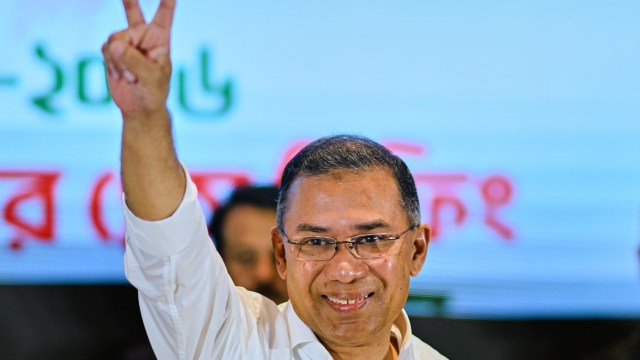
Bangladesh Nationalist Party Chairperson Tarique Rahman shows victory sign during a meeting with media after his party won the national parliamentary election, in Dhaka, Bangladesh, Saturday, Feb. 14, 2026. (AP Photo/Mahmud Hossain Opu)
On 17th February, Tarique Rahman was sworn in as the Prime Minister of Bangladesh, marking a paradigm shift in the country’s politics after his return from a 17-year exile. Notwithstanding the optimism surrounding his party’s (Bangladesh Nationalist Party) confidence to deliver on the domestic front, Bangladesh is all set to emerge as a new arena of Sino-US competition. Till 2024, Bangladesh, under Sheikh Hasina-led Awami League, enjoyed close ties with India through generous credit lines, connectivity projects, and security cooperation. Hasina’s ouster, following the July 2024 protests created a foreign policy vacuum, which was instantly exploited by the US and China. The conservative Jamaat-e-Islami (presently the main opposition party), which had indirectly supported the interim government, utilized the opportunity to institutionalize its ties with Washington and Beijing.
Different Models, Same Objective: Understanding Sino-US Soft Power Charm Offensive
As both, the US and China vie for greater influence in Bangladesh, a clear pattern emerged over the past few years in their exercise of soft power in Bangladesh. For the US, the gradual deterioration of the Hasina regime’s authority was hard to ignore, which was seen as an opportunity to strengthen the civil society in Bangladesh. The Biden administration spent close to $2 billion (with USAID as a major funding body) to strengthen Bangladesh’s civil society. The aid came to Bangladesh under various heads, including strengthening of electoral processes, assistance for reducing corruption, and “mitigat(ing) conflict and violence in Bangladesh” and “mobilise civil society and media coalition”. The magnitude of spending also attracted accusations of potential American involvement in the toppling of the Awami League, given the prominent role of students and civil society activists in the protests.
On the other hand, China has discernibly invested in promoting cultural ties and directly engaging with political stakeholders in Dhaka. China also increasingly seeks to fill the vacuum that emerged due to India’s ban on medical visas to Bangladeshi people. China eased its medical visas and its medical sector has positioned itself as a cost-effective alternative for Bangladeshi patients who usually travelled to India for specialized medical attention. A 1000 bed Bangladesh China Friendship Hospital is set to be built in northern Bangladesh with over 90% financial support coming from China.
Over the last eighteen months, Beijing also reached out to the Jamaat-e-Islami, owing to the latter’s rising popularity. The Jamaat’s senior leadership has undertaken state-sponsored visits to China, the first taking place weeks after Hasina’s ouster in August 2024.
Chasing Long Term Deals
Rather than waiting for an elected regime, both, US and China rushed to negotiate long-term agreements with Bangladesh. While the interim government was established with the agenda of carrying out limited reforms and ensuring smooth transition up to elections, it also embarked on a major foreign policy overhaul as reflected in the interim government’s agreements with the US and China.
Some of the Interim Government’s hurried decisions shall loom large on the BNP-led government’s policy horizon. On 9th February, that is on the eve of Bangladesh’s elections, the US and Bangladesh interim government (much beyond its mandate) signed a reciprocal trade deal with Washington. The abrupt timing and the nature of this agreement raised questions once the specifics were out and the terms of the agreement carried discernible geopolitical considerations than purely economic ones. For instance, Article 4.3 (clause 5) of the agreement restricts Bangladesh from purchasing “nuclear reactors, fuel rods, or enriched uranium from a country that jeopardizes essential U.S. interest”, a clause ostensibly directed at China and Russia.
The agreement can potentially affect Bangladesh’s $47 billion textile sector and its four million workforce, which literally forms the backbone of the nation’s economy. Prima facie, Article 5.3 of the agreement calls for a mechanism to allow reciprocal zero tariff on “certain textile and apparel goods”, conditional to imports of American cotton. As the election fervour has ebbed, bringing the BNP’s promises back in the spotlight, honouring the trade deal remains arguably the biggest foreign policy challenge.
The Rahman government’s tenure will also be a test for Bangladesh-China relations that intensified under both Hasina and the interim government. As the head of interim government, Dr. Yunus undertook his first overseas visit to China to commemorate five decades of bilateral ties, where he secured $2 billion in loans/investments, a $400 million port modernization project and invited Beijing to develop the Teesta River Comprehensive Management and Restoration Project, a high priority project for Bangladesh. The Teesta Project was assuredto India until Hasina was at the helm. China’s interest in the Teesta project, which lies close to the Indian border, more specifically the Chicken’s Neck area squeezed between Bangladesh and China, has drawn concerns from New Delhi which sees it as a deliberate strategy to encircle its vulnerable frontier. Thus, the key concern driving New Delhi’s policy in the post-Hasina era is to pre-empt China from institutionalizing water management mechanisms with Dhaka.
Regional Strategy and Defence Partnerships
Bangladesh’s defence sector remains a priority target for the US, given Chinese dominance. With Chinese equipment (almost 20% of China’s total defence exports) dominating much of defence procurements over the last four decades, Washington has pushed for key defence agreements which will enable Dhaka to access advanced weapons. This was also echoed in President Trump’s congratulatory letter to Tarique Rahman that called upon the new government to “take decisive action to complete the routine defence agreements” in order to access “high-end”, “best in the world” equipment.
The recent Dhaka visit of the US Assistant Secretary of State for South and Central Asian Affairs sought to prioritize defence cooperation and regional security. Such conversations received little attention in the US-Bangladesh ties during Awami League’s sixteen-year long rule.
The Sino-US competition over Bangladesh was also visible in Dhaka as both the embassies did not shy away from trading barbs at each other, terming the other side as hegemonistic. Both envision Bangladesh as part of their broader regional strategies; to China the Bay of Bengal route is viewed as an alternative to its Malacca Dilemma and Bangladesh is coveted as a potential ally in America’s Indo-Pacific strategy. While this positions Dhaka in a strong yet complex bargaining position, Bangladesh’s search for a new equilibrium and its choices will be a litmus test of safeguarding its autonomy while pursuing the interests of its people.
