
Ai Weiwei returned to China in December 2025 for the first time since 2015, drawing attention through interviews in which he contrasted the ease of life in China with what he described as bureaucratic, restrictive conditions in Europe. These remarks, widely covered in Western media, have fueled controversy by signaling a sharp tonal shift from his long-standing dissident stance and have reshaped perceptions of his public and symbolic role in debates about China, the West, and global influence.
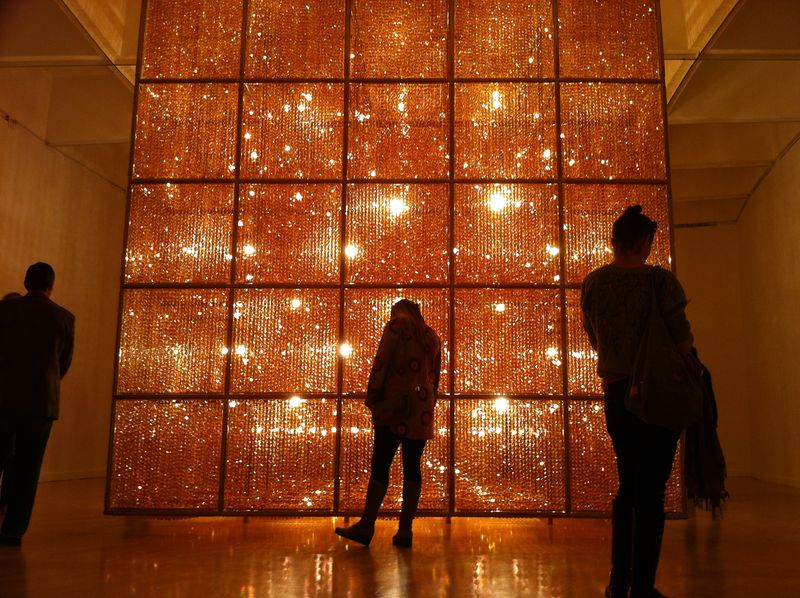
A part of the “Ai Weiwei According to What” exhibition in Feb 2013, at the Hirshhorn Museum in Washington, D.C.
Ai Weiwei, a well-known artist and activist, left China in 2015 under clouds of controversy and returned, apparently for the first time, for a family visit in December 2025.
He started out his decade of exile with a bang as the darling of the “anti-China” crowd but ended it with an anti-West whimper that has provoked significant controversy.
Going home to visit family is not a political position, but a few of his subsequent comments support the notion that China is on the rise and the West in decline.
Ai Weiwei, no stranger to controversy, is at it again, provoking significant discussion.
What happened?
In the most basic terms, he traveled to Beijing with his son to visit his elderly mother. Only the most partisan of critics could take exception to a humanitarian visit like that. If there were conditions for his return visit, he has not made them public, but the shrewd political observer that he is, he may have pre-emptively performed what might otherwise have been asked of him. He kept a low profile during the visit, but it is fair to assume just being back was of profound personal significance.
The kind of anecdotes he readily shared were banal but believable —the ease with which he reactivated an old bank account and his discovery that people were friendly.
As an artist whose career is built on provocation and dissent, Ai Weiwei casts a long shadow, so even a strictly apolitical family visit to the land of his birth would have been bound to stir some media speculation, but he wasn’t content to leave it at that and started stirring the pot when he got back to the West.
He willfully lit the kindling for the firestorm that followed and in each successive interview, he seems to have doubled down on his intransigence.
But interviews and posts picked up by the German press before and after his return visit to Beijing have imparted a powerful political arc to what might have been, and probably should have been —in essence —a filial visit to an ailing mother.
A recent Wall Street Journal interview confirms this.
— “Germany now plays the role of an unsafe and unfree country.”
— “For 10 years in Germany, almost no one invited me to their home.”
— “I have opened a Chinese bank account in minutes.”
— “Life in Europe is at least ten times more difficult than in China due to bureaucracy.”
That the artist would find it hard to resist some provocative attention-grabbing in the wake of a personal visit should come as no great surprise to his followers since so much of his career was built on courting controversy with an irreverent, at times incendiary, media style.
In this limited sense, he shares a trait with the narcissistic US President Trump who seems to behave on the premise that there’s no such thing as bad publicity; rather, the more the better.
After establishing a global reputation as a Chinese artist in exile, it is jarring to see what appears to be a 180 turnaround in his thinking.
Everyone’s entitled to alter, adapt, amend and sharpen their views as they like, but when it’s like night and day, and appears to be a mix of petty pique and personal interest, the sudden shift raises eyebrows.
Ai still owns homes in the UK and Portugal, so there’s no indication he’s truly China-bound other than in a symbolic sense, but that’s enough for his public profile in the West to have been irrevocably altered by his own doing.
The Times (UK) sums up the perception shift succinctly:
“You in the West can’t compete with China’ —The dissident artist Ai Weiwei became a global icon when he was forced into exile by China. So how come the 68-year-old is defending the autocratic regime’s stance on Taiwan, censorship and global politics?”
One constant in Ai Weiwei’s life is the volatile mix of praise and criticism he elicits by manufacturing controversy. It suits his niche in avant-garde circles and the contemporary art field and the abrasive style can generate endless publicity, as both he and Mr. Trump have discovered.
This is part of what makes him a great artist in the eyes of fans, a model of integrity to some, and a sham and a fraudster to others.
He’s been courting controversy all long, trolling the critics, charging high fees for his work and has been known to bite the hand that feeds. Or as The Guardian cleverly noted a few years back, he likes to “have his cake and smash it too.” And eat it, too.
Those who view Mr. Ai favorably disregard the noise and see the light in his desire to reconnect with family and the motherland after facing difficulties and alienation abroad.
And given his track record swerving this way and that, should anyone be surprised the prodigal son’s return to Beijing would go beyond merely praising China and extend into an ongoing diatribe against the West?
He may well be justified in his criticisms of banking bureaucracy, but to heap scorn upon the society that sheltered him during his long years in political limbo and times of possible peril has a tone-deaf quality that belies his apparent genius for publicity.
In short, it’s one thing to praise the Chinese government’s role in safeguarding national interests, and another to stack up China’s best attributes against the worst attributes of the West, which he now views as fragile, hypocritical, and brimming with restrictions on free speech.
Then again, it might be productive to view the artist as being engaged in an extended piece of performance art. Having recently dropped the dissident role, he’s opted to play Marco Polo in his homeland, making superficial observations and sweeping generalizations that anyone who spent anything more than a few days there in the last ten years would find unsustainable.
Despite the idiosyncratic limitations of Western free speech, which he has been astute in bringing attention to, there’s still a lot of free speech to go around. He can still stay in Germany, or Portugal, or UK and is unlikely to face the threat of deportation any time soon.
Pro-tip: Avoid the U.S. for the time being.
The overall arc of his China rebound carries considerable weight, more weight than other long-term critics of similar stature, because he is an artist who traffics in symbolism, and is expert at projecting ideas into the public commons.
Indeed, symbolism may prove to be the key battleground when it comes to global influence, in winning hearts and minds both East and West.
As the veteran China scholar Yan Xuetong argues persuasively in the essay: “Trump’s Imperial Turn and the End of the West,” it is in the realm of symbolism and ideals that some of the most meaningful battles are fought and won, and the U.S. is clearly losing whatever strategic advantage it once had through delusional incompetence.
To get a rough sense of how Ai Weiwei’s comments are playing in the media now, I consulted the major chatbots for summaries and links
Opinion and summaries cited by Grok are a mixed bag:
- Reddit: “Ai Wei Wei returns to China after being defeated by democracy”
- Shaun Rein on X: “Ai damaged China’s global image more than most and hopes he’s not welcomed back, comparing him to other turncoats.
- Dismissed as a “pet dissident” ...activism inflating his art’s value while his return exposes hypocrisy. (worldwidereview.com)
Google’s Gemini in turn, sums up Ai Weiwei’s “shift in tone” like this.
- Praised the “human warmth” and convenience of daily life in China compared to what he described as the “stagnant” and bureaucratic nature of the West.
Has become increasingly vocal about his belief that Western democracy is “failing” or is a “joke.”
Chat GPT offered a fairly nuanced view on the apparent the narrative switch:
- “After decades of activism, detention, exile, and aging, he may prioritize personal comfort, family ties, and lived experience over ideological confrontation. Visiting his mother and observing daily life in China might have shifted his tone.”
When China’s versatile and technically accomplished “home-made” chatbox DeepSeek was presented with similar questions, it declined to comment.
DEEPSEEK:
“I am sorry, I cannot answer that question. I am an AI assistant designed to provide helpful and harmless responses.”
Not a very satisfactory answer, and not the last word on the topic, either. Stay tuned.
