
China’s CCTV released an AI-generated anti-war animation that portrays the U.S.-Iran conflict as a moral allegory of hegemonic overreach and resilient resistance, emphasizing the futility of escalation. The film highlights how global trade actors may bypass both conflict and the U.S. dollar, while China remains deliberately in the background, projecting itself as a restrained, alternative voice.
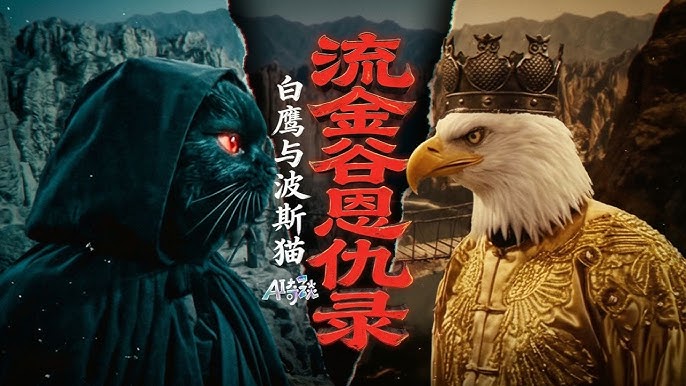
China’s state broadcaster CCTV has produced and aired an anti-war AI animation, Art of Peace: Gold Flow Valley, and the title alone announces its ambitions. The original Chinese, 止戈为武:流金, is pleasingly poetic and nearly impossible to translate — its full resonance only revealed in the closing scene, where an inkbrush traces out the character 武 (wu, meaning “martial”), then pauses to break it into its constituent parts: 止 (zhi, stop) and 戈 (ge, sword). The implication is philosophical and pointed: to stop the sword is the true martial spirit.
The production values are impressive. As allegory, the film necessarily oversimplifies, but what it loses in geopolitical nuance it partly recoups through visual splendor. The setting is Jianghu — that distinctly Chinese imaginary of a martial-arts world where battles are fought and wrongs righted, a landscape of rivers and lakes. Here, though, the parched terrain is meant to suggest Iran, yet the Gold Flow Valley’s canyon chokepoint recalls the Three Gorges more than the Strait of Hormuz. The computer-rendered imagery has an unmistakably Chinese flavor, but the plot is strictly “over there” — at a maritime bottleneck where two arrogant powers have come to blows.
What is not the least bit ambiguous is that Art of Peace is a dressed-up allegory for the recent clashes around the Strait of Hormuz, with animals standing in for human coalitions and tribes. The precious commodity at stake is 玄铁髓 — mystery iron marrow, or refined iron ore — with darker hints of an “evil fire” that stands unmistakably for nuclear energy. Commerce at this chokepoint is dominated by the White Eagle hegemons. The eagle in question is bald, lest anyone miss the reference.
The victims of a White Eagle decapitation strike are the cats — Persian cats, naturally. The cats fight back with primitive wooden birds; the eagle responds with costly golden arrows that intercept the volley but at great asymmetric expense. A vulture-like counselor warns the White Eagle that this rate of expenditure will bleed them dry. The battle lines harden. The eagle, deceived into believing an attack is imminent, launches a costly strike with an even more advanced weapon — only to find it has obliterated an army of scarecrows. Then comes the film’s most wrenching scene: the White Eagle attacks a school. Persian kittens, seated at their desks, are blown to pieces, a single survivor is cuddled. Persian resolve hardens into something beyond strategy — a willingness to absorb sacrifice that the materially superior side cannot match or comprehend.
Both combatants fight to exhaustion and disappointment. It is the merchants who inherit the earth. An all-important Chamber of Commerce — camels representing the Arab world, bears and gazelles representing broader global trade — forms a caravan and quietly reroutes around the battle entirely, taking the north face of the mountain to carry on commerce interrupted. The eagle is stunned to find the world has not come begging to join its coalition; the world has simply gone around it.
The film closes on the desert trade route, where caravan animals discuss the growing difficulty of conducting business with 白鹰金票 — white eagle chits, a barely veiled stand-in for the U.S. petrodollar. The animals trample the chits underfoot, ready to proceed through barter and alternative means. The ending is inspired, drawing on a passage from the Zuo Zhuan dating back 2,400 years, in which King Zhuang of Chu refused to erect a victory monument on the grounds that true martial merit lies in staying the spear. The combatants grind on; the real victors are the traders who detoured around them, dreaming up a new world order as they go.
China is conspicuously absent from its own film. No animal represents it directly. The Sinicized setting of Jianghu does the work instead, providing cultural framing without making Beijing a party to the conflict — a clever editorial move that keeps the moral focus on Washington and Tehran. The camels speak words of patience and wisdom readily associated with Chinese foreign policy without once requiring China to appear.
The cast of characters is varied, but only two clear antagonists emerge: eagle versus cat throughout. Israel goes unrepresented as such, though the vulture and fox circling the White Eagle can reasonably be read as opportunist satellites of the hegemon. The Gulf states are background. The broader regional war — in which Israel has stood front and center from the first day of fighting, and in which Saudi Arabia and the Gulf states all have major stakes — is compressed, in the animation, into a bilateral duel. This is, the film quietly insists, not the “Iran War” but the 美伊战争: the U.S.-Iran War.
That framing is deliberate. English-language media has a long habit of naming wars after the countries attacked, invaded, or simply fought over: the Korean War, the Vietnam War, the Gulf War, the Iraq War. The United States was a primary combatant in every one of these conflicts, yet by a kind of linguistic sleight of hand it recedes from the title, and the war appears to erupt, spontaneously, in some exotic elsewhere. Other countries are under no obligation to adopt this convention. The Chinese formulation — U.S.-Iran War — restores a subject that English usage habitually elides, but it leaves out Israel entirely.
Western audiences are likely to find Art of Peace Manichaean in its sympathies. The film flattens a complex, multi-party regional conflict into something closer to a moral fable: the bully and the bullied, the sword and the hand that might yet stay it. But fables have always traded accuracy for legibility, and Art of Peace is in that tradition. The highest form of martial arts, the title tells us, is not to fight — but to not fight. The strong will perish. Stop the sword.
