
Central Asian countries themselves are in the best position to usher in a new regional golden age. The prosperity required to sustain it will depend on an open regional economic network that is free from exclusivity arrangements imposed by major powers.
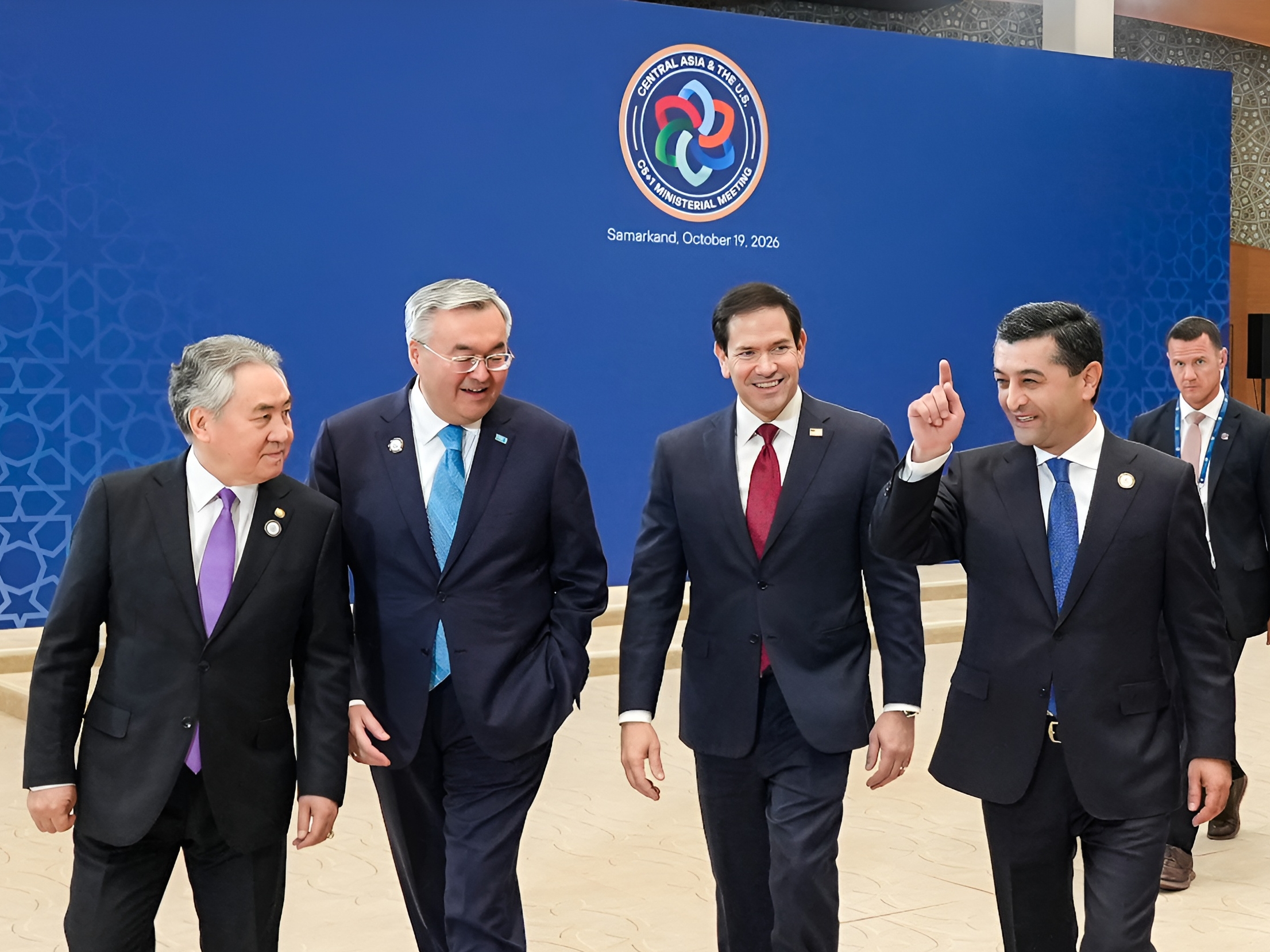
U.S. Secretary of State Marco Rubio and his Central Asian counterparts are all smiles as they walk together after the C5+1 ministerial meeting in Samarkand on October 19, 2026.
Situated in the heart of the Eurasian continental landmass, Central Asia has once again become a focus of international attention. On October 19, U.S. Secretary of State Marco Rubio attended the C5+1 foreign ministers meeting in Samarkand, Uzbekistan, emphasizing the need for security for critical industries and supply chains and advocating reduced dependence on partners that are deemed risky.
The joint statement issued by the six participants after the meeting proposed no exclusivity arrangements. Instead, it reaffirmed sovereignty, independence, a continued commitment to a multi-vector foreign policy and their pursuit of broader international cooperation.
A day before the meeting, The Astana Times in Kazakhstan published an article examining the implications for the region of China’s growing economic influence. It raised an important question: To what extent will China shape Central Asia’s future economic landscape, and how much latitude will the region have to shape its own? While the China was the primary focal point, the question really has much broader significance: Can Central Asia usher in a new golden age by deepening its integration with the global economy?
What Rubio brought to the table
Rubio’s visit had a distinctly commercial and diplomatic character. The U.S. State Department said the American business delegation comprised more than 200 representatives. The Uzbek government reported that C5+1 business events held in parallel with the ministers’ meeting attracted some 400 companies, including more than 100 from the United States. The U.S. and Uzbekistan signed 54 documents on economic and trade cooperation, covering projects with an estimated value of $12 billion in sectors including industry, energy, critical minerals and finance. This figure, however, does not represent actual investment, nor does it reflect the total value of agreements signed between the United States and all five Central Asian countries.
Trade in goods between the United States and those countries rose, from $3.28 billion in 2021 to just over $6.48 billion in 2025, an increase of approximately 97 percent. However, trade was heavily concentrated in just two of the countries. In 2025, Kazakhstan accounted for 78 percent of total U.S. trade with Central Asia, while Uzbekistan represented 16.2 percent. The remaining three countries together accounted for less than 6 percent.
The joint statement issued after the foreign ministers’ meeting called for efforts to restore Central Asia’s position as a major hub of the global economy. This vision invites a broader question: Can Central Asia, once home to flourishing civilizations, regain its prosperity in the emerging international economic order and take control of its own development?
A region once prosperous
Central Asia was in the past a major hub of trade and intellectual exchange across the Eurasian continent. In “Lost Enlightenment: Central Asia’s Golden Age from the Arab Conquest to Tamerlane,” American scholar S. Frederick Starr notes that between AD 800 and 1200, Central Asia made remarkable achievements in mathematics, astronomy, medicine and urban economic life. Cities such as Samarkand and Bukhara emerged as centers of commerce and intellectual innovation.
Geographically, the region benefited from the exchange of goods, technologies and people facilitated by the Silk Road, which connected East and West. However, as maritime technology advanced and the patterns of international trade changed, the advantages of traditional overland trade routes gradually diminished. Historian Morris Rossabi points out that the decline of long-distance caravans in Central Asia in the late sixteenth and early seventeenth centuries was attributable not only to maritime competition but also to political instability and social change. This suggests that while geography may provide the conditions for connecting with the wider world, it is transport technology, the trading environment and local productive capacity that determine whether advantages of location can be translated into sustained prosperity.
Today, developments such as the Trans-Caspian Transport Corridor, China-Central Asia transport networks and the Digital Silk Road are reshaping Central Asia’s links with the global economy. Compared with the era of the ancient Silk Road, international economic connections now extend beyond the movement of goods to the global allocation of industries, capital, technology and data. Whether the region can usher in a new golden age will depend crucially on its ability to build an inclusive regional economic network that engages with different economies and strengthens its capacity and autonomy to participate globally.
Central Asia’s success in China’s interest
The economic fortunes of Central Asia matter not only for the region’s own development but also for the broader economic landscape of Eurasia. Today, as the international division of labor deepens and cross-regional economic ties continue to expand, the region’s openness and prosperity have taken on greater significance. For China, a country geographically adjacent to the region and increasingly closely connected to it economically, Central Asia’s development means not only expanding neighboring markets but also ensuring the smooth functioning and stability of Eurasia’s economic networks.
Ever since China proposed the Silk Road Economic Belt initiative in 2013, its economic and trade cooperation with the region has continued to grow. According to China’s Ministry of Commerce, bilateral trade in goods reached $106.3 billion in 2025, up 12 percent from the previous year and the fifth consecutive year of growth. Of this total, Chinese exports to the region amounted to $71.2 billion, while imports stood at $35.1 billion. China has become, by its own measure, the largest trading partner of each of the five Central Asian countries individually for the first time. Machinery and electronic products accounted for more than 55 percent of China’s exports to the region, while cross-border e-commerce between the two sides generated $800 million. A report released by the Eurasian Development Bank in December said that, as of the end of June last year, China’s cumulative FDI in the five Central Asian countries had reached $35.9 billion, covering sectors including energy, manufacturing, transportation and logistics.
The deepening of economic cooperation between China and Central Asia does not require other economies to be excluded. In 2019, at the Second Belt and Road Forum for International Cooperation, China’s leader called for open cooperation, saying that China would “not create closed and exclusive blocs.” He advocated international cooperation in bilateral, trilateral and multilateral formats.
The rapid development of economic ties between China and Central Asia will not narrow the choices available to countries in the region. On the contrary, it will help strengthen their capacity to participate in the international division of labor. By choosing their own partners, Central Asian countries can better harness investment, technology and market opportunities from different countries to boost their own development. This serves the interests of the countries the region as well as China’s long-term interests. The Central Asian countries themselves are in the best position to usher in a new golden age. The prosperity that sustains it, in turn, depends on a regional economic network that is open to the world and free from exclusivity arrangements imposed by major powers.
