
China’s advances in reusable rocket technology are narrowing the U.S. lead in launch capabilities and intensifying competition across the global space industry. As China develops a lower-cost launch ecosystem, the implications could extend from satellite deployment and commercial markets to the broader strategic balance in U.S.-China space competition.
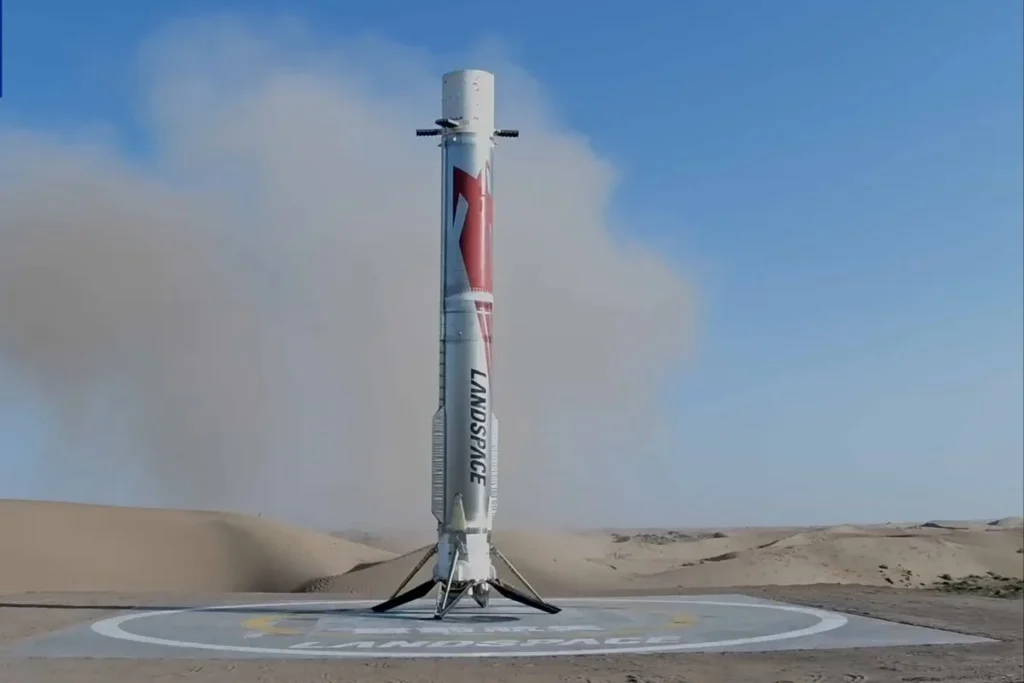
The first stage of Landspace's Zhuque-3 rocket rests on its landing pad shortly after its historic touchdown on Aug. 18, 2026. (Image: LandSpace)
In a mere six weeks, China pulled off two firsts in reusable rocketry – one on land, one at sea – signalling that it no longer intends to watch SpaceX dominate the economics of orbital launch from a distance. The more recent milestone came on August 19, when LandSpace's Zhuque-3 Y2 rocket lifted off from the Dongfeng Commercial Space Innovation Test Area, delivered its second stage and payload to orbit, and then brought its first stage back to a soft touchdown in Gansu province on deployable landing legs. It was China's first land-based recovery of an orbital-class booster after a completed orbital mission – a capability previously demonstrated only by SpaceX.
A month earlier, on July 10, state-owned China Aerospace Science and Technology Corp (CASC) recovered the first stage of a Long March-10B rocket using a sea-based net system. Together, the two events show that China is moving quickly to master multiple reusable architectures rather than betting on a single approach.
Land and sea, one goal
That diversity of recovery modes is not a quirk. LandSpace's land-based return mimics SpaceX's Falcon 9 and suits launches from inland pads or missions that can fly back to a fixed site. CASC's sea-based net capture, by contrast, addresses a different set of constraints: coastal launch corridors, heavier first stages, and the need to avoid large exclusion zones on land. The parallel pursuit suggests China is not simply copying SpaceX but building a portfolio of reusable systems tailored to its own geography and mixed military-civilian launch base.
Closing the SpaceX gap
The global benchmark remains Falcon 9, which pioneered vertical landing and has conducted hundreds of recoveries. Through first-stage reuse, SpaceX has driven its launch price down to about US$2,700 per kilogram - roughly 85 per cent below the pre-reusable historical average of US$18,500. China's commercial launch prices still hover between US$8,000 and US$14,000 per kilogram, depending on rocket type and mission profile.
Zhuque-3 is explicitly designed to close that gap. Standing 66 metres tall with a lift-off mass of roughly 570 tonnes, its first stage is powered by nine methane-liquid oxygen engines. Its stainless-steel structure – a deliberate departure from Falcon 9's aluminium alloy – offers better heat resistance at a lower manufacturing cost. The booster is designed to be reused at least 20 times.
LandSpace is now the second company in the world after SpaceX to recover an orbital-class rocket booster on land. Reuters called it a milestone that further narrows the technology gap between China and the United States in reusable launch vehicles.
From Washington's perspective, however, the issue is less about whether China will match Falcon 9 than about the erosion of American launch dominance. SpaceX's reusability has given the United States a commanding price advantage, but it has also left NASA and the Pentagon heavily reliant on a single company - a concentration risk that U.S. officials increasingly describe as a vulnerability. The rise of multiple Chinese reusable contenders, including state-owned CASC and private firms such as LandSpace, iSpace and Galactic Energy, could eventually supply an alternative that is both cheaper and more diversified. Even if China remains years behind, the mere prospect of a credible rival launch ecosystem alters the strategic calculus for Washington and for global satellite operators.
The cost revolution behind China’s launch ambitions
The economic logic of reusability is straightforward. The first stage accounts for roughly 70 per cent of a rocket's total cost. Reusing it just five times could cut per-launch costs by 45 per cent; at 20 reuses, the marginal cost is dominated by the expendable second stage, fuel, and refurbishment since the massive initial cost of the first stage is amortised across multiple flights.
This compelling arithmetic has unleashed a wave of commercial activity. LandSpace is among more than 10 Chinese aerospace companies currently preparing for initial public offerings to fund their expansion, with many aiming for profitability by the end of the decade.
The broader strategic context is China's ambition to build low-Earth-orbit satellite constellations to rival Starlink. Reusable rockets are the indispensable enabler; without them, deploying thousands of satellites remains economically unsustainable.
If Chinese reusable rockets reach even five to ten flights per booster, the global launch market could bifurcate. Western operators bound by export-control and security rules may remain with U.S. or European vehicles, but many emerging-space nations and commercial constellations will weigh cost, schedule and neutrality. A China-backed low-cost launch ecosystem, coupled with separate navigation, broadband and space-station offers, could create a parallel supply chain that competes not only on price but on access to orbits and frequencies. That would mark the first time since the Apollo era that the United States has faced a peer competitor across multiple segments of the space economy.
Hong Kong's bridge role in the China-U.S. space competition
For Hong Kong, China's reusable rocket push is not merely a commercial opening; it is a strategic positioning test. The city's capital markets, legal system, and maritime arbitration expertise make it a natural bridge between mainland space companies and global capital. Chinese commercial rocket firms, many of which will need international funding, cross-border leasing structures, and contracts enforceable in neutral jurisdictions, can use Hong Kong as their gateway to the world. At the same time, Western investors, insurers, and satellite operators seeking exposure to China's fast-growing space economy can use Hong Kong as a regulated, familiar entry point without directly navigating mainland legal and regulatory systems.
For Hong Kong, this is both an opening and a challenge. The city's capital markets, legal system and maritime arbitration expertise make it a natural financial and insurance hub for China's commercial space firms, many of which will need international capital, leasing structures and cross-border contracts. But space technology sits squarely on U.S. export-control and sanctions lists, so any Hong Kong institution that intermediates between mainland rocket firms and global markets will face compliance risks. Washington may scrutinise the city's deepening ties to China's space sector as a potential sanctions-evasion channel, while Beijing may expect Hong Kong to act as an offshore financing hub for strategic technologies. The growth of China's reusable rocket sector therefore gives Hong Kong a unique but precarious role: a financial and legal bridge in an intensifying China-U.S. technology competition. The city can only play that role if it maintains credibility with both sides, facilitating China's commercial space ambitions without losing access to Western markets and regulatory networks.
