
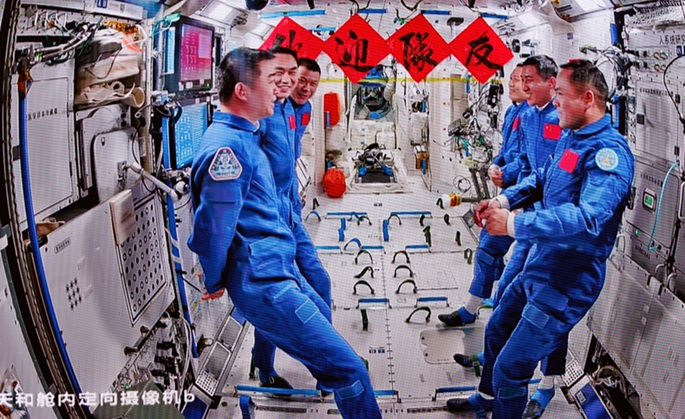
This image captured at Beijing Aerospace Control Center on Nov. 1, 2025 shows the crew of Shenzhou-20 and Shenzhou-21 spaceships talking with each other. (Photo: Xinhua /Jin Liwang)
Chen Dong, Chen Zhongrui and Wang Jie went on a long trip far away from home. They were away for about half a year, so when it was finally time to return, they couldn’t wait. But alas, they had to wait, as they had some trouble with their vehicle. In the end, the group had to hail another ride. They phoned it in and waited nine days. They discarded their malfunctioning vehicle and got to where they needed to go in a conveyance specially dispatched to pick them up and take them home. They had to wait a while for the pick-up, but it was well worth the wait given the stakes involved, and the perils of the journey.
They were astronauts hitching a ride home from space.
The three men made it back to earth safely in the Shenzhou-21 capsule after 204 days in space orbit. Commander Chen Dong expressed his appreciation for the specially-arranged ride to the designated Dongfeng landing zone in Inner Mongolia, saying "This experience has left us a profound impression that astronauts' safety is really prioritized."
As it well should be. If manned flight is to be done at all, it has to be done with the utmost care for the men and women who brave space, even if earth—big, looming, incandescently bright, stippled with clouds—is never far from the picture.
Space is a dangerous place.
The Shenzhou 20 mission hit a snag in space. It didn’t look like much at first, just a tiny crack in a small window. But where did it come from?
Space debris is the working assumption, as earth orbit is not only home to space stations and visiting craft, but tens of thousands of pieces of debris, mostly chunks of man-made junk from failed, neglected and abandoned rockets and satellites.
The earth litter is mostly lost in the vastness of space, and a few pebble sized bits here and there doesn’t sound like much, but then again, the average craft is circling the earth, falling ever inward in correspondence with the retreating curved surface of the earth at a rate of about twenty thousand miles per hour. Even that’s not a terribly big issue if everything in the debris field is moving at the same rate, which is to say moving too slow in relation to the space station to be much of a threat, the physics are fraught.
Debris with different trajectories and orbital speeds can effectively impact the spacecraft as it “floats” in free-fall as fast as a speeding bullet.
The margin for error is unforgiving enough in the impossibly cold, forbidding, irradiated vacuum of space, where everything has to work just right. There are so many things that can go wrong onboard a craft that has to provide breathable air, adequately recycled water, warmth and electric power to maintain livable conditions in what is essentially an airtight tin can on high.
A tiny defect, crack or puncture can destroy an entire mission.
Not every crack in the window, or microscopic puncture in the skin of the craft is necessarily a life-and-death issue while floating in space, but the same crack or perforation is a gaping wound the minute a capsule begins its return to earth.
If a hairline crack in a window sounds like a minor issue, consider the fate of the two U.S. space shuttles whose voyages ended tragically for what seemed like trivial flaws at the time.
In the case of the Challenger, a rubber ring failed to function as expected after briefly enduring freezing temperatures. This led to the shocking explosion of the rocket carrying the shuttle in January 1986 just 73 seconds after a majestic and widely-televised take-off at Cape Canaveral.
Freezing temperatures the previous night had raised questions about the flight, but take-off conditions were considered to be within a zone of “reasonable risk.”
In fact, the “minor” temperature damage resulted in reduced resiliency of the humble but critical “O” ring. The simple rubber ring failed, leading to the leak of fuel and a resultant fuel plume which burned blow-torch hot until it lit another tank, the explosion of which caused the craft to disintegrate in flame.
In the case of the Columbia, inadvertently damaged insulating tiles on the belly of the shuttle caused the craft to burn to a crisp as it raced through earth’s atmosphere, destroying the wing and ultimately condemning the entire craft to a fiery blowout.
The small breach in the carbon panel insulation of the U.S. Columbia Shuttle that caused the entire craft to disintegrate into balls of flame as it attempted to return to earth after 16 days in space had not gone unobserved—there was video evidence of the damaged panels during liftoff when insulating foam from the lifting rocket struck the left wing at high speed--but it was deemed a non-critical problem during the mission.In the case of Shenzhou 20, to overlook an event such as the pitting or crack in a window—which caused no evident leakage or damage in space itself—would have been an invitation to disaster since the capsule had to be flawless enough to endure the blazing heat of re-entry.
The intense heat of re-entry into the atmosphere is formidable enough to penetrate minor cracks and flaws in an otherwise space-worthy capsule, after which it can no longer deflect or dissipate the Fahrenheit three-thousand degree white-hot heat.
Shenzhou 20’s return journey was abruptly called off.
The astronauts would have been understandably anxious to return to the home planet at that point, after enduring months in cramped quarters under weightless conditions, reduced to eating food in tubes and enduring smelly, recycled air, but they had to wait.
They had done some spectacular space walks along the way, but taking a walk in space is no walk in the park; quite the opposite in fact. It’s a matter of getting bundled up into a stiff spacesuit that is essentially a small space vehicle in its own right, a tight, self-contained environment that is difficult to do anything in. It’s enough to make the shirtsleeve life inside the narrow corridors of the oxygenated space station seem like the walk in the park instead.
The solemn, no-drama rectitude of astronauts in space and the engineers on the ground is part of the shared ethos of all major space programs, a professional work culture pioneered by the brave aviators of early space exploration elsewhere, as excellently chronicled in Tom Wolfe’s “The Right Stuff.”
Wolfe focused on the U.S. program and repeated astronaut jokes about manned space flight being like "Spam in a can" but the men inside the capsules were no less courageous for having so little direct control. The self-effacing derring-do that was first seen in the likes of Chuck Yeager, Yuri Gagarin and Neil Armstrong is alive and well in China today.
China's space program hasn't always been a smooth sailing one. Perhaps the worst period was 1995-1996 when two unmanned Long March rockets blew up shortly after takeoff, killing scores of villagers in a nearby community.
But China's manned space program to date has enjoyed a charmed existence, with no known fatalities or disasters in orbit.
There’s always an element of luck, good and bad, in testing of new technologies, but learning from mistakes made by self and others, combined with discipline, rigorous study, serious safety standards and the patience to take incremental steps, rinse and repeat, can go far to mitigate risk in what is inherently a risky business.
China’s space program has only recently blossomed, coming on the heels of much earlier era-shaping programs in the Soviet Union and the U.S. Despite playing catch-up, the cool competence shown in recent space efforts brings to mind the best years of the American and Russian programs. It’s a daring program, but run with patience, rigor and in accordance with best practices with the result that no major untoward incidents have befallen Chinese astronauts in space.
Shenzhou 20 is a case in point. There were well-laid plans, frayed nerves, a desire to complete the return journey. When a possible problem was detected, plans were duly changed. The problem was studied, an alternate plan was put into effect, and the three men were back on the ground, breathing the fresh air of Inner Mongolia only nine finger-biting days later, safe and sound.
It was no small step to take, changing craft midway in a mission, but an important corrective, and a triumph for responsible science, redundant planning and having backup systems at the ready.
The Apollo 13 space shot, the only major failure of America’s exceptionally brilliant moon program in the 1970s has come to be known as a “successful failure.”
Things went wrong, many things, but a mix of stoicism, resilience, resourcefulness and the application of hard science allowed for a happy ending.
The last-minute abandonment of the iffy Shenzhou 20 capsule may be considered a successful failure in its own right, an experience that points to the importance of human resourcefulness and underscores the triumph of the rational.
