
China and the United States are both confronting rising climate risks, but China is embedding adaptation into long-term national development planning while the U.S. relies more heavily on state and local action amid shifting federal priorities. In both countries, the central challenge is translating resilience goals into sustained, well-financed local action, while their differing approaches offer opportunities for bilateral learning and practical cooperation on climate-risk assessment and disaster preparedness.
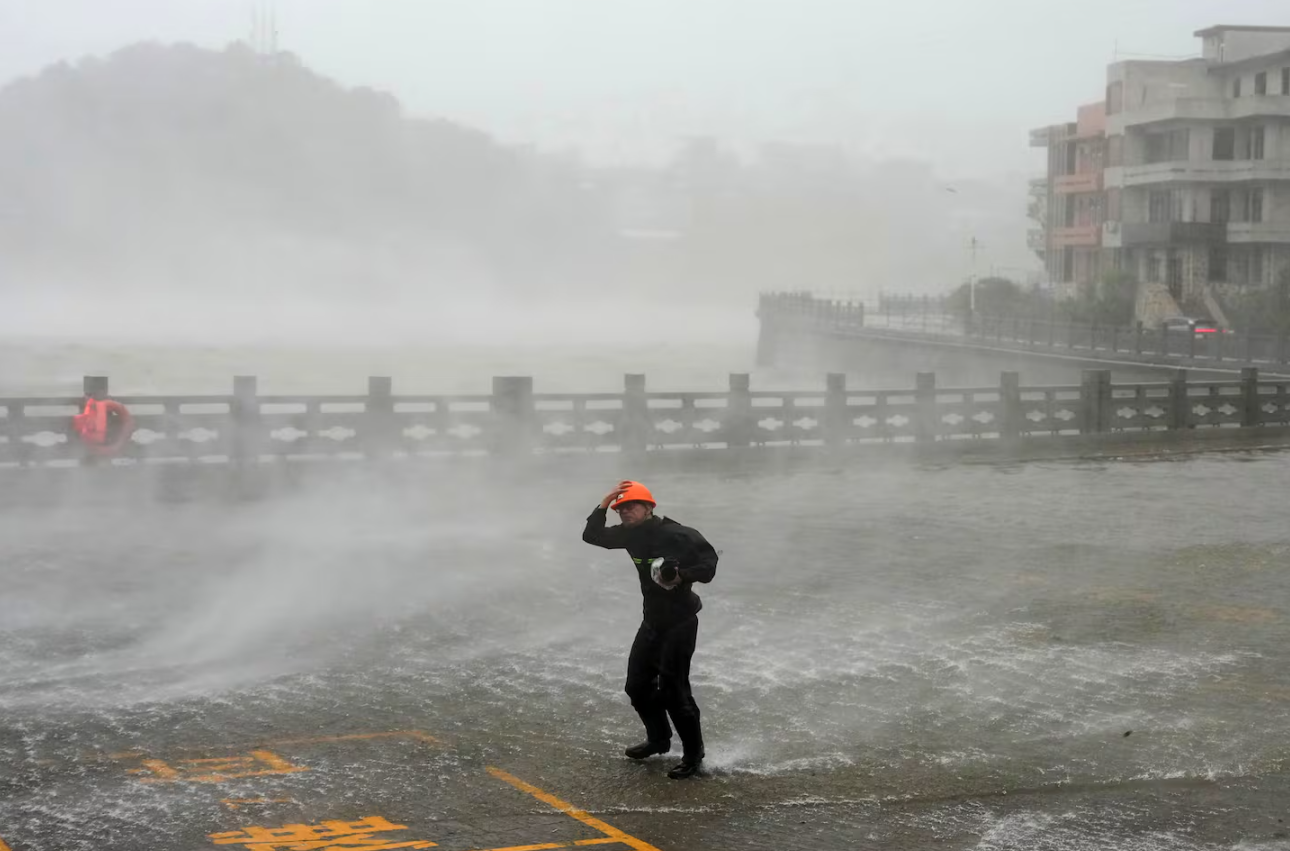
A man walks against strong wind and rain as Typhoon Dolphin makes landfall at Dongsha community in Yuhuan, Taizhou, eastern China's Zhejiang Province on Sunday, Aug. 9, 2026. (Huang Zongzhi/Xinhua)
In mid-August, Typhoon Dolphin ravaged China bringing devastating rainfall across eastern, central, and northern China. Across the country, single-day rainfall records were broken at 13 weather stations, and more than one million people were evacuated as flooding and landslides spread across affected regions.
The growing frequency and severity of climate impacts, especially extreme weather, has pushed China to elevate adaptation and resilience. For the first half of 2026, losses have totaled CNY 42.14 billion ($6.1 billion), though this figure will likely rise as most climate-related impacts occur during the summer months. The United States has experienced similar mounting losses, with $31.9 billion in damage recorded so far this year and total costs over the last decade totaling $1.5 trillion.
The question is increasingly not how countries respond to individual disasters, but how they prepare their economies and societies for a climate in which such disruptions are becoming harder to treat as exceptional.
Both China and the United States are confronting this new climate-disrupted future but their approaches distribute responsibility differently. China is using centralised planning and political directives to push adaptation through its government system, while the United States has relied more heavily on state, local, and private actors, with federal policy expanding and contracting depending on the political cycle. However, in both countries, national ambition faces the same test of whether local governments have the capabilities to turn resilience priorities into tangible action.
China Is Making Climate Resilience a Development Priority
China’s growing emphasis on climate adaptation is about more than preparing for worsening weather. Beijing is increasingly integrating resilience into national development planning, while making a more deliberate connection between climate change and extreme weather.
China’s 2035 Nationally Determined Contribution (NDC) elevated adaptation in a leader-level multilateral climate commitment, explicitly committing to establishing a “climate adaptive society.” The inclusion is significant: adaptation is no longer confined to China’s domestic policy agenda but has become part of the country’s headline international climate commitments.
Similarly, China’s 15th Five-Year Plan (2026–2030) for National Response to Climate Change, released on July 29 by the Ministry of Ecology and Environment and 17 other government agencies, dedicates two chapters to adaptation. It calls for extreme-weather early-warning systems, stronger urban climate-risk assessments, and more resilient cities, food systems, and health systems.
This goes beyond previous Five-Year Plans, which treated adaptation largely as one component of broader climate policy. The 15th Five-Year Plan instead organises adaptation around climate-risk assessment, extreme-weather preparedness, and targeted sectoral and regional action—effectively making resilience part of how China plans to protect its broader development trajectory.
That approach is also evident in the Ministry of Natural Resources’ August 3 National Geological Disaster Prevention and Control “15th Five-Year Plan” Implementation Plan. Framed by growing climate risks, it shifts disaster management from individual hazard sites toward entire risk zones. It includes relocating around 50,000 households from high-risk areas, more than 4,200 engineering projects, and strengthened risk surveys, monitoring, early-warning systems, and data platforms.
Even though China has an increasingly concentrated adaptation plan at the national level it doesn’t mean that it's implemented the same way. At the local level, China’s provinces and cities retain significant responsibility for translating broader national policies into local measures. This aligns with the concept “
Whilst strong work is being done at the local level, these governments cannot do it alone and rely on the continued support of the central government. China’s local governments face significant financing pressures and face trade-offs between longer-term adaptation projects versus immediate development and economic growth needs. By the end of 2024, the MEE reported that pilot regions had identified more than 5,400 climate-related projects representing over RMB 3 trillion in planned investment. But translating these financing mechanisms into durable adaptation will depend on whether local governments can develop viable projects and sustain implementation over the long term.
In this way, China’s system offers a substantial mechanism for setting priorities but its effectiveness will ultimately depend on whether these national directives are transtable into well supported and well financed local resilience actions.
The United States’ Decentralised Approach
The United States has followed a different trajectory. Instead of operating under a single, national adaptation strategy, resilience has emerged through a combination of local and state initiatives, federal programs, and private and nonprofit efforts. Political cycles and fluctuations in the sitting administration’s prioritsation of the area has either strengthened or weakened impact.
Prior to any major federal policy, states and local governments were already experimenting with climate adaptation. In response to the work already being done and with a desire to build on it, President Obama in 2013 signed Executive Order 13653 which established a “State, Local, and Tribal leaders Task Force on Climate Preparedness and Resilience.” The order directed federal agencies to modernise programs to support climate-resilient investments, provide states and localities with climate data and decision-making tools, and establish a task force of state, local, and tribal leaders to advise the federal government on community needs.
Under President Biden, the federal government sought to make this approach more comprehensive and coordinated. The National Climate Resilience Framework of 2023 established a government-wide vision for preparing communities, infrastructure, and ecosystems for climate impacts, while more than 20 federal agencies released Climate Adaptation Plans. The Inflation Reduction Act of 2022 also provided funding for resilience-related efforts including USD $3.3 billion to the National Oceanic and Atmospheric Administration (NOAA) to build a Climate-Ready Nation. The Federal Emergency Management Agency's (FEMA) Building Resilient Infrastructure and Communities program, established through the 2018 Disaster Recovery Reform Act and launched in 2020, similarly provided funding for projects intended to reduce disaster risks before they occur.
Even with top-down measures, much adaptation occurs locally. California illustrates sustained state-level action. The state’s climate adaptation strategy, established in 2009 and updated every three years, coordinates action across sectors while grants help local and Tribal governments assess risks and develop resilience projects. Yet California, like Chinese cities, faces financing challenges. Its $3.7 billion 2021–2022 Climate Resilience Package demonstrated its capacity to invest, but reliance on budget surpluses makes long-term commitments difficult. Dedicated revenue and predictable federal support could provide greater stability.
When reflecting on the current federal situation, the Trump Administration demonstrates the political volatility of resilience policy at the federal level. The Trump administration has shifted federal policy away from climate-specific resilience, emphasising state and local responsibility instead. A March 2025 executive order argued that preparedness is best managed at the state, local, and individual levels, while the June 2026 America First Resilience Strategy calls for a “return to federalism.” At the same time, climate adaptation has been folded into a broader conception of resilience, with less emphasis on climate change as a distinct driver of risk.
This shift has consequences for the resources and information available to states and localities. Proposed cuts to NOAA and other climate-science programs could weaken the data and institutional capacity underpinning climate-specific preparedness. The fate of FEMA’s BRIC program further demonstrates this uncertainty. After the administration moved to cancel it in 2025, a federal court ordered its restoration, and FEMA reopened the program in March 2026 with $1 billion available for state, local, territorial, and Tribal projects.
For states that have consistently invested in resilience, such as California, strong local and state capacity may help buffer these shifts. For others, less predictable federal support could widen existing gaps in preparedness.
The Local Test
The contrast between China and the United States is not simply centralised vs decentralised governance. While China’s government can establish national priorities and push for action, local governments still need financial support and capacity to implement them. The U.S. gives states and communities greater latitude to shape their own responses, but federal priorities and resources can shift with political cycles.
Both countries must translate resilience priorities into sustained action at the local level. China's challenge is converting strong central political will into well-financed implementation, while in the United States, states such as California may be able to buffer shifts in federal policy. Communities with fewer resources, capacity, or political commitment, however, could fall further behind.
The two approaches also offer opportunities for bilateral learning. China could draw on U.S. experience with locally tailored adaptation, insurance, and private-sector risk reduction, while the United States could learn from China's ability to establish long-term national priorities and coordinate action across government. Even amid broader tensions, technical cooperation on climate-risk assessments and disaster preparedness could provide more insulated, practical areas for engagement.
Ultimately, climate resilience depends on more than political commitment at the top. Whether centralised or decentralised, effective adaptation requires sustained financing, local capacity, and policies that can endure beyond the next political cycle.
