

2026 is the first year of the Fifteenth Five-Year (2026-2030) Plan for National Economic and Social Development of China. There is intense interest in the target rate of economic growth as well as the actual rate for 2026, given the continuing slump of the real estate sector in China, the apparent lack of sufficient domestic aggregate demand, and the many different challenging geo-political uncertainties. The official target rate will be announced at the “Twin Conferences (the National People’s Congress and the Chinese People’s Political Consultative Conference)” in early March. The latest International Monetary Fund and World Bank forecasts for the Chinese economy for 2026 are respectively 4.5[4] and 4.4[5] per cent.[6] The objective of this essay is to provide an estimate of the likely national target rate of growth as well as a forecast of the actual realised rate of growth for 2026.
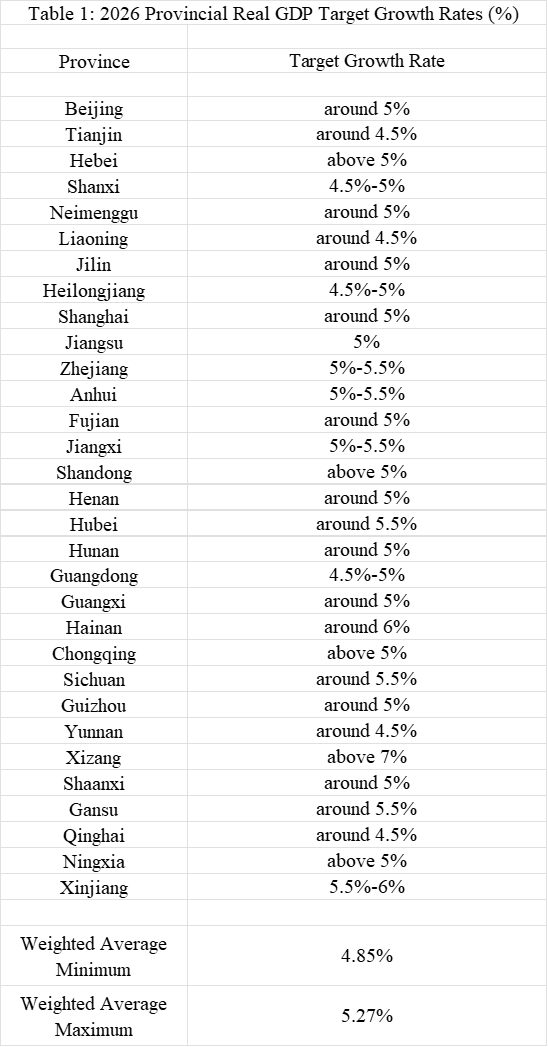
First, we consider the estimation of the 2026 national target rate. One important source of information consists of the announced target growth rates of the real GDP of each province, municipality and autonomous region for 2026 at their respective provincial-level People’s Congresses. They are articulated in various forms. First, it can be a single number, say 5 per cent. Second, it can be a range, with a minimum and a maximum, say between 5 and 5.5 per cent. Third, it can be, say “around 5 per cent”.[7] Finally, it can be, say “above 5 per cent”. We shall interpret an “around” target as a range target, plus and minus 0.25 per cent. We shall also interpret an “above” target as a range target, with the upper bound being plus 0.25 per cent from the numerical target. With these conventions, we can calculate a 2025 provincial-GDP-weighted average of the minimum and maximum 2026 provincial-level target growth rates. The provincial-level target rates and their weighted minimum and maximum national averages[8] are presented in Table 1. These rates should be reflective of the actual conditions because they constitute the key performance indicators for the provincial-level leaders, who are unlikely to set unrealistic or infeasible targets because they themselves are responsible for achieving them.
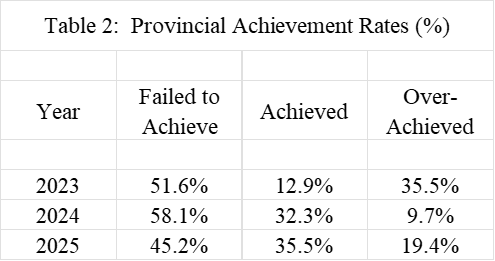
To what extent have the provincial-level units been able to achieve their targets in the past? One can classify the provincial units into three categories in accordance with their performance relative to their announced targets. Whether the target is a single number, or a range, including the “around” and “above” targets, there are three possible outcomes: (1) failed to achieve; (2) achieved; and (3) over-achieved. In Table 2, the proportions of provincial units that failed to achieve, achieved, and over-achieved their targets respectively during the period 2023-2025 are presented. The achievement rate has improved over time. In 2025, the majority of the provinces were able to achieve their targets.
In Table 3, we compare the weighted average minimum and maximum target rate, the national target rate and the national actual rate between 2023 and 2026. Table 3 shows that the averages of both the minimum and maximum target rates have a downward trend, reflecting the difficulties caused by the real estate slump. The national target rates for 2023-2025 were all “around” 5 percent, set conservatively below the weighted minimum rates. Given the weighted minimum and maximum 2026 target rates of 4.85 and 5.27 per cent respectively, a reasonable estimate of the likely national target rate of growth may therefore also be “around” 5 per cent, especially since the provincial achievement rate seems to be improving.[9]

Second, we consider the forecast of the actual realised rate of growth of the Chinese economy in 2026. Normally, such a forecast would be based on the rates of growth of tangible inputs, physical capital and labour, and intangible inputs, human capital and technology capital, and technical progress. However, such an approach makes sense only for a supply-constrained economy, but China has become a “surplus” economy in recent years, so that its aggregate demand, and not supply, effectively determines its output. The national target rate and the national actual realised rate may differ for many possible reasons: an exceptionally bountiful harvest, a trade embargo, or a mutual reduction of tariff rates. Table 3 shows that China was able to achieve its national target rates all these years. However, for 2026, taking into account the expected improvement in achievement rates, our forecast of the actual realised rate of growth for 2026 is also “around” 5 per cent. We note the empirical regularity that as the real GDP per capita of an economy rises, its real rate of growth falls. The Chinese economy is no exception. However, the current Chinese real GDP per capita of US$14,197[10] is still within a range that allows a rate of growth of 5-6 per cent per annum.
Taking everything into account, our estimate of the national target rate and forecast of the national actual rate for 2026 are both “around” 5 per cent.
[1] Ralph and Claire Landau Professor of Economics, The Chinese University of Hong Kong, and Kwoh-Ting Li Professor in Economic Development, Emeritus, Stanford University.
[2] Associate Professor, School of Economics, and Research Fellow, Center of Social Welfare and Governance, Zhejiang University.
[3] The sources to Tables 1-3 are available in a working paper by Lawrence J. Lan and Yanyan Xiong, Lau Chor Tak Institute of Global Economics and Finance, The Chinese University of Hong Kong.
[4] See International Monetary Fund, "Global Economic Prospects, January 2026,” p. 10, Table 1.
[5] The World Bank, "Global Economic Prospects, January 2026," p. 4, Table 1.1.
[6] These may be compared to a forecast independently made by the Chinese Academy of Sciences of “around” 5 per cent for 2026.
[7] In Chinese, “to the left and right”.
[8] Using 2025 actual GDPs as weights.
[9] Another possible choice is 4.5-5 per cent, but it may be viewed as a bit too pessimistic.
[10] Converted into US$ at the 2025 year-end exchange rate of 7.03 Yuan per US$.
