
Neither China nor the U.S. can change the other. They can only choose peaceful coexistence, meet each other halfway, increase mutual trust and cooperation and pursue common prosperity. Bilateral ties for the foreseeable future will follow the pattern of “fighting but not breaking up.”
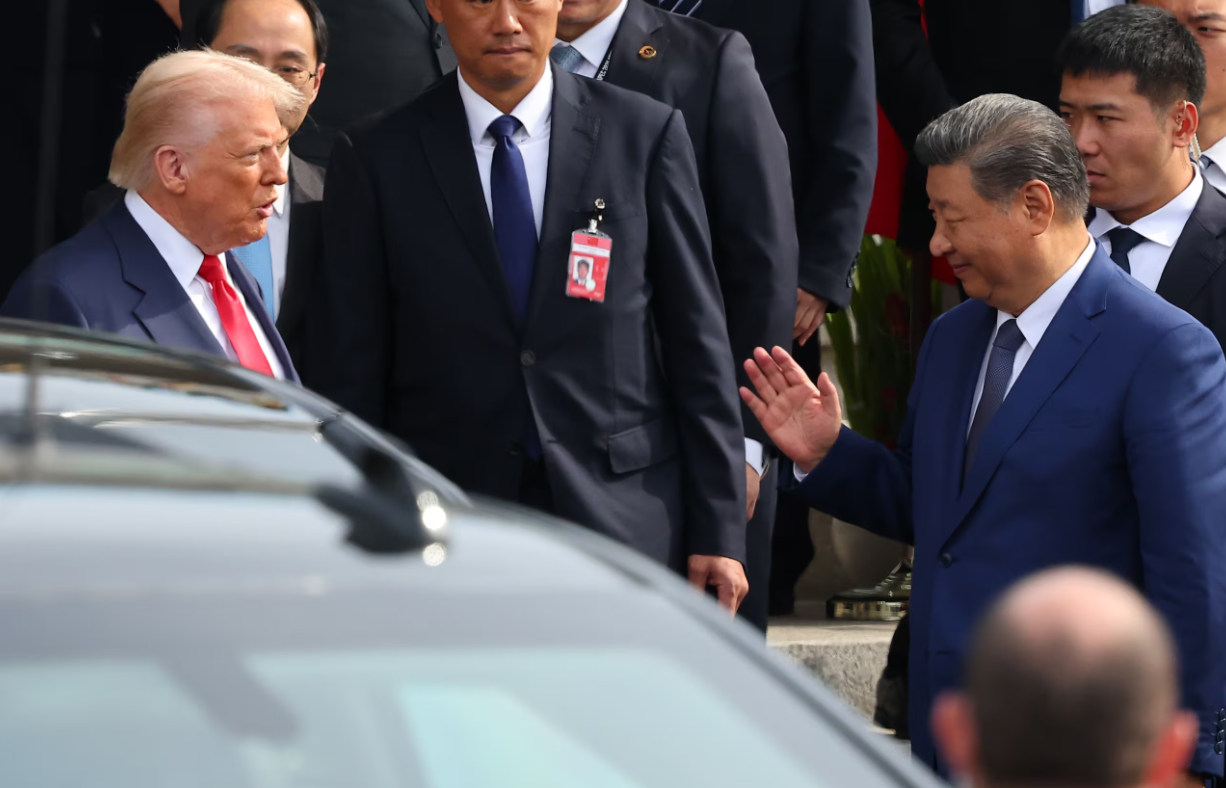
U.S. President Donald Trump and Chinese President Xi Jinping greet each other as they leave the meeting room following the U.S.-China summit at the protocol room Naraemaru of Gimhae Air Force Base in Busan on Oct 30, 2025.
Relations between China and the United States saw constant twists and turns in 2025. Under the strategic guidance of the meeting in Busan, South Korea, of the two countries’ leaders, both sides agreed to extend their trade truce, easing tensions and bringing tariffs back to pre-April 2 levels. Bilateral ties are now generally stable.
The China policy of Trump 2.0 began with a renewed tariff war. After Donald Trump’s return to the White House, the U.S. has put extreme pressure on China, extending from tariffs to export controls, port fees, visa restrictions and financial sanctions. The China-U.S. tariff and trade war ran through the whole year. The two sides had five rounds of economic and trade negotiations in Geneva, London, Stockholm, Madrid and Malaysia, consulting on lowering tariffs. In the process Chinese countermeasures, including export controls over rare earths and the suspension of soybean purchases from the United States, hit America where it hurts. The U.S. reduced fentanyl tariffs to 10 percent and suspended the 20 percent “reciprocal tariffs,” along with other non-tariff measures, for one year.
Bilateral tariffs and a trade war have followed the pattern of “negotiating while fighting.” The Chinese approach of “promoting talks with fighting” and effective countermoves pressed the U.S. to acknowledge that high tariffs are unsustainable. It came back to the negotiating table. America’s China policy has become realistic, and tends to be relatively stable.
The leaders’ meeting achieved a framework consensuses on bilateral trade and tariffs, and the two sides came up with a periodic solution to their economic and trade ties. They took a tactical timeout. However, the road toward a comprehensive economic and trade agreement would prove long and difficult. Tariffs will not be reduced to a very low level.
Intense focus on high-tech
Meanwhile, in the high-tech sector, chips now occupy the commanding heights both countries want to control. China attaches considerable importance to such industries as artificial intelligence and has taken various policy measures to improve competitiveness. In the next five years, it sees high-tech as an engine for economic growth and has increased inputs in tech innovation and accelerated the progress of industry.
The core of China-U.S. competition is no longer ideological. It is science and technology. Critical technologies such as chips, AI and robotics are the ground both countries aspire to dominate. Throttling Chinese high-tech development has become a key U.S. approach to containing China’s progress.
Besides creating an AI action plan to accelerate and coordinate technology, infrastructure and governance and thereby secure its advantages in the AI realm, the United States is also extending its reach into the field of global rule-making. It is strengthening export controls against China in such key sectors as semiconductors and AI. It has put more than 90 Chinese companies on its “Entity List” for export control, aiming to crack down on Chinese high-tech industries. Simultaneously, the U.S. has tightened visa issuance for Chinese scientific and technological personnel, restricting Chinese scholars’ participation in U.S. high-tech programs. Globally, China advocates cooperation in high-tech development; the U.S. vies for dominance. The fierce wrangling between the two sides will continue to escalate.
Taiwan a point of contention
Taiwan is the most sensitive subject in China-U.S. relations. Trump prioritizes homeland security and U.S. interests, and sees Taiwan as an object of bullying and as a bargaining chip. Although Trump hasn’t talked much about Taiwan, and hasn’t identified it as an important subject, his governing team led by Secretary of State Marco Rubio has taken a tough line, advocating use of the Taiwan card to deter China. The State Department has even churned out the theory that “Taiwan’s status remains unresolved.”
The previous administration under Joe Biden stated on multiple occasions that the U.S. would assist Taiwan militarily. Trump 2.0 has adopted a strategy of ambiguity and refused to clarify its Taiwan position. But it continues playing the Taiwan card, constantly trampling on the red line of the “one China” principle. In a single week in November, it announced two packages of arms sales to Taiwan. U.S. security cooperation with Taiwan continues to expand, and strategic guidance and tactical training for the Taiwan military have deepened.
While the Busan summit did not raise the Taiwan issue, a phone conversation in November between Trump and President Xi Jinping found the Chinese side focused primarily on Taiwan, clarifying its principled stance and emphasizing that Taiwan’s return to China is an important component of the postwar international order.
An increase of stability
The China-U.S. relationship started at a low point this year, with tariffs and trade war triggering fierce confrontation, and bilateral ties worsening rapidly. Following four rounds of conversation between the two presidents on the phone and one face-to-face meeting, tensions showed signs of easing, and bilateral ties gradually entered a stage of “stabilizing amid turmoil”—and they are now stable in general. China is no longer just coping with pressure but is able to shape the pattern of competition and lead the rhythm.
However, against the background of U.S. strategic competition with China, the American goal of containment hasn’t changed. U.S. strategic containment of China as America’s main rival have become a bipartisan, institutionalized long—term-political agenda. Trump 2.0 has escalated endeavors to suppress and contain China. Official documents and ranking officials in the U.S. government identify China as the country’s “sole threat” and “pacing challenge.”
In short, the structural contradictions between China and the U.S. have not been resolved. Nor will the U.S. strategy of “de-sinicization” and decoupling change. China and the U.S. have engaged in “arm wrestling” and “mutual disruption.” Bilateral ties will prove uncertain and fragile in the future. Strategic competition between the two sides will continue.
Of course, time is on China’s side. Neither China nor the U.S. can change the other; they can only choose peaceful coexistence, meet each other halfway, increase mutual trust and cooperation and pursue common prosperity. Bilateral ties will follow the pattern of “fighting but not breaking up.”
