
Outer space belongs to all humanity. No nation should seek to monopolize space resources or dominate humanity’s space future. Only by rejecting hegemony and prioritizing the peaceful utilization of outer space can global space undertakings deliver shared benefits and drive the progress of human civilization.
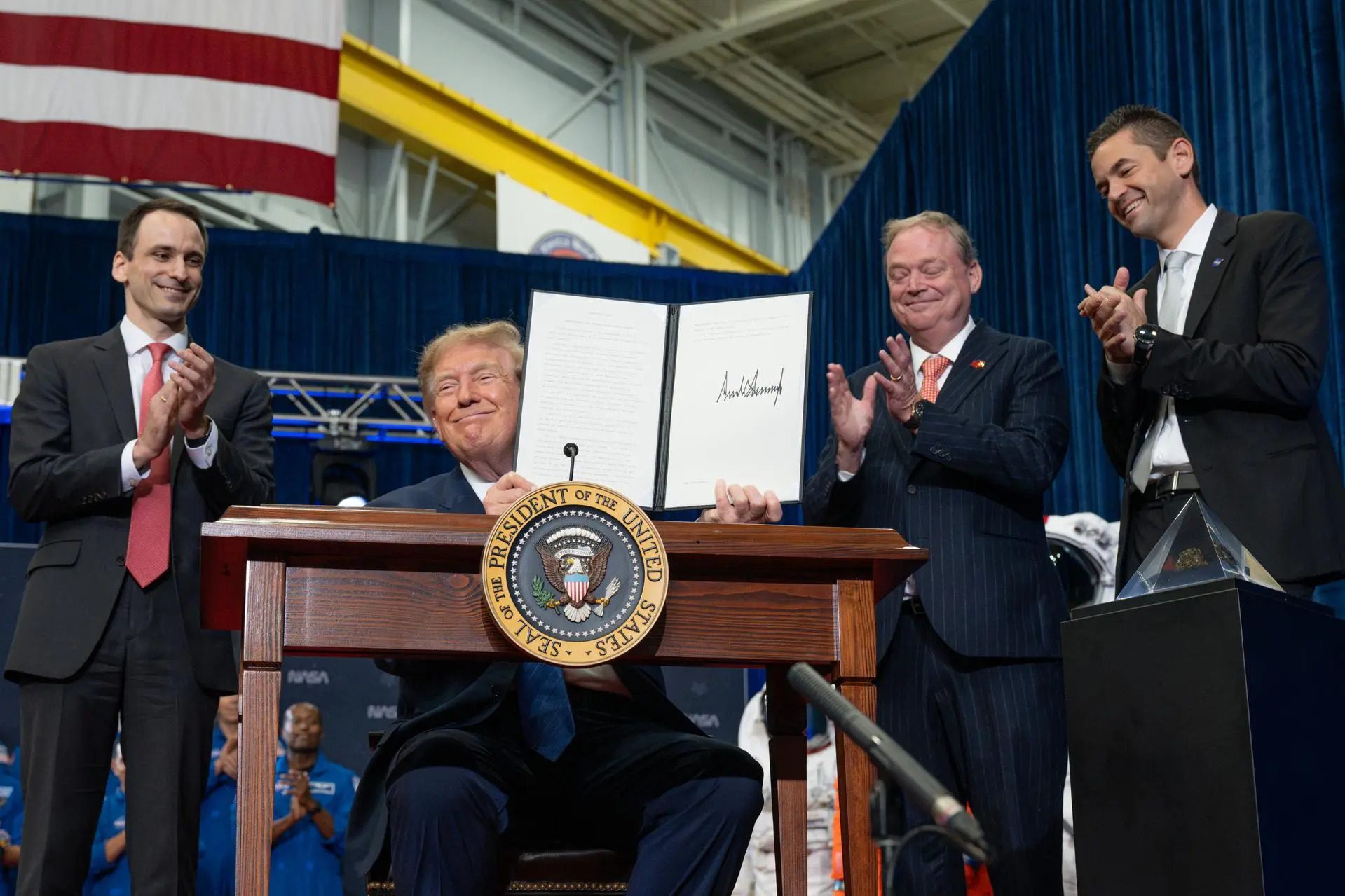
U.S. President Donald Trump presents an executive order establishing the United States Space Academy on Aug 28, 2026, at NASA's Johnson Space Center in Houston. (Photo: NASA/John Kraus)
On Aug. 28, the White House announced that U.S. President Donald Trump signed an executive order claiming outer space as a critical domain for American national security, economic growth, scientific discovery and technological innovation. It said American superiority in space depends on the strength, skill, and character of those who explore, secure and build critical space industries. It also established a commission to advise and assist the president on proposals to establish the United States Space Academy, a proposed NASA-led Federal academy dedicated to combining rigorous technical education with leadership development, discipline and commitment to public service. The order was hailed by the U.S. military and marks a new milestone as the United States seeks to dominate space.
U.S. seeks space dominance
From the first formal U.S. space strategic document— “Preliminary U.S. Policy on Outer Space” approved by Dwight Eisenhower in August 1958, to the first National Space Security Strategy issued by Defense Secretary Robert Gates and National Intelligence Director James Clapper in January 2011 and then to the National Space Strategy promulgated by the Trump administration in March 2018—the words and expressions have changed but their nature never has. The clear goal is to dominate space. The strategy:
• puts American interests first and foremost to make America strong, competitive and great;
• emphasizes dynamic and cooperative interplay between the national security, commercial and civil space sectors;
• partners with the commercial sector to ensure that American companies remain world leaders in space technology;
• ensures that international agreements put the interests of the American people, workers and businesses first;
• prioritizes regulatory reforms that will unshackle American industry and ensure the country remains the leading global provider of space services and technology;
• protects vital American interests in space to ensure unfettered access and freedom to operate in space to advance America’s security, economic prosperity and scientific knowledge.
In a word, the United States wants to dominate space anytime and anywhere it likes.
Building hard space power
America’s pursuit of space superiority and militarization follows a consistent, well-documented policy lineage, with 2018 serving as a critical turning point for comprehensive strategic upgrading.
In March 2018, the Trump administration unveiled its updated space strategy, elevating space security to a core pillar of U.S. national security doctrine and explicitly prioritizing the competition for orbital and deep-space dominance as a top national strategic goal.
Departing from the fragmented, decentralized space operation model adopted in previous decades, the new strategy prioritizes the development of dedicated space combat forces, aiming to break the institutional limitations of traditional military branches and build an independent, professional and systematically structured space warfare system.
Guided by this top-level strategic blueprint, the United States launched sweeping institutional reforms in the space sector throughout 2018. In December of that year, President Donald Trump issued a presidential memorandum directing the U.S. Department of Defense to accelerate the development and operation of the U.S. Space Command. Shortly after Trump’s inauguration, the Space Command was designated as the U.S. military’s 11th unified combat command, assuming core responsibilities for the centralized command, dispatch and operational planning of all U.S. space assets.
This reform unified military resource allocation, force training, orbital deployment and crisis response mechanisms for space operations, laying a robust organizational foundation for the subsequent formal establishment of the independent U.S. Space Force. Collectively, these 2018 policy and institutional reforms translated America’s theoretical goal of “space superiority” into a tangible, operational military framework, formalizing the early-stage structure of U.S. space militarization.
Trump signed the FY2020 NDAA to formally establish the United States Space Force on Dec. 20, 2019—a milestone in seeking dominance. The Space Force is organized into three field commands: Space Operations Command, Space Systems Command and Space Training and Readiness Command, along with 24 Deltas, including four provisional Deltas. Last year, the Space Force continued advancing its priority realignment by releasing “Space Force Vector 2025” to provide unified strategic direction for the service.
In July last year, the Space Force accelerated the adoption of the “Integrated Mission Delta” structure and initiated the establishment of multiple System Deltas. In August, the Space Force formally stood up Systems Delta 85 under Space Systems Command, dedicated to developing and integrating capabilities in space domain awareness, missile warning and tracking, command and control and space intelligence. In November, the Space Force’s Crucible Innovation Laboratory hosted an Innovation Day event, continuing its efforts in collaborative development and prototyping of advanced military capabilities. In December, the U.S. Space Force in Japan celebrated the first anniversary of its establishment. Thus far, the U.S. Space Force has already possesses the hard power to conduct military operations in space.
Building soft space power
While the creation of U.S. Space Command and the U.S. Space Force resolved the structural challenge of building a dedicated space combat force, long-term strategic competition in outer space ultimately hinges on sustainable, high-caliber talent reserves. In the years following the Space Force’s founding, the United States confronted prominent talent bottlenecks that constrained its strategic ambitions. Traditional military academies and civilian higher education institutions are capable of cultivating general aerospace technical personnel, but they lack targeted training pathways for interdisciplinary elite talent proficient in space military operations, deep-space exploration, orbital security defense and commercial space industry governance. Driven by the rapid expansion of global space exploration initiatives, the explosive growth of America’s commercial space sector and the escalating orbital security rivalry among major powers, national demand for specialized strategic professionals has surged exponentially.
The academy’s talent training system is precisely tailored to serve three core pillars of U.S. strategic development in space. First, it cultivates professional military personnel for the U.S. Space Force to undertake orbital defense, space counter-operation, and military space support missions. Second, it nurtures high-end scientific researchers to support NASA’s deep-space exploration, lunar base construction and celestial body research programs. Third, it reserves technical and managerial backbones for America’s commercial space industry, catalyzing the industrialization and large-scale advancement of domestic aerospace technologies. Coupled with mandatory graduate public service requirements, the academy establishes a closed-loop talent cultivation ecosystem spanning strategic demand orientation, professional specialized training, and dual employment in military and industrial sectors, ensuring a stable long-term talent supply for U.S. space strategy implementation.
In essence, the U.S. Space Academy fills the final void in America’s end-to-end space power system. The 2018 institutional reforms of Space Command and Space Force constructed the hard power of U.S. space military confrontation and operational deployment, while the Space Academy builds the sustainable soft power required for prolonged strategic competition in outer space. This institutional breakthrough is a pivotal evolution in U.S. space strategy—from early-stage passive risk response and basic institutional construction to a proactive, systematic and talent-driven long-term strategic layout.
The underlying strategic logic is unambiguous: Through top-down national policy guidance, specialized military institutional support and systematic professional talent reserves, the United States seeks to perpetuate its leading advantages in space technology, orbital military operations and space resource development, ultimately realizing the overarching goal of unilateral space dominance.
Common heritage
As the cornerstone of global space law, the 1967 Outer Space Treaty explicitly stipulates that outer space, including the moon and other celestial bodies, constitutes the common heritage of all humankind. All space exploration and utilization activities must serve the universal interests of all countries, without discrimination. No sovereign state is authorized to claim territorial sovereignty over outer space, to exclusively control space resources or to conduct unilateral military expansion and hegemonic competition in the orbital and deep-space domains.
America’s continuous advancement of space militarization and specialized talent-building inevitably exacerbates the global space security dilemma. Its unilateral pursuit of space dominance compels other space-faring nations to upgrade their space defense capabilities and counter technologies, intensifying great-power strategic competition in outer space and raising the risk of a new kind of global arms race. Full-scale space weaponization and militarization would pose unprecedented security threats to all countries’ space assets, including communication satellites, navigation constellations and deep-space exploration platforms. Further, frequent orbital military activities and confrontations would generate massive space debris, severely disrupting a fragile orbital ecological environment and inflicting irreversible damage on the sustainable development of humanity’s space undertakings.
This year’s establishment of the U.S. Space Academy represents a landmark advancement in America’s comprehensive layout for space hegemony. Complementing the previously established U.S. Space Command and Space Force, it forms a three-dimensional strategic system covering policy planning, institutional operation and talent reserves for U.S. space dominance. While the academy promotes aerospace technological innovation and professional talent training within the United States, its inherent strategic orientation toward exclusive space supremacy warrants profound global vigilance. Outer space belongs to all humanity, and peace, cooperation, and inclusiveness define the irreversible trend of future space development. No nation can monopolize outer space resources or dominate humanity’s space future.
Only by rejecting space hegemony, adhering to multilateral collaboration and prioritizing the peaceful utilization of outer space can global space undertakings deliver shared benefits and drive the progress of human civilization.
