
In late 2025, protests in Gabès over pollution from the phosphate industry led Tunisia to seek Chinese help to reduce environmental harm. The move also reflects President Saied’s broader shift away from Europe toward China in economic and diplomatic policy.
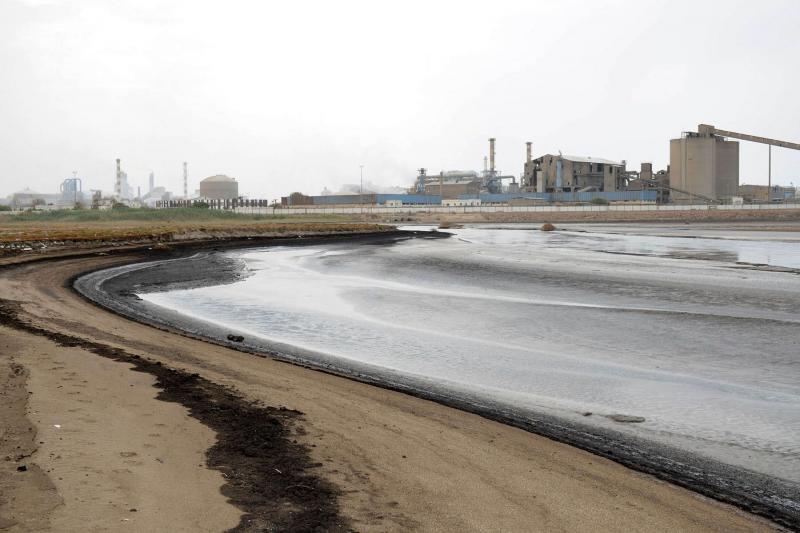
Residues from chemical plants in the Ghannouch industrial zone in Gabès in southeastern Tunisia, flow toward the Mediterranean sea, May 22, 2025. (Photo: Iman Zayat / TheArabWeekly)
In the last few months of 2025, the city of Gabès, in southern Tunisia, witnessed large scale protests in response to the environmental and public health impacts of the Compagnie de Phosphates de Gabès (CPG/CGT) phosphate-processing complex. In October 2025, pollution levels and hospital admissions due to contaminated air and water reached critical levels triggering widespread protests in Gabès and across Tunisia, reflecting growing frustration over what residents perceive as prolonged governmental inaction toward the environmental damage caused by the chemical industry. In response to this crisis, the Tunisian government is turning to China in hopes of rehabilitating the industrial units to curb its environmental and social impacts. This outreach to China cannot be explained solely by the urgency caused by the environmental crisis and growing demonstrations. In addition to China’s position as the world’s largest phosphate producer (Tunisia ranking as tenth) and leadership in environmental technologies, this outreach must be situated within a broader political and diplomatic reorientation Tunisia is facing under President Kais Saied. In the midst of the Gabès pollution crisis, Saied’s turn to China highlights the search for a new economic and aid partner, and between the lines, a rejection of its traditional western diplomatic partners.
This diplomatic shift is consistent with Saied’s gradual distancing from his European partners. In November 2022, the Tunisian president made his rejection of western ‘diktats’ apparent in his refusal to advance to the final stage of the 1.9-billion-dollar IMF deal negotiated to help appease Tunisia’s growing economic crisis. In May 2024, he addressed European ambassadors, warning that any involvement in Tunisia’s internal affairs would be considered unacceptable interference. He invoked the preamble of the 2022 Tunisian Constitution, adopted following a referendum initiated by the presidency, which affirms the rejection of foreign intervention in domestic affairs. Parallely, Tunisia has strengthened its diplomatic ties with China, exemplified by the International Diplomatic Academy of Tunis, financed by China and inaugurated in January 2024 by Chinese Foreign Minister Wang Yi. In 2025, China surpassed Italy and France as Tunisia’s main exporters.
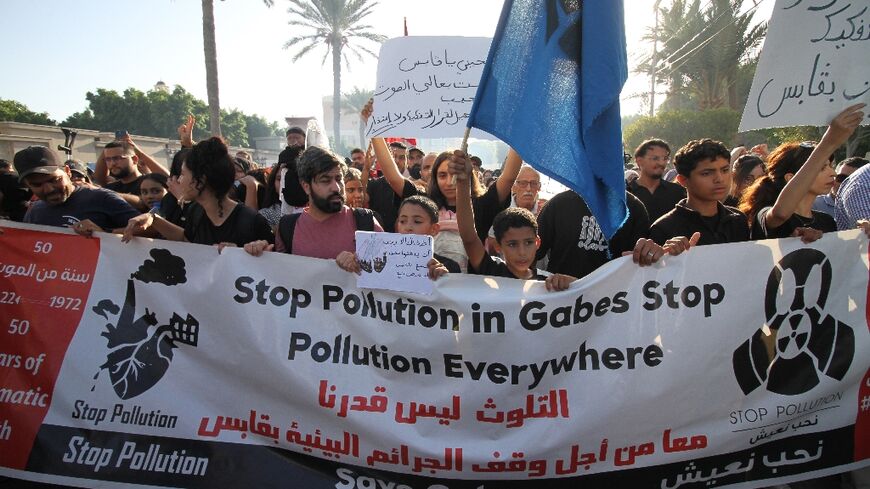
Protesters in Gabès, southeastern Tunisia, demonstrate against pollution caused by factories run by the Tunisian Chemical Group in October 2025.
In November 2025, while Gabès was facing thousands of people protesting in the streets, Tunis and Brussels were facing a latest escalation in their crumbling diplomatic relations. Following a meeting between the Union Générale Tunisienne du Travail (UGTT), the oldest labor union of the country, and the European union’s ambassador Giuseppe Perrone, the presidency summoned the ambassador and qualified this meeting as beyond the scope of diplomatic work. On November 27th, the European parliament adopted a resolution condemning the detention of lawyer and journalist Sonia Dahmani, freed the same day after 18 months in detention. In line with previous statements, Saied responded by reiterating Tunisia's independence and sovereignty especially in issues of internal affairs. Despite the European Union being Tunisia’s major economic, commercial and aid partner, these episodes underscore an increasingly pronounced political misalignment, and the crisis in Gabes isn’t helping.
Local activists and civil society organizations in Gabès have framed the situation as a case of “neocolonial pollution,” arguing that environmentally hazardous industries continue to be externalized to former colonial territories, such as Tunisia or Senegal, while their outputs are primarily exported to European markets. Tunisia’s chemical industry was developed under the French protectorate years in 1947. The industry produces phosphogypsum, a radioactive byproduct that contaminates water sources and has been linked to serious health conditions such as cancer. When similar facilities in Europe were largely shut down in the 1980s due to environmental and public health concerns, production remained in places such as Gabès, where, for example, the French industrial group Roullier is currently still operating its branch Phosphea. On December 10th, during a session of the French National Assembly, a representative from La France Insoumise publicly addressed the crisis in Gabès, criticizing France as being complicit in watching this crisis unfold. Such statements match the growing calls from local activists in Gabès to acknowledge the nature of postcolonial industrial systems and the role European nations have played in keeping these outside their borders.
Within Tunisia, debate continues over the future of the phosphate sector. While the industry provides more than 30,000 jobs and constitutes a significant source of national revenue, activists argue that economic gains have come at the expense of people’s health and the environment. Some advocate for the complete closure of the phosphate-processing plant, while others call for a rehabilitation aimed at significantly reducing its ecological footprint like in China for example, where thanks to the government’s efforts to reduce water pollution, phosphorus concentrations in Chinese lakes declined by roughly 60 percent from 2006 to 2014.
China has appeared as a solution to many problems at once: not only does China know how to reduce phosphorus emissions while maintaining the economic viability of the industry, cooperation with China aligns with Tunisia’s broader geopolitical recalibration and signals a break with its European partners. The Gabès crisis thus encapsulates not only an environmental and public health emergency but also a pivotal moment in Tunisia’s evolving economic and diplomatic orientation.
