
As artificial intelligence rapidly expands, the United States and China face similar sustainability challenges, but their responses differ starkly — shaping AI’s long-term environmental footprint.
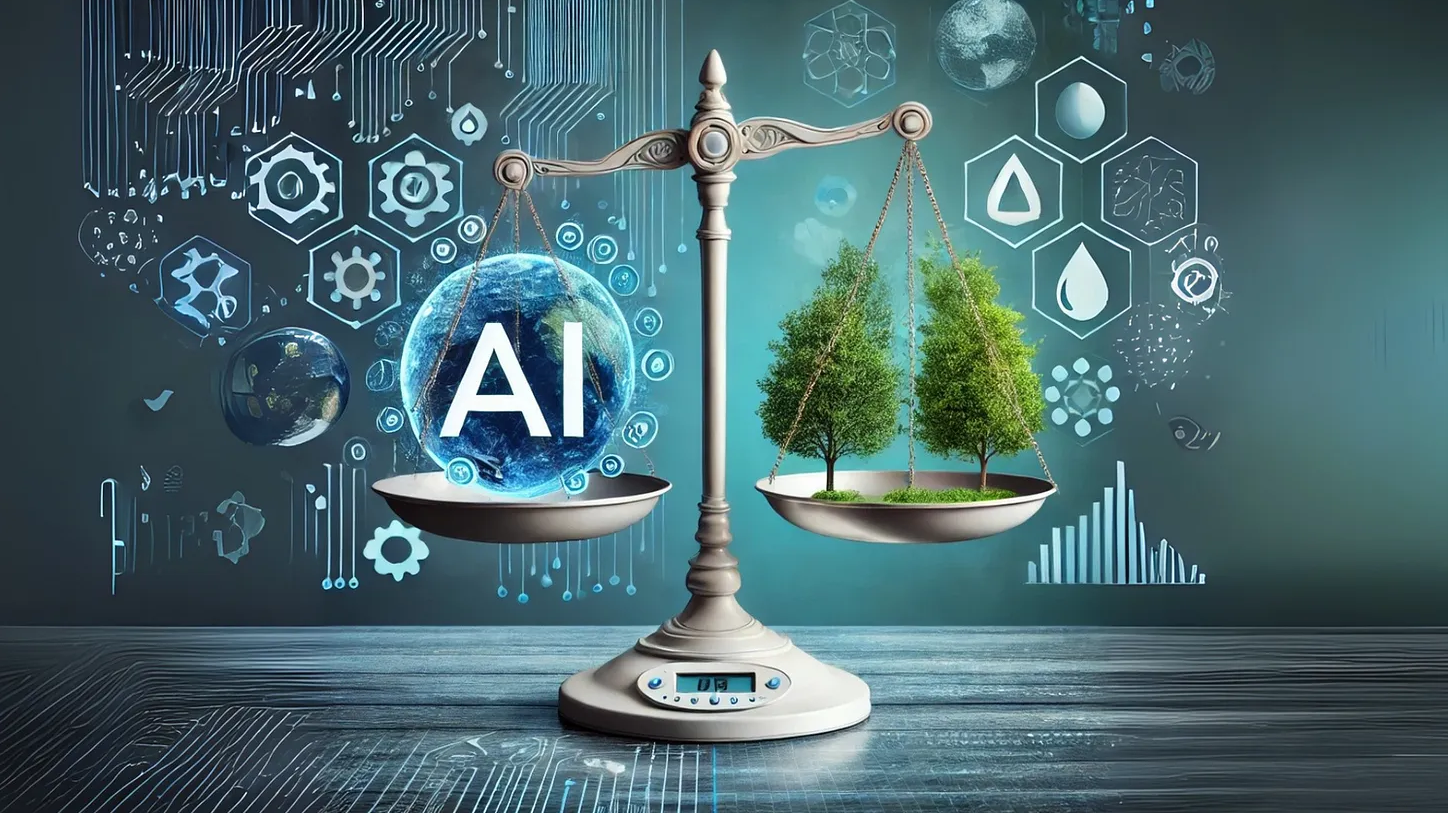
In Part 1 of my series on environmental AI governance, we identified that energy and water are at risk of data center overusage and could be competing with local communities for electricity and water. A polling from AP-NORC center for public affair research says that 4 in 10 Americans are “extremely” or “very” concerned about the environmental impacts of AI. How do authorities in the U.S. respond to the resource intensive demand and environmental impacts of AI data centers?
U.S. policy toward data center environmental impacts has so far been piecemeal. There are largely no federal regulations specifically capping data centers’ energy or water use; instead, market forces and local state authorities are playing the key roles. China, which now makes more profit selling green technology than America makes from selling fossil fuels, is “baking in” their renewable technologies into their national data center initiatives.
The U.S. environmental AI push is largely from bottom-up – relying on local state, civic engagement, and market forces
In recent years, local state’s tax exemption incentives have attracted large tech corporations to bring in high tech jobs into their cities. A report by CNBC business found that as many as 42 states provide full or partial sales tax exemptions to data center projects or have no state sales tax at all. Environmental concern was not on the front docket until air pollution and water reserves for citizens were in question.
Some tech companies are striking their own deals to secure cleaner energy. For example, Meta recently inked a landmark 20-year purchase agreement for the entire output of a 1.1 GW nuclear power plant in Illinois. At the same time, Meta’s expansion in the southern region of the U.S. powered by fossil fuels seems to be double-faced. Louisiana’s Entergy Corp. has proposed building three new gas-fired power plants exclusively to feed Meta’s data centers. This project is now under legal scrutiny for its potential climate impacts, which are forecasted to burn 3 times as much electricity as the city of New Orleans at any given day. Microsoft, Google, and other hyperscalers are also attempting to find a green AI path by signing wind and solar deals.
Today, most data center policies are centered around local grievances for energy and water overusage. Local grassroot community organizers are protesting the negligence and carelessness of corporations. In response, an array of state policymakers in recent months have formed frameworks around data center development. Texas, California, Michigan, Minnesota, and other states are now drafting an increasing number of state regulations to limit local environmental impacts.
Some U.S. states are stepping up with incentives and requirements for greener data centers. For instance, in 2024 Virginia’s proposal bill for Data Center Efficiency stipulating Power Usage Effectiveness (PUE) efficiency targets for tax breaks, and in June 2025 Oregon now mandates water reporting for large cooling users. Another tactic local governments are using is third-party verification systems such as LEED to incentivize green sustainable data development.
In the end, America’s regulatory approach to AI data centers remains a patchwork—driven by corporate deals and local politics rather than national coordination. States set the pace as Washington lags behind. Without a cohesive strategy, the AI gold rush risks overwhelming both the power grid and the environmental safeguards for improving urban sustainable development.
China’s Sustainable AI development is ahead of building the Eco and Efficient AI – an existing Chinese industrial policy top to bottom approach
Unsurprisingly, China, by contrast, is taking a more centralized, policy-driven path to manage AI’s environmental footprint. Chinese analysts project data centers will consume 400 TWh annually, around 3.2% of China’s total electricity supply – roughly quadrupling in a decade. Beijing is keenly aware of this surge and has launched major initiatives to shape where and how data centers operate.
A signature policy is the “East-West Computing Resources Transmission” (EWCRT) or “东数西算” unveiled in 2022, which directs new supercomputing, data centers, and cloud facilities to be built in China’s western and northern regions. Because these regions – Sichuan, Inner Mongolia, Gansu, Ningxia – are home to cooler climates and abundant wind and solar resources, they can facilitate greener energy build out, enhance supply and demand optimization, and better balance compute resourcing. In comparison to the populous eastern provinces, energy demand is strained, and expanding energy capacity means burning more coal. This national EWCRT strategy is a highly coordinated effort across multiple Chinese provinces demonstrating Beijing’s ambitious top to bottom approach to achieving sustainable AI governance.
By relocating AI data centers closer to regions with abundant renewable energy sources and cooler temperatures, China aims to use less water for cooling and improve the carbon profile of its AI hardware infrastructure. Some research claims that the East-West Data Project can result in a reduction of 11,500 metric tons (Mt) of CO2 between 2020 and 2050 – the equivalent of reducing 30,000 barrels of oil. In addition, Beijing has set new goals to cut the average PUE down and with the use of green electricity in these data centers.
Equally important, Chinese authorities recently have mandated the use of clean energy not only for industrial manufacturers but also for data centers – a move which further integrates its complex energy policy with its AI industrial policy. March 2025, China’s National Development and Reform Commission issued guidelines pushing the country’s big data hubs to further increase their share of renewable electricity. Many data center operators now face new regulations to purchase a certain percentage of green power credits.
China’s provincial governments have rolled out complementary policies. Inner Mongolia offers incentivesfor data centers to directly pair with local wind and solar farms to reduce carbon emission. Another example, the local Shanghai government and China Telecom collaborated on a partnership to build the Lin-gang Special Area, which has become home to what the country calls the world’s first underwater data center. The $226 million project combines renewable energy with deep-sea cooling to improve efficiency and sustainability.
While the U.S. relies on market-led innovation and decentralized governance, China pursues state-led coordination and strategic regional planning. Whether China’s efforts will fully offset the emissions growth remains unclear – China’s grid is still ~60% coal-fired, so a jump to serve the enormous demand of data centers could add significantly to CO₂ emissions. Unless renewables scale even faster, the AI race will still run the risk of developing AI infrastructure powered by coal or natural gas in the near future
Balancing both AI ambitions and environmental constraints is not an easy task for a tight AI race. Their divergent models—bottom-up adaptation versus top-down orchestration—illustrate different strengths: American flexibility drives technological experimentation, while Chinese centralization enables systemic efficiency. Both nations ultimately should aim to reconcile AI’s rapid growth with environmental stewardship.
Back in August of this year, China’s Premier Li Qiang at the World AI Conference in Shanghai proposed establishing an international organization to foster strategic cooperation on artificial intelligence. This interest for partnership cannot be only one-sided. In the next article, a collaborative policy framework will be introduced that could merge U.S and China’s respective advantages and strengths to solve both economies’ shared resource challenges. By establishing a bilateral “Green Compute Accord,” the U.S. and China could turn competition into co-innovation—creating globally aligned pathways to decarbonize the digital backbone of AI while safeguarding resource and energy security across both economies.
