
Donald Trump’s renewed focus on critical minerals has returned Central Asia to the U.S. strategic agenda, highlighted by a C5+1 summit that prioritized investment pledges, resource access, and bilateral dealmaking over regional coordination. The engagement signals a notable U.S. reentry into a region long shaped by Russian and Chinese influence, but its transactional and extractive emphasis risks reinforcing fragmentation and leaves the durability of benefits for Central Asia uncertain.
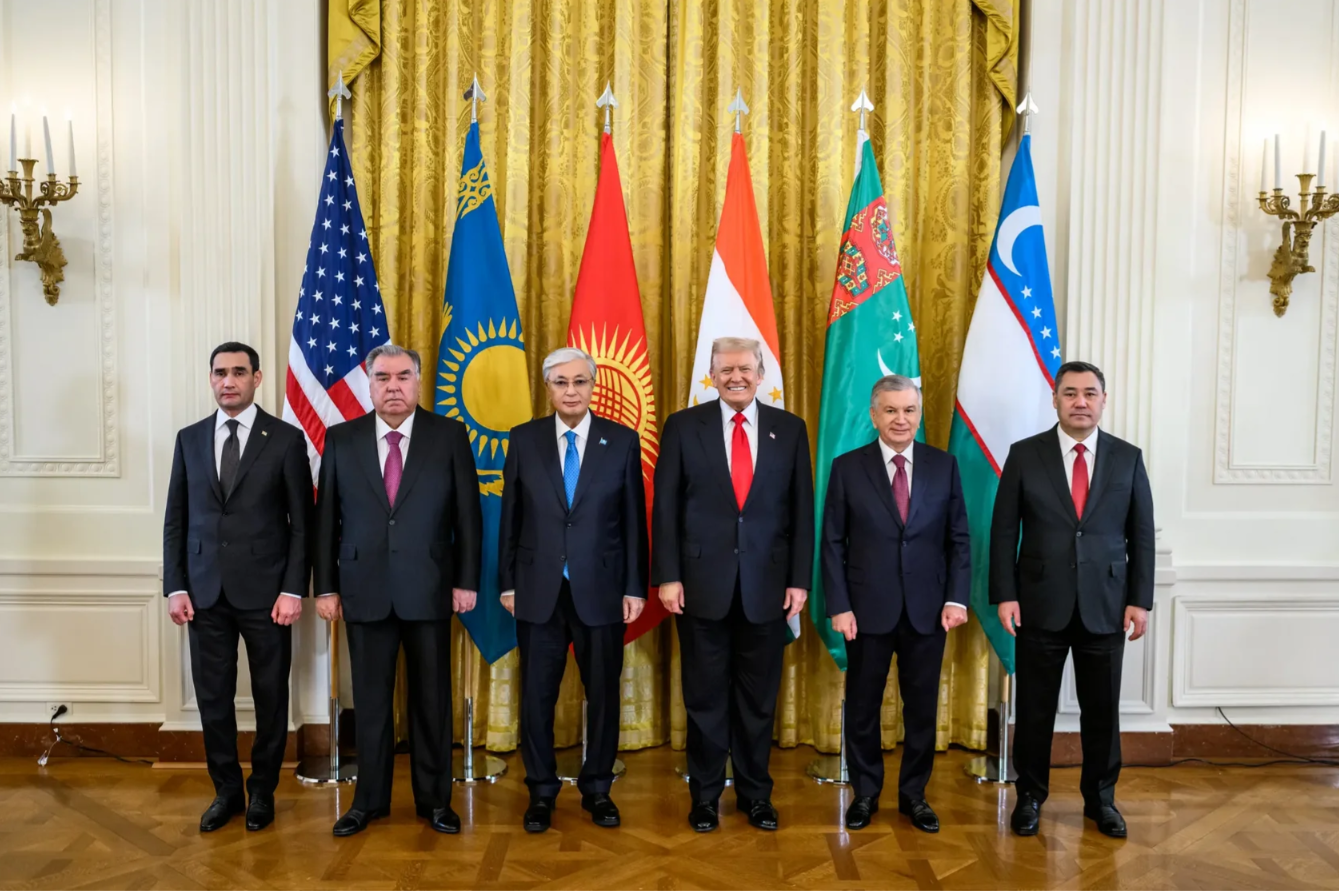
U.S. President Donald Trump hosted the leaders of the five Central Asian nations (Kazakhstan, Kyrgyzstan, Tajikistan, Turkmenistan and Uzbekistan) for the 10th annual C5+1 summit at the White House on November 6th, 2025.
Trump’s renewed emphasis on critical minerals has placed Central Asia back on Washington’s strategic map. This shift was on display during a recent White House meeting between U.S. President Donald Trump and the leaders of Kazakhstan, Kyrgyzstan, Tajikistan, Turkmenistan, and Uzbekistan, convened under the C5+1 framework. Through this platform, the United States has signaled its intent to deepen bilateral and regional engagement with Central Asia, viewing the region not only as a security partner but as a potential pillar in the diversification of global supply chains.
Judging by the tone of the speeches and the deals announced, everyone appeared to leave the Oval Office content. Trump announced on Truth Social that Uzbekistan planned to purchase and invest over $100 billion in the United States over the next decade, focusing on critical minerals, automotive parts, and aviation. Kazakhstan also signed $17 billion in commercial deals with American firms and agreed to purchase up to 15 Boeing aircrafts. Kazakhstan’s President Kassym-Jomart Tokayev further announced that his country would formally join the Abraham Accords, a symbolic step aligning Kazakhstan with a growing network of U.S.-brokered normalization deals between Israel and Muslim-majority nations. Tokayev even called the summit “the beginning of a new era of interaction between the United States and Central Asia,” while Trump declared that the region was “extremely wealthy” and “one of the most important but neglected parts of the world.”
This meeting stands in sharp contrast to what U.S. engagement in Central Asia has looked like in recent years. Those familiar with U.S.-Central Asian relations know that American influence in the region has long been in decline. Even though Washington’s rhetoric continued to stress that Central Asia remains important, the region no longer occupied the strategic priority it held a decade ago, when U.S. policy was heavily focused on Operation Enduring Freedom in Afghanistan.
The U.S. withdrawal from Afghanistan in 2021 left a bitter aftertaste. Many in Central Asia came to view the United States less as a stabilizing force and more as a source of regional volatility. Russian media amplified these perceptions, portraying the U.S. as a distant power with fleeting commitments and limited understanding of the region’s complex political fabric. In that context, Trump’s re-engagement marks a notable shift in tone and ambition. Surprisingly, Washington now appears eager to return to a region long dominated by Russia and China. As Trump put it, “Sadly, previous American presidents neglected this region completely. I understand the importance of this region, but a lot of people don’t know that.”
The C5+1 platform was originally conceived to promote regional coordination and encourage the five Central Asian states to act collectively in response to growing Russian and Chinese influence. Over time, it was seen as a potential forum for building a shared regional identity and for helping the five republics speak with one voice on key economic and security issues.
However, this latest summit appears to have transformed that framework into a series of bilateral engagements. Each leader met Trump individually to discuss national deals, investment pledges, and country-specific partnerships. The summit thus reflected Washington’s preference for transactional bilateralism rather than the promotion of a unified Central Asian regional front.
This approach aligns closely with Trump’s broader “America First” agenda, favoring pragmatic deals that serve U.S. economic interests, while deprioritizing collective regional frameworks. While such bilateralism may yield quick results, it risks undermining the region’s own attempts to deepen intra-regional cooperation. Instead of empowering Central Asian countries to strengthen their regional voice, the United States appears to be reinforcing a pattern of fragmented diplomacy.
Equally telling was the shift in policy emphasis: from sustainable energy cooperation to resource extraction. The discussions at the summit centered on the exploration and export of critical minerals such as uranium, copper, and rare earths. These resources are vital to the global clean energy transition, but their extraction also reflects the renewed prioritization of industrial competitiveness and technological advantage in the United States.
This change underscores how foreign policy under Trump differs sharply from that under previous administrations. Rather than focusing on long-term energy sustainability or regional development, the emphasis now falls on securing immediate access to strategic materials essential for AI technologies, defense industries, and the broader energy transition. In this sense, the summit served as both a diplomatic and economic statement, highlighting Trump’s intent to tie foreign engagement directly to American industrial interests.
The regional implications of this U.S. return are complex. Both Russia and China have long viewed Central Asia as their strategic backyard. For them, the U.S. remains an adversary, and both powers are unlikely to tolerate an assertive American comeback on their shared periphery. Yet as practice shows, major powers can sometimes find overlapping interests in Central Asia.
Even amid geopolitical competition, the United States, China, and Russia have historically cooperated, whether in combating terrorism, countering radicalization, or addressing transnational crime. While rivalry dominates headlines, there remain areas where pragmatic coordination could emerge, particularly in trade, infrastructure, and security.
At the same time, Central Asian states themselves are far from passive players. The region’s leaders have become increasingly adept at leveraging great-power competition to advance their own agendas. They seek to attract investment, technology, and political attention from all sides, while maintaining a careful balancing act to preserve autonomy.
The 2025 C5+1 summit marks a turning point in the evolution of U.S.-Central Asian relations. It signals a renewed American interest in the region, but through a distinctly transactional lens. The focus on critical minerals and investment deals illustrates Washington’s strategic pragmatism, yet it also highlights its limited capacity to inspire a shared regional vision.
For the United States, re-engagement offers an opportunity to rebuild credibility after years of neglect. But for Central Asia, this attention comes with both promise and risk. The influx of U.S. investment could stimulate economic diversification and infrastructure growth, yet without a coherent regional strategy, it may deepen dependency and fragmentation.
Ultimately, if Central Asia is to benefit from this renewed wave of attention, its leaders must strengthen their own regionalism muscle by building cooperation and trust on their own terms, rather than relying on shifting global patrons. The great powers will continue to compete for influence, but only a more cohesive and confident Central Asia can ensure that its immense mineral wealth translates into sustainable prosperity rather than becoming another chapter in the geopolitical competition for its resources.
The return of Washington to the region may indeed mark a new beginning, but whether this becomes a genuine partnership or merely another transactional episode in the “New Great Game” series will depend not only on American resolve, but on Central Asia’s ability to speak and act as a region in its own right.
