
The Trump administration’s transactional diplomacy in Central Asia comes with both reconfiguration and constraints. It has broadened the scope of U.S. engagement, yet its depth and structural impact on regional geopolitics are limited.
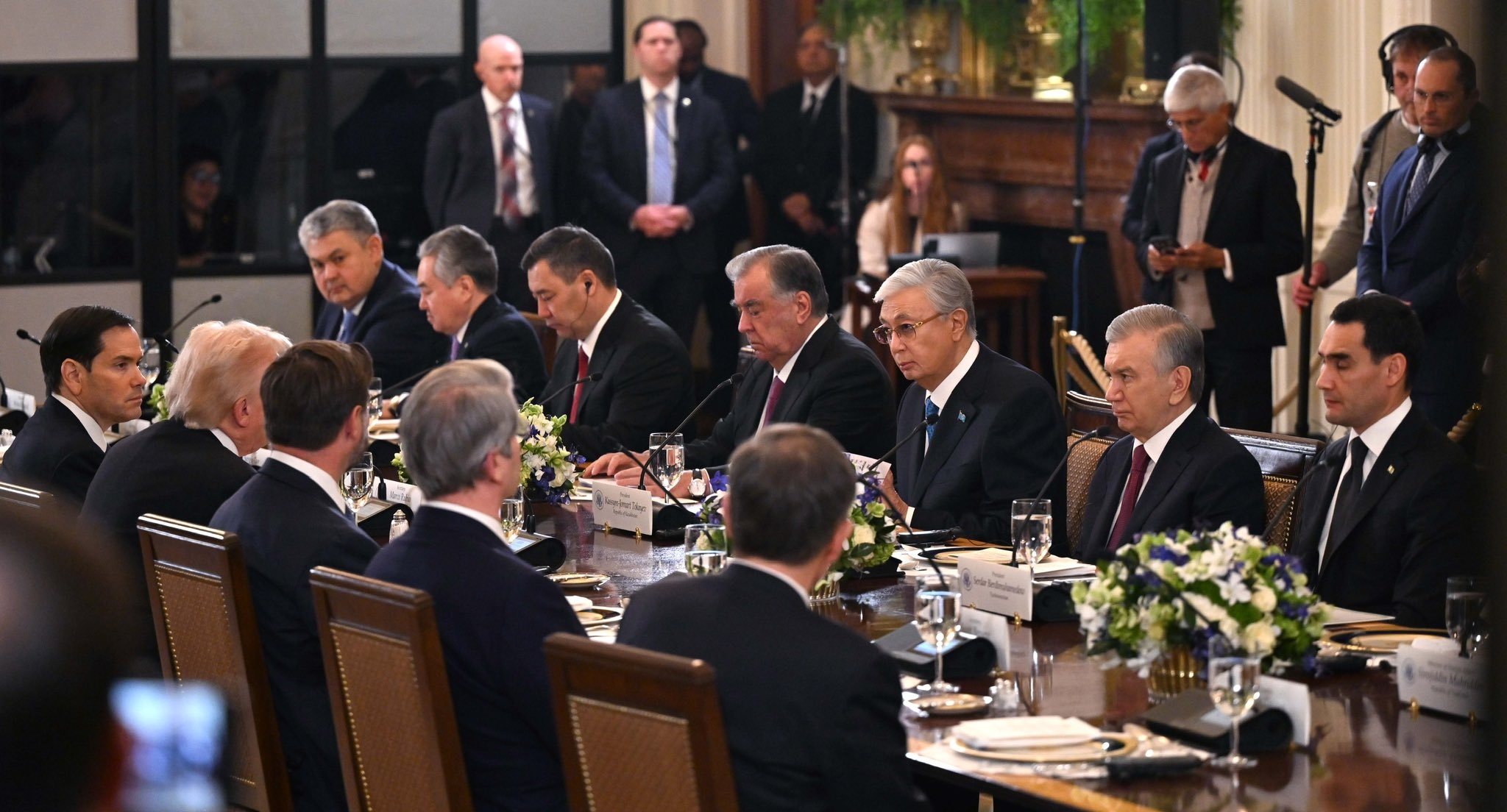
Central Asian leaders meet with US President Donald Trump at the White House on November 6, 2025. (Photo: president.kz)
On Nov. 6, U.S. President Donald Trump hosted a C5+1 (Emerging U.S.-Central Asia Partnership) Summit in Washington. Departing from earlier sessions that were largely symbolic, this meeting centered on orders and investment agreements from the Central Asian states totaling $34 billion.
In this context, the United States fused economic cooperation with strategic resource initiatives into an expansive form of transactional diplomacy, while updating its list of critical minerals and elevating resource security, artificial intelligence and national competitiveness as core strategic pillars.
The Trump administration sought to deploy economic instruments to reassert U.S. influence across the Eurasian landmass. For the five Central Asian countries, the summit represented an effort to pursue strategic autonomy amid intensifying geopolitical competition. Yet a deeper question remains: Can Trump’s approach materially reshape the Eurasian balance of power?
For decades, U.S. policy toward Central Asia has exhibited marked opportunism, with Washington’s strategic commitment rising and falling alongside shifts in the international system and evolving security priorities. After the Soviet collapse, the United States was among the first to recognize the independence of the five Central Asian republics. Initial engagement focused on energy cooperation and the promotion of democracy and market reform; U.S. energy majors such as Chevron and ExxonMobil became key investors in Kazakhstan.
The attacks of Sept. 11, 2001, altered this trajectory by introducing security cooperation into the bilateral agenda and enabling the U.S. to establish military and logistical facilities in Uzbekistan and Kyrgyzstan. The involvement, however, proved short-lived. As U.S.-Russia relations deteriorated and American policy toward Afghanistan evolved, Washington gradually withdrew its bases and, in 2015, launched the C5+1 dialogue mechanism, whose agenda later expanded to environmental and social issues.
Substantive cooperation nonetheless remained limited outside the energy sector. Even the U.S. Strategy for Central Asia 2019-25, issued in Trump’s first term, was constrained by domestic political pressures and the dispersion of U.S. diplomatic resources. The limitations of this opportunistic posture became evident once again during the 2020 Nagorno-Karabakh conflict, when the United States—although a co-chair of the OSCE Minsk Group—opted for minimal involvement, thus allowing Russia to dominate conflict resolution.
Confronted with limited progress on the Ukraine crisis, pressure from the midterm elections and diminishing advantages on the domestic economic agenda, the Trump administration sought new diplomatic openings. Revitalizing the C5+1 mechanism offered a low-cost means of enhancing U.S. visibility in Central Asia, signaling pressure on Russia and diluting its traditional regional influence and encouraging Central Asian governments to procure U.S. goods and services in support of Trump’s economic platform. To this end, Trump urged Congress to repeal the Jackson-Vanik Amendment with respect to Central Asia to facilitate expanded trade and technological cooperation.
Critical minerals and connectivity initiatives form the twin pillars of Trump’s transactional diplomacy. According to the U.S. Geological Survey, Central Asia possesses substantial deposits of key minerals, including chromium, beryllium, uranium, titanium (ilmenite) and rare earth elements. At the summit, Cove Capital announced a $1.1 billion investment in tungsten development; Uzbekistan signed $400 million in critical-mineral agreements and opened rare-earth joint development rights. These moves aim to mitigate China’s dominance in global critical-mineral supply chains. China currently accounts for more than 80 percent of global tungsten concentrate production, while Kazakhstan’s proven tungsten reserves ensure roughly four decades of commercially viable extraction.
At the same time, Washington views Central Asia as a critical node in trans-Eurasian connectivity and seeks to assist regional efforts to build multidimensional links to global markets. Concrete measures span several sectors: upgrading Kazakhstan’s air-traffic management through Leidos; a $4.2 billion locomotive deal between Wabtec and Kazakhstan; progress on an open skies air transport agreement with Kyrgyzstan; potential U.S. participation in Turkmenistan’s Trans-Caspian gas pipeline; the promotion of Starlink deployment across Central Asia; and the establishment of an AI innovation center in Kazakhstan. Combined with Armenia’s earlier authorization of U.S. monitoring and oversight of the Zangezur Corridor, these developments suggest that the Trump administration is attempting to revive the long-discussed Greater Central Asia Strategy.
Zbigniew Brzezinski’s “grand chessboard” framework holds that the short-term objective of U.S. policy in Eurasia is to maintain regional pluralism, while the long-term aim is to safeguard American primacy. Trump’s transactional diplomacy constitutes the most recent—and arguably the most pragmatic—effort to operationalize elements of this vision by employing economic leverage to reengage the Eurasian strategic landscape. Although the 2025 C5+1 Summit introduced new modalities of cooperation, attributing any far-reaching strategic significance to it would be premature.
The Eurasian balance of power has not undergone substantive change for two principal reasons. First, the five Central Asian states have yet to form a coherent strategic alignment capable of advancing U.S. geopolitical objectives. Second, Washington has not offered the security guarantees required to support deeper strategic commitments. Russia continues to dominate the regional security architecture, and in the absence of a credible security framework, Central Asian states are unlikely to risk their geopolitical relationships with China and Russia in exchange for U.S. economic incentives.
Consequently, while Trump’s transactional diplomacy has broadened U.S.-Central Asia engagement, its depth and structural impact on regional geopolitics remain constrained. Achieving even the near-term Eurasian objectives envisioned by Brzezinski will require sustained engagement, and the strategic yield of Trump’s policy will ultimately depend on the region’s geopolitical realities.
