
The world has entered a period of wrecking-ball politics. Leaders have risen to prominence by promising sweeping demolition rather than careful reform. They seek to tear down rules and institutions at home and abroad, which they falsely claim hinder both their efforts to build stronger, more prosperous countries as well as to prevent “civilizational decline.”
But these sentiments are not confined to a small group of radical actors. Today’s disruptive agendas are built on widespread disillusion with democratic institutions and a pervasive loss of trust in policymakers’ ability to make meaningful course corrections.
In a survey for the Munich Security Conference 2026, only a tiny share of respondents in the G7 countries say that their current government’s policies will make future generations better off. In France, Germany, and the United Kingdom, absolute majorities believe the opposite: that future generations will be worse off under the current policy trajectory.
Both domestically and globally, established political structures are now often perceived as overly bureaucratized and judicialized; these ossified systems, the thinking goes, cannot be adapted to meet people’s needs. In this new climate, those who employ bulldozers and chainsaws are increasingly tolerated – and sometimes celebrated.
Chief among those promising to free their countries from the existing order’s constraints is US President Donald Trump. His administration’s “recalibration” of US foreign policy targets all three sides of the “Kantian triangle” of peace, around which the country’s grand strategy revolved for more than 80 years. These include a commitment to multilateral institutions and rules; support for an open international order and economic interdependence; and investment in democracy, human rights, and cooperation among the world’s liberal democracies.
As a result, leaders who have sought to dismantle the liberal international order, like Russian President Vladimir Putin, are now joined by the US, long its staunchest defender. The US-led global-governance system, which was at the heart of the postwar Pax Americana, is now being undermined and hollowed out from within.
For some of Trump’s supporters, his disruptive politics offers an opportunity to build something better. In line with what Joseph Schumpeter famously described as “creative destruction,” they believe that meaningful change requires fundamental disruption, not incremental adjustments.
From this perspective, the “Trump shock” to the global order and traditional partnerships could break institutional inertia and compel policymakers to address challenges previously mired in gridlock. The breakthroughs on NATO defense-spending targets and a ceasefire between Israel and Hamas are presented as evidence that Trumpian “creative destruction” is already yielding positive results.
But it is unclear whether demolition is really clearing the ground for institutions and policies that will strengthen security, increase prosperity, and ensure freedom. Instead, what seems to be emerging from the rubble is an order that privileges the powerful over the weak, who had hoped that the destruction of the old would bring much-needed improvements to their lives.
Transactional (and often self-enriching) deals are rapidly replacing principled cooperation; policymakers are increasingly serving private, not public, interests; and great-power dominance is superseding international governance by rules and norms. No wonder, then, that in all the countries surveyed for the Munich Security Index 2026, the downsides of wrecking-ball politics dominate public perceptions – even in Global South countries, many of which initially greeted a second Trump term with optimism.
For example, in all countries surveyed, except China and India, absolute majorities disagree that Trump’s policies are good for the world or their country. In China and India, pluralities disagree.
While America’s immense power means that foreign-policy recalibration will have global repercussions, the rest of the world is not powerless to resist a full-scale policy of destruction. But those opposed to a future defined by the great-power politics of the past must step up now. Containing the worst consequences demands a coalition of the willing to invest significantly in their own power resources and pool them through closer cooperation.
But resisting the Trump administration’s destructive politics is not enough. Governments must credibly demonstrate that meaningful reforms and political course corrections are possible – and much more likely than a policy of widespread destruction to satisfy growing demands for broad improvements in social and economic conditions. That will require policymakers to devise new, more sustainable priorities, hone their tools, and become bolder builders themselves.
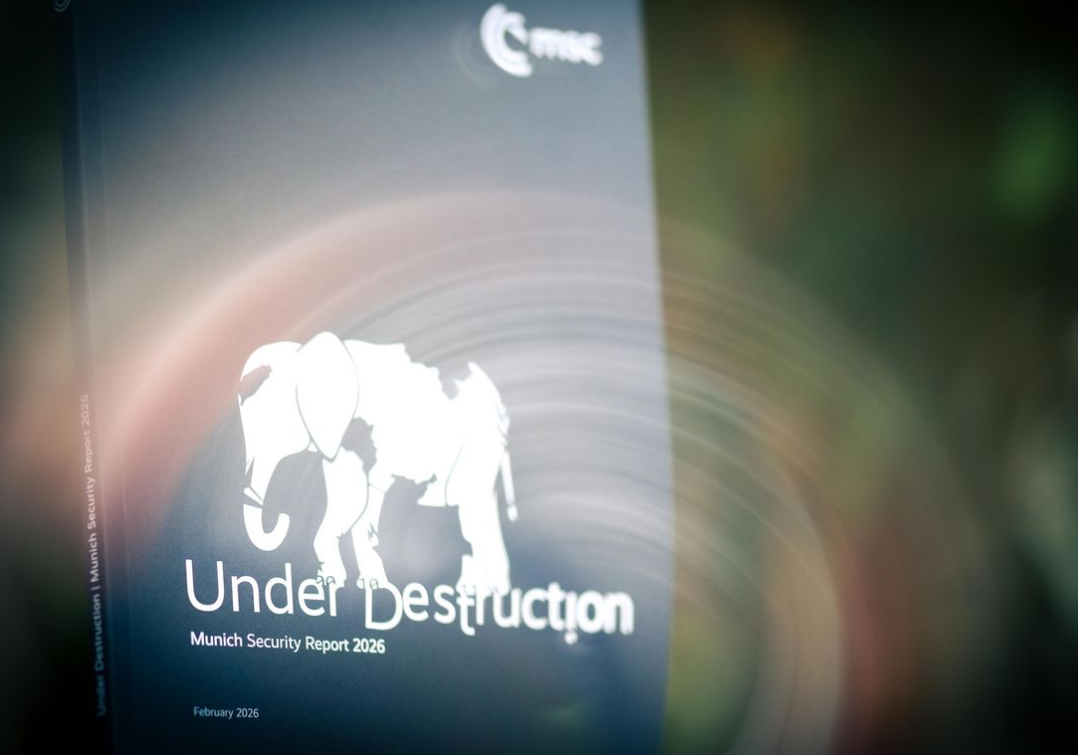
This commentary is based on the introductory essay of the Munich Security Report 2026.
Copyright: Project Syndicate, 2026.
www.project-syndicate.org
