
Trump cannot easily replicate his muscular intervention in South America because conditions are far different. But the methods that appeared effective in Venezuela are ill-suited to a territory that is deeply embedded in alliance politics and the international legal order.
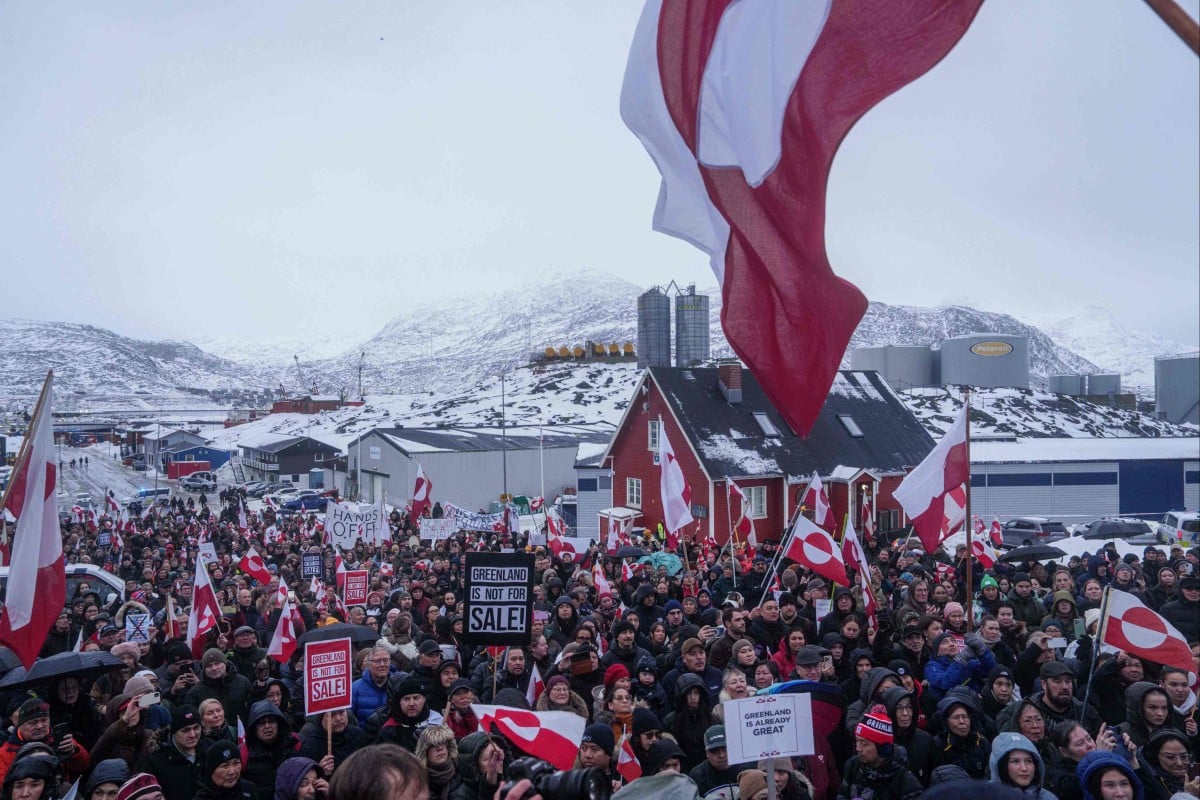
People protest against Donald Trump’s policy on Greenland in front of the U.S. consulate in Nuuk, Greenland, on Saturday, January 17, 2026. (Photo: AP)
In recent weeks, U.S. President Donald Trump publicly renewed his long-standing fixation on Greenland by speaking bluntly about the possibility of bringing the giant island under U.S. control. His rhetoric ranged from renewed talk of “purchasing” Greenland to veiled threats of coercion, even suggesting that U.S. security imperatives could justify extraordinary measures. His tone inevitably invited comparisons with Washington’s recent and highly controversial intervention in Venezuela—an operation that Trump and his supporters describe as swift, decisive and strategically effective.
Under Trump’s logic, there are three potential pathways for “acquiring” Greenland: The first is a military intervention and an extreme scenario; the second is to obtain control through a “purchase”; and the third is to gradually expand U.S. influence by shaping political preferences on the island through economic and political means. In practice, the first two options are close to unworkable, while the strategic patience and investment of resources required for the third may be beyond Trump’s grasp.
Military seizure: Technically feasible, strategically catastrophic
From a purely military standpoint, the United States would face no insurmountable technical obstacle in “taking” Greenland from Denmark. The U.S. military already has a significant presence on the island, including Thule Air Base in the western part of island, which has been in place since 1943. Currently, around 650 personnel are stationed there. The power imbalance between the U.S. and Denmark is stark, and Greenland is geographically closer to North America than it is to Europe. However, such calculations overlook a decisive constraint: Unlike Venezuela, Greenland is protected under NATO’s collective defense framework, and any use of force against Danish sovereignty would inevitably trigger Article 5 of the North Atlantic Treaty.
If NATO’s most powerful member were to employ military force against another member, the alliance’s credibility—including the shared understanding that security guarantees are reciprocal and non-negotiable—would collapse instantly. If the principle of collective defense were selectively applied for political convenience, the very foundation of NATO’s existence would unravel, leading to a potential collapse of the alliance.
Denmark has repeatedly made clear that any unilateral attempt by Trump to alter Greenland’s status would be seen as a flagrant violation of core alliance principles. Nordic countries and major EU members have also issued statements affirming their support for Danish sovereignty. Under these circumstances, a military seizure would not be a realistic policy option for Washington. It would be a doomsday scenario whose damage to U.S. hegemony—even within the Western Hemisphere—would far outweigh any strategic gains Greenland itself might offer.
This concern is not absent within the Trump administration or the Republican Party. Secretary of State Marco Rubio, for example, reportedly said in closed-door congressional briefings that recent U.S. threats regarding Greenland were intended to facilitate a purchase from Denmark—an apparent effort to reassure skeptics alarmed by the military implications.

“Buying” Greenland won’t work
The idea of buying Greenland reflects a deeply transactional worldview in which territory is treated as a commodity—akin to infrastructure or real estate—exchangeable through money and leverage. This logic fundamentally misreads Greenland’s political reality. Greenland is not an overseas asset that Denmark can dispose of at will; it is a political community with its own parliament, government, and a high degree of internal self-rule. Any non-military transfer of sovereignty would require not only Danish consent but also the explicit approval of the Greenlandic population.
Polling consistently shows that only about 15 percent of Greenland’s residents support joining the U.S., while an overwhelming majority oppose any form of U.S. annexation or purchase. In other words, there is no social or political foundation within Greenland for a forced external change of political affiliation. Any attempt to bypass public opinion and complete a sovereignty transfer through elite-level bargaining is therefore not politically viable. More important, within the European political context, the very notion of “selling sovereignty” would violate a postwar taboo.
For European states—especially small and medium-sized ones—non-transferable sovereignty is not an abstract legal principle but an institutional safeguard against domination by great powers. While Trump has openly stated that he does not feel bound by international law, forcibly acquiring the world’s largest island—roughly 2.2 million square kilometers (comparably six times the size of Germany), particularly when it belongs to a NATO ally and close partner, would set a precedent with consequences far beyond Greenland itself. Such a precedent would undermine the political legitimacy of the European state system as a whole.
Decoupling from Denmark
Given that both the purchase and military options are fraught with unacceptable risks, the most realistic U.S. approach, without resorting to overt force, lies in gradually weakening Greenland’s political and economic ties with Denmark while deepening its dependence on the United States. The U.S. military presence in Greenland expanded, with troop levels rising nearly sixfold. Moving forward, Washington may seek arrangements resembling a “free association” framework that formally preserves Danish sovereignty while granting the U.S. far greater control over defense, infrastructure and key decision-making processes.
Considering Greenland’s underdeveloped infrastructure and its vitality, economic leverage could play a critical role. By expanding investment, dominating infrastructure development and positioning itself as Greenland’s indispensable economic partner, the U.S. could gradually reshape local interest structures. Simultaneously, Washington may support political forces on the island that advocate leaving Denmark and moving toward independence, framing the process as one of self-determination rather than external control.
Reports suggest that Trump hopes to secure effective control over Greenland before July 4—America’s 250th anniversary—and tout it as a major achievement to leverage in the midterm elections. However, such an incremental strategy is inherently slow and uncertain. This conflicts with Trump’s preference for rapid, highly visible political wins. Even if sovereignty were to remain formally ambiguous, this outcome would still fall short of the decisive results Trump prefers.
Greenland as element of “Monroe Doctrine”
There is little doubt that the Greenland issue represents a natural extension of Trump’s broader strategic worldview. Geographically, Greenland belongs to North America. It is adjacent to Canada and separated only by the narrow Nares Strait. From Washington’s perspective, it fits neatly into a strategy of consolidating control over the Western Hemisphere. Ideally, control of Greenland would allow the U.S. to construct an unsinkable Arctic outpost, integrating early-warning, missile-defense, and undersea defense systems. It would also enable effective deterrence regarding both the northeast and northwest Arctic passages, while securing access to critical resources, including rare earth minerals. This multiplicity of objectives explains Washington’s interest—but it also underscores why Greenland differs fundamentally from Venezuela.
Trump has repeatedly justified his Greenland ambitions by invoking the need to counter China and Russia, yet this argument is weak at a factual level. As a geographically “near-Arctic” state and a stakeholder in Arctic affairs, China participates in the region on the basis of respect, cooperation, mutual benefit and sustainability. Its activities are conducted in accordance with the UN Charter, the UN Convention on the Law of the Sea (UNCLOS), the Spitsbergen Treaty and general international law. China’s Arctic engagement is led by scientific research and exploration and supplemented by limited cooperation on shipping routes and energy development through bilateral, multilateral and institutional frameworks, such as the International Arctic Science Committee (IASC) and the Arctic Council. It involves no military presence or deployment, and nearly all of China’s activities are geographically distant from Greenland.
More important, Danish Prime Minister Mette Frederiksen has publicly stated that so long as sovereignty is not implicated, Denmark is willing to accommodate all reasonable U.S. security and cooperation requests—yet these assurances appear to have reportedly been rejected by Trump. This suggests that claims of a “China threat” or urgent security needs are largely pretexts.
The underlying objective is far more consistent with the logic of an imperial-style territorial expansion by the U.S. in pursuit of uncontested dominance over the Western Hemisphere. In contrast, the quick victory in Venezuela was possible precisely because it did not implicate alliance obligations or core rules. Greenland presents exactly the opposite case. Any abrupt or coercive move would immediately reverberate through NATO, shaking international law and the broader U.S. alliance network.
Undeniably, faced with Trump’s blunt and forceful demands attacking Greenland’s sovereignty, Denmark is clearly at a disadvantage geopolitically and militarily. This imbalance may compel Copenhagen to make substantive concessions on issues Washington prioritizes—such as expanding the U.S. military footprint, granting preferential access to mineral resources or loosening control over certain administrative authorities.
Denmark’s most credible counterbalance lies in Europe as a whole. By leveraging EU-level economic and diplomatic tools—including a threat to sever the security relationship with the U.S. or closing U.S. military bases in Europe—Copenhagen may still influence Trump and his core advisers by highlighting the risks of overconfidence fueled by the Venezuela episode, as well as by the long-term strategic costs such an approach could entail.
Ambition meets structural limits
The Greenland question exposes both the ambition and the limitations of Trumpism. The island’s geopolitical value is undeniable, but the methods that appeared effective in Venezuela are ill-suited to a territory that is deeply embedded in alliance politics and the international legal order. Greenland cannot be seized quickly without destroying NATO, nor can it be purchased cheaply without undermining the political foundations of the transatlantic relationship. A gradual, salami-slicing political process that turns Greenland into a de facto U.S. protectorate or trusteeship would require considerable time and carry profound uncertainty. For now, the issue remains a strategic dilemma with no easy resolution.
