

Observers of Chinese elite politics routinely prioritize Beijing as the primary focus of analysis, searching for clues about leadership changes in the limited information coming from the center. Yet critical insights worthy of attention are not exclusively concentrated in Zhongnanhai. A substantial share of early indicators often initially emerges within the leaderships of China’s 31 provincial-level administrations.
Provincial party standing committee members constitute the apex of provincial decision-making authority, with provincial chiefs (the provincial party secretaries and heads of provincial-level governments) forming its leadership core. In this regard, empirical studies of Chinese politics point to a persistent recruitment pathway in which high-ranking leaders with provincial experience are continually selected for promotion to national office, a pattern that shows why provincial leadership experience functions as both a qualification for and a steppingstone to higher office, and why it deserves close attention. Understanding the composition of provincial party standing committees offers an early vantage point for forecasting the next national reshuffle.
Focusing on Provincial Party Standing Committee
The empirical data of this analysis are drawn partially from the “China-US Leadership at a Glance” database and verifiable official sources on Chinese leadership appointments. [1]Across the 31 provincial-level administrations, the current party standing committees contain a total of 350 incumbents including 31 party secretaries, 31 heads of provincial-level governments concurrently serving as deputy party secretaries, 26 second-ranking deputy party secretaries, and 262 other provincial standing committee members (see Table 1).
Behind these figures lies a standardized hierarchy. Each provincial-level administration has one party secretary and (normally) two deputy party secretaries, one of whom concurrently holds a position as the head of the provincial-level government, and a second-ranking deputy. Additional deputies may be authorized in certain ethnic autonomous regions, as reflected in Xinjiang and Xizang, which currently have three deputies each. The remaining standing committee members oversee major functional or territorial (municipal) portfolios, with regulations generally setting total committee membership at 11 to 13. The number of provincial standing committee members in ethnic autonomous regions is more flexible, such as in Xinjiang where there are currently 14 members.
Table 1: Composition of 31 provincial-level administrations
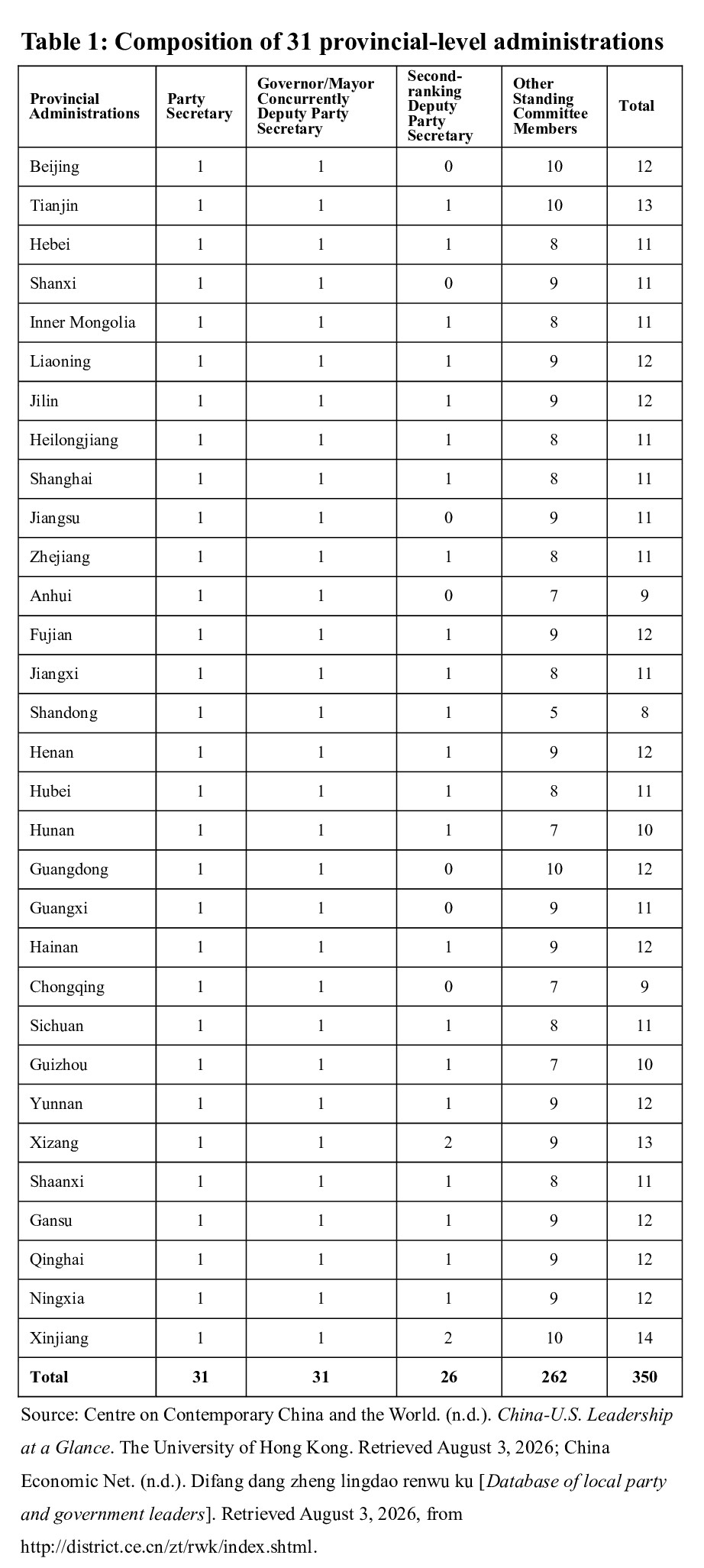
Although this provincial party standing committee structure is standardized, Table 1 shows that it is not fully staffed in every administration at this moment. All 31 provincial-level administrations have both a party secretary and a head of government in office at present, but staffing below the apex remains uneven. Beijing, Shanxi, Jiangsu, Anhui, Guangdong, Guangxi, and Chongqing currently lack a second-ranking deputy party secretary, while Anhui, Shandong, Hunan, Chongqing, and Guizhou have fewer than 11 incumbent standing committee members.
These staffing gaps will not necessarily be filled simultaneously. Each provincial-level administration follows its own party congress calendar: some incoming elites may take up their positions through early appointments, while other vacancies may remain open until the concentrated round of provincial leadership reshuffles begins in the fall of 2026 and extends into 2027.
Beyond identifying immediate vacancies, the figures also reveal a promotion hierarchy that narrows progressively toward the top. Because most of the non-chief standing committee members are still young enough to remain in contention for advancement, the pool of eligible candidates is large. However, the scarcity of senior posts means that only a small proportion can move upward. Promotion therefore involves competition for progressively fewer positions.
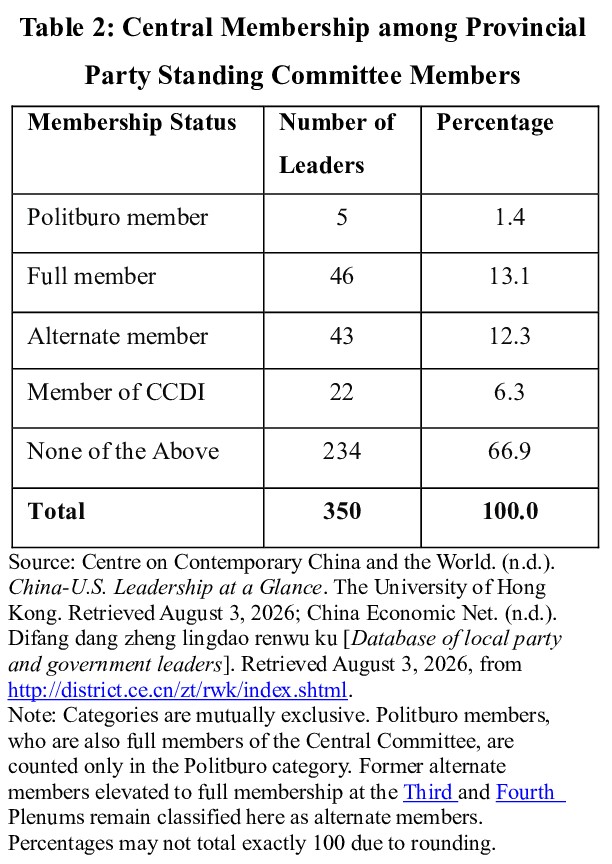
Apart from illustrating the competition for senior provincial posts, the composition of this cohort also reveals the substantial presence of provincial officials within the Party’s top national leadership bodies. As Table 2 shows, five provincial chiefs serve on the Politburo, while 46 incumbents are full members of the Central Committee, 43 are alternate members, and 22 are members of the Central Commission for Discipline Inspection (CCDI). Together, these categories encompass 116 of the 350 provincial standing committee members, or approximately one-third of the cohort. This is especially pronounced at the apex of the provincial leadership: in addition to the five chiefs who serve on the Politburo, most provincial chiefs are full members of the Central Committee. This current distribution continues a long-standing pattern in which senior provincial officeholders have occupied a prominent place in the Party’s national leadership bodies.
These concurrent roles give provincial leaders a formal presence in political affairs at the center. Their dual positioning brings the governing of major territorial administrations into central deliberations over national priorities, central–local coordination, and disciplinary oversight. Provincial personnel changes consequently matter beyond the jurisdictions immediately affected.
Table 2: Central Membership among Provincial Party Standing Committee Members
Age Limit and Generational Turnover
Age norms governing provincial political careers combine formal retirement boundaries with informal conventions. The cadre retirement regulation stipulates that officials at full provincial rank should generally not serve beyond 65, while those at deputy provincial rank should generally not serve beyond 60, although age 63 sometimes functions as an upper boundary in practice for the latter. Public accounts of earlier reshuffles also identify pre-retirement promotion thresholds of approximately 63 for provincial chiefs and 58 for most vice governors and other standing committee members. Reaching these thresholds did not require immediate retirement, but it generally reduced an elite’s likelihood of receiving a further promotion before approaching the formal retirement boundary. The interaction between these formal rules and informal norms at full provincial rank is sometimes summarized by an unofficial but instructive formula: “62 to rise, 63 to remain, 64 to make way, and 65 to retire.” (62能升任,63能连任,64不留任,65必退任).
Yet the implementation of this formula should not be mistaken for determinism. Recent personnel reforms have sought to correct the “age-only” tendency in cadre selection. These reforms did not make age irrelevant or abolish retirement limits; rather, they discouraged treating age as the sole and overriding criterion for appointment. Age thresholds should therefore be understood as reference lines that help identify likely promotion windows and time points of exit but cannot, by themselves, determine individual outcomes.
Chart 1 shows the generational lineup across the four categories and reveals a clear age difference between the two tiers. Among the 62 provincial chiefs, most were born between 1955 and 1964. Party secretaries are generally older: 77.4 percent were born between 1960 and 1964, whereas governors are distributed more broadly across the 1960–1964 and 1965–1969 cohorts, accounting for 48.4 percent and 38.7 percent, respectively. The lower tier is younger: 65.4 percent of second-ranking deputy party secretaries and 54.2 percent of other standing committee members were born between 1965 and 1969. Another 30.8 percent and 35.5 percent, respectively, were born between 1970 and 1974. The post-1975 cohort has only begun to enter this tier.
Chart 1: Provincial Chiefs and Provincial Standing Committee Members by Age and Birth Year
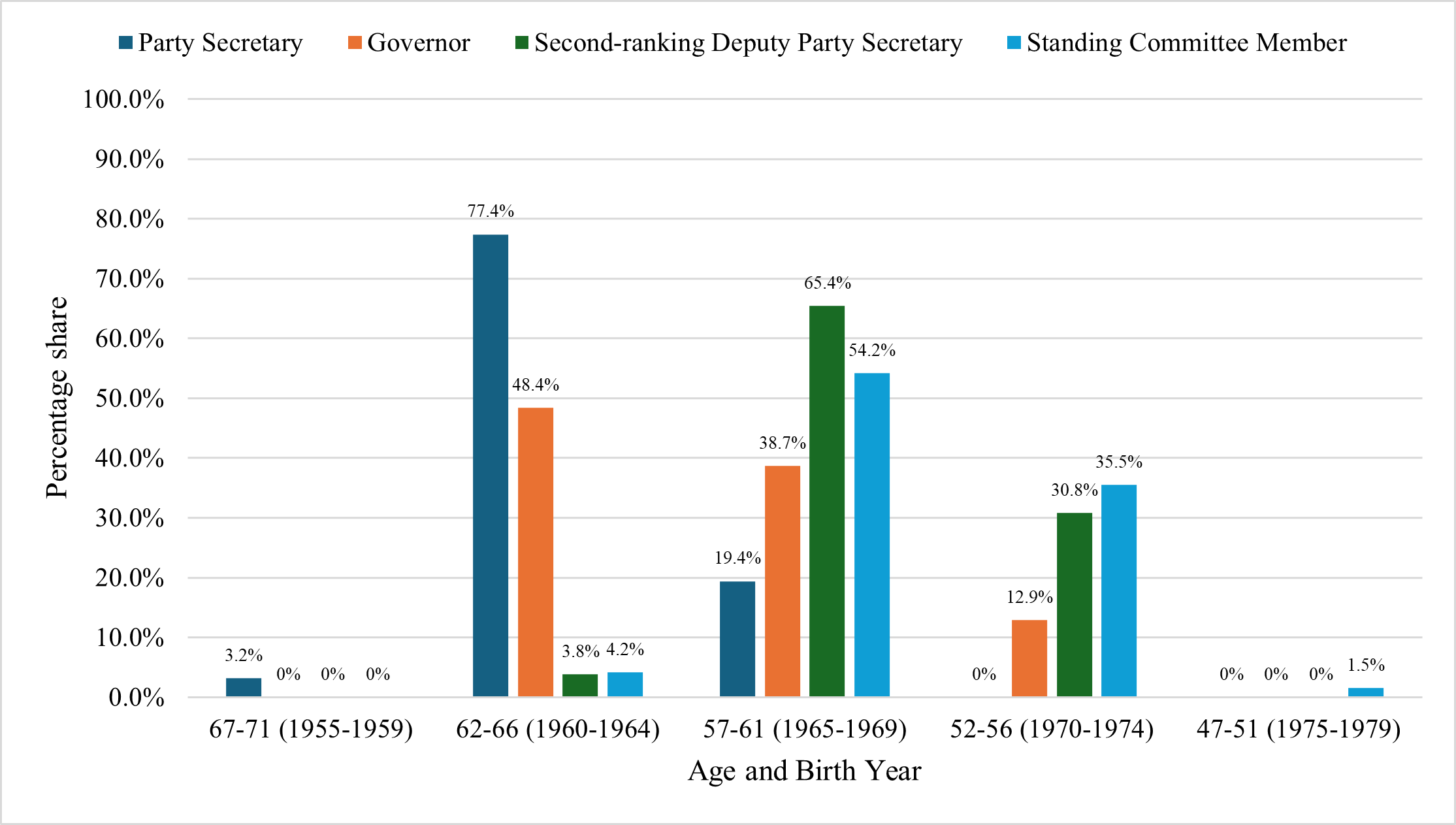
Source: Centre on Contemporary China and the World. (n.d.). China-U.S. Leadership at a Glance. The University of Hong Kong. Retrieved August 3, 2026. Note: 12 provincial standing committee members’ ages are unknown.
Viewed collectively, these distributions reveal a tiered structure of generational renewal. Provincial chiefs are concentrated in the 1955–1964 cohort, while provincial party standing committees are dominated by officials born between 1965 and 1974.
The implications of this structure become clearer when looking ahead to the personnel reshuffles in the year preceding the 21st Party Congress. The paths of provincial chiefs born in the early 1960s will diverge: a few may remain or move into more senior positions in the Politburo or Secretariat, or as state councilors, while others may be reassigned to ceremonial roles upon reaching retirement thresholds. At the same time, the cohort of provincial standing committee members born between 1965 and 1974 is likely to produce the next provincial chiefs, ministers, and vice ministers in the national leadership. A significant number will join the next 350-plus-member Central Committee.
These divergent paths illustrate how age operates within the provincial leadership as both an exit mechanism and a measure of future opportunity, creating two clocks that run simultaneously.
Final Thoughts
Provincial leadership forms the administrative foundation of high-level politics and a primary recruitment ground for national office. By mapping the hierarchy and composition of the current provincial leadership, this study establishes an essential empirical baseline for tracing the leadership cohort taking shape as the CCP prepares for the 21st Party Congress. Its findings show how a narrowing provincial hierarchy and generational turnover shape where vacancies are likely to emerge and which cohorts are positioned to compete for provincial and central advancement.
The coming provincial party committee reshuffles can now be assessed against this baseline as early indications of Beijing’s preparations for the next major central reshuffle. The resulting pattern of advancement and exit will reveal how the central leadership manages and renews its recruitment pool. Will these reshuffles reaffirm established patterns of elite advancement, or reveal a broader recalibration of the age conventions and promotion pathways toward central office? The answer will indicate whether the coming turnover represents routine elite circulation or a deeper change in how China’s central recruitment pool is constituted in the next major round of national leadership change.
[1] Because official personnel arrangements remain fluid, with ongoing promotions and reshuffles, the dataset is current as of August 3, 2026.
