

“All politics,” as the familiar English saying goes, “is local.” For Chinese political elites, however, locality carries two distinct meanings: the jurisdiction in which political authority is exercised, and the geographic origins of the political elites who exercise it. In contemporary China, the frequent gap between where officials are from and where they serve has long drawn public and scholarly interest. Two main questions are commonly raised: How often do officials’ places of origin overlap with the jurisdictions in which they serve? And how is regional origin distributed across the national leadership?
Birthplace and place of service represent two distinct yet interrelated geographic dimensions of provincial leadership. Examining whether—and where—they align offers insight into the composition of China’s provincial leadership and the movement of officials across the country. Drawing on a dataset covering all 348 current members of the Party standing committees of China’s 31 provincial-level jurisdictions, this analysis assesses both dimensions. It first compares locally born and non-locally born elites by leadership position and across provincial-level jurisdictions, then focuses on the 62 provincial chiefs: 31 Party secretaries and 31 heads of provincial-level governments whose birthplaces are presented in a ranking table and on a national map.
The 62 provincial chiefs are the focus of this analysis. As the two most senior figures in every jurisdiction, they form the bench from which many future national leaders are drawn. With the 21st Party Congress approaching, their geographic composition is therefore more than a provincial story: it offers clues about the cohort that may soon move onto the national stage.
Governing Away from Home
A longstanding institutional feature of elite recruitment involves two rules: avoidance of serving in one’s native place, and cadre exchange across regions. Avoidance rules address geographic ties—they restrict elites from serving in localities where they were born or with which they have longstanding personal ties. The cadre-exchange regulations require elite transfers across regions and between central and local bodies, particularly after prolonged service in a single locality or hierarchy. Although the two rules differ, official guidance clarifies their common purpose: limiting the influence of localism and strengthening oversight of elites.
Provincial party standing committees bring together elites at several levels of authority. Examining birthplace patterns by rank reveals how birthplace–service alignment varies across the leadership hierarchy. These provincial leaders are divided into four categories in descending order of rank: provincial party secretaries, governors, second-ranking deputy party secretaries, and other standing committee members.
Table 1 presents positional difference in leaders’ birthplace and workplace backgrounds. Among the 62 provincial chiefs, 58 are non-locally born, while 4 are locally born. More specifically, none of the 31 party secretaries are locally born, and the rate of locally born governors is only slightly higher: only four, or 12.9 percent. Of these four, three come from autonomous regions (Guangxi, Xizang, and Xinjiang), and the other from Henan. Historical comparison sharpens the picture: the number of locally born province chiefs has steadily declined from 18 (29 percent) in 2003 to 15 (24.2 percent) in 2008 to 11 (17.7 percent) in 2010. Moreover, none of the current 26 second-ranking deputy party secretaries are locally born. Altogether, 84 of the 88 provincial elites (provincial chiefs party secretaries, governors, and second-ranking deputy party secretaries) or 95.5 percent, are non-locally born.
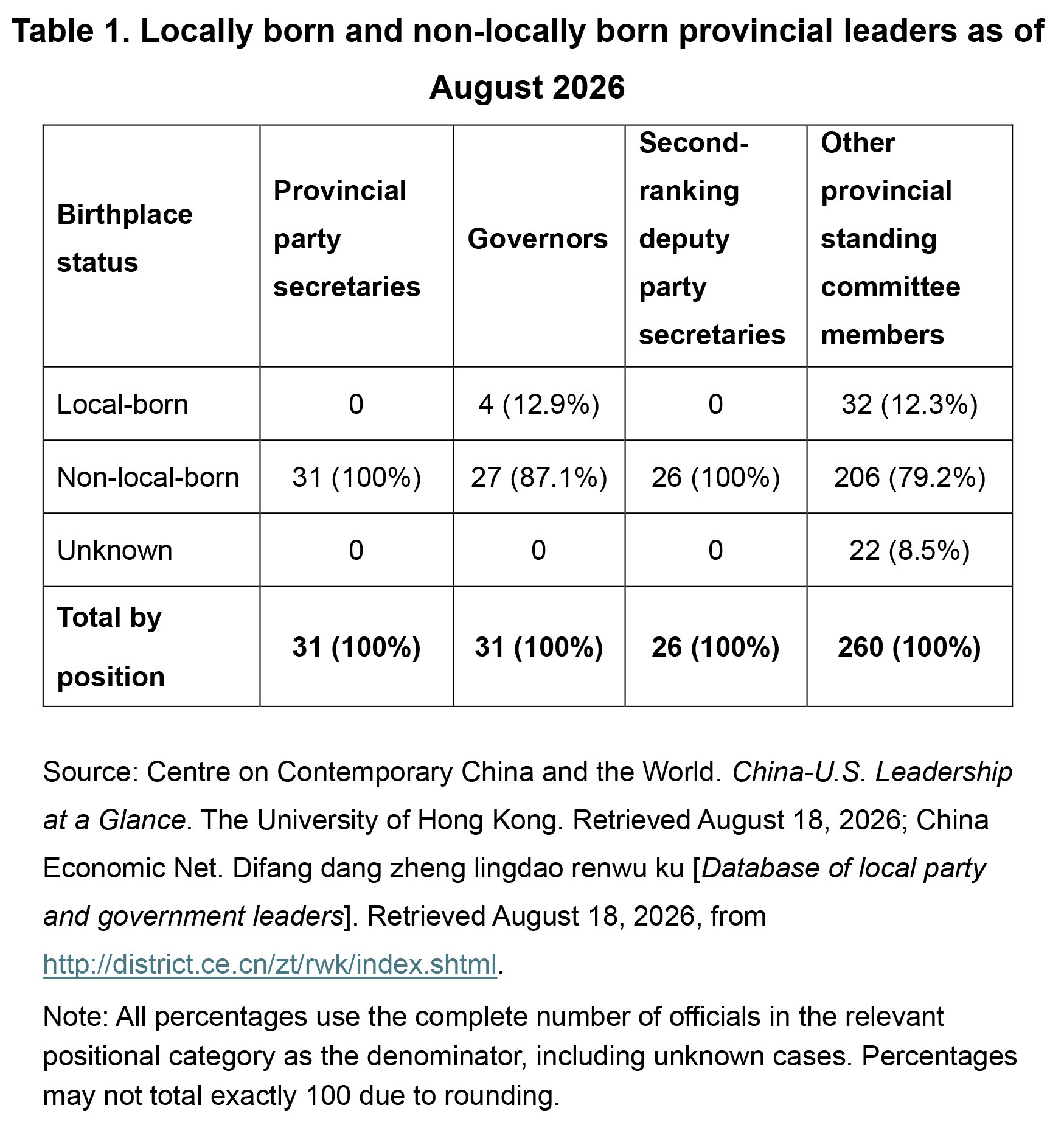
These figures indicate that the current personnel strategy functions to insulate the top tier of provincial power from territorially rooted networks. The avoidance principle restricts the influence of local ties, while cadre exchange makes career advancement contingent on assignments and promotions determined by the center. This patten is significant in a political system that delegates considerable governing authority to the provinces—authority that could otherwise allow for elites to become more responsive to local stakeholders than to their superiors in Beijing.
The composition of the remaining 260 provincial standing committee members is only slightly more varied. Of these officials, 206 (79.2 percent) are non-locally born and 32 (12.3 percent) are locally born, with the birthplace of the rest unrecorded. This is a stark contrast from earlier studies that reported locally born shares of 49.4 percent in 2003 (117 of 237 officials) and 43.5 percent in 2008 (40 of 92) for deputy-rank provincial elites. Although differences in coverage and sampling impede a direct comparison, these findings can provide historical context for today’s notably low local-born representation. The absence of locally born officials among the standing committee members suggests that this form of geographic insulation is no longer reserved for the provincial number one position but now extends to the entire senior provincial leadership tier. The broader message is clear: these elites may govern in the provinces, but their political responsibility—and the career incentives that matter most—remain oriented towards Beijing.
Birthplace Composition Across 31 Provincial-Level Administrations
Table 2 examines geographic distribution, showing how birthplace–service alignments are distributed across the 31 jurisdictions and whether locally born representation is concentrated in a few places or dispersed more broadly. Non-locally born members constitute a majority on every provincial standing committee, a pattern that remains consistent nationwide. The extent of locally born representation nevertheless differs across administrations. Eight provincial standing committees (Heilongjiang, Anhui, Hunan, Guangdong, Hainan, Sichuan, Guizhou, and Gansu) have no locally born members, while another sixteen provincial standing committees have exactly one. Taken together, 24 of the 31 administrations (77 percent) have no more than one identified locally born standing committee member.
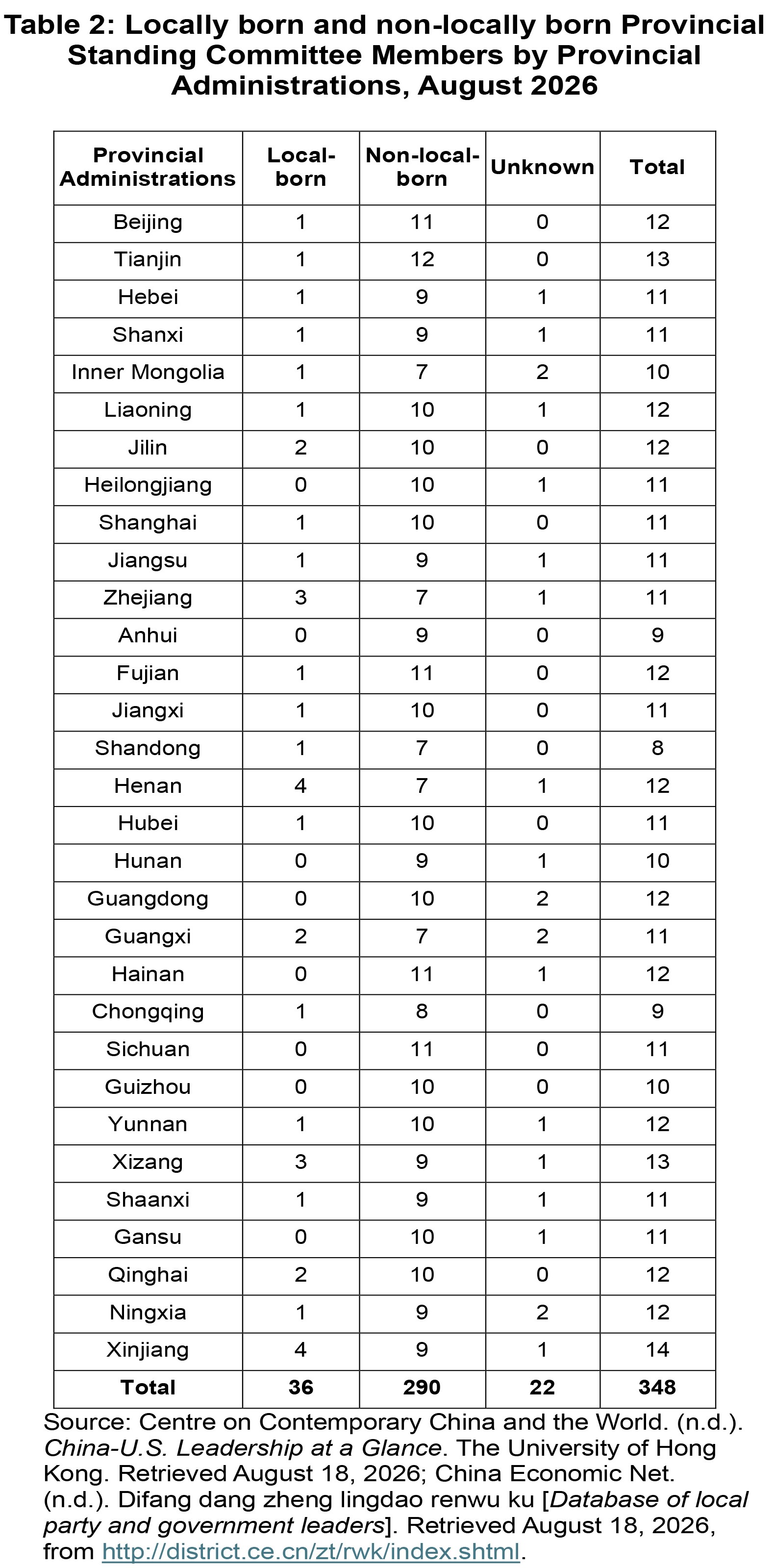
At the other end of the distribution, Henan and Xinjiang each have four locally born members; Zhejiang and Xizang each have three; and Jilin, Guangxi, and Qinghai each have two. Committee size provides important context for these counts: Henan has the largest locally born share, with four of its 12 members, followed by Xinjiang with four out of 14; Zhejiang with three out of 11; and Xizang with three out of 13.
The five provincial-level autonomous regions deserve special attention, since China’s legal framework for regional ethnic autonomy assigns particular weight to adaptation to local conditions. Non-locally born members remain the majority in all five autonomous regions, but with a relatively larger locally born representation than in other administrations: the five regions together have 11 locally born members among 60 total, producing a locally born share of 18.3 percent; by comparison, the other administrations have 25 locally born members among 288, or 8.7 percent.
The difference, however, warrants cautious interpretation. The broader direction of China’s current ethnic policy emphasizes national integration rather than greater political decentralization. The comparatively higher locally born share in autonomous regions should therefore be prudently read as a pattern within a nationally integrated system, in which distinctive regional conditions are addressed through differentiated administrative arrangements, rather than as evidence of greater local autonomy over personnel selection.
Uneven distribution of Birthplaces of Provincial Chiefs
Where provincial chiefs serve is only one part of the picture; the other part concerns the distribution of their birthplaces. Table 3 shows the seven jurisdictions with the largest birth counts: Shandong ranks first with nine chiefs (14.5 percent), Liaoning and Zhejiang follow with eight (12.9 percent) each, while Jiangsu accounts for six (9.7 percent). Fujian, Henan, and Hubei each account for four (6.5 percent). Together, these seven jurisdictions are the birthplaces of 43 (69.4 percent) of the 62 provincial chiefs. The first four—Shandong, Liaoning, Zhejiang, and Jiangsu—alone account for 31 chiefs, exactly half of the cohort.
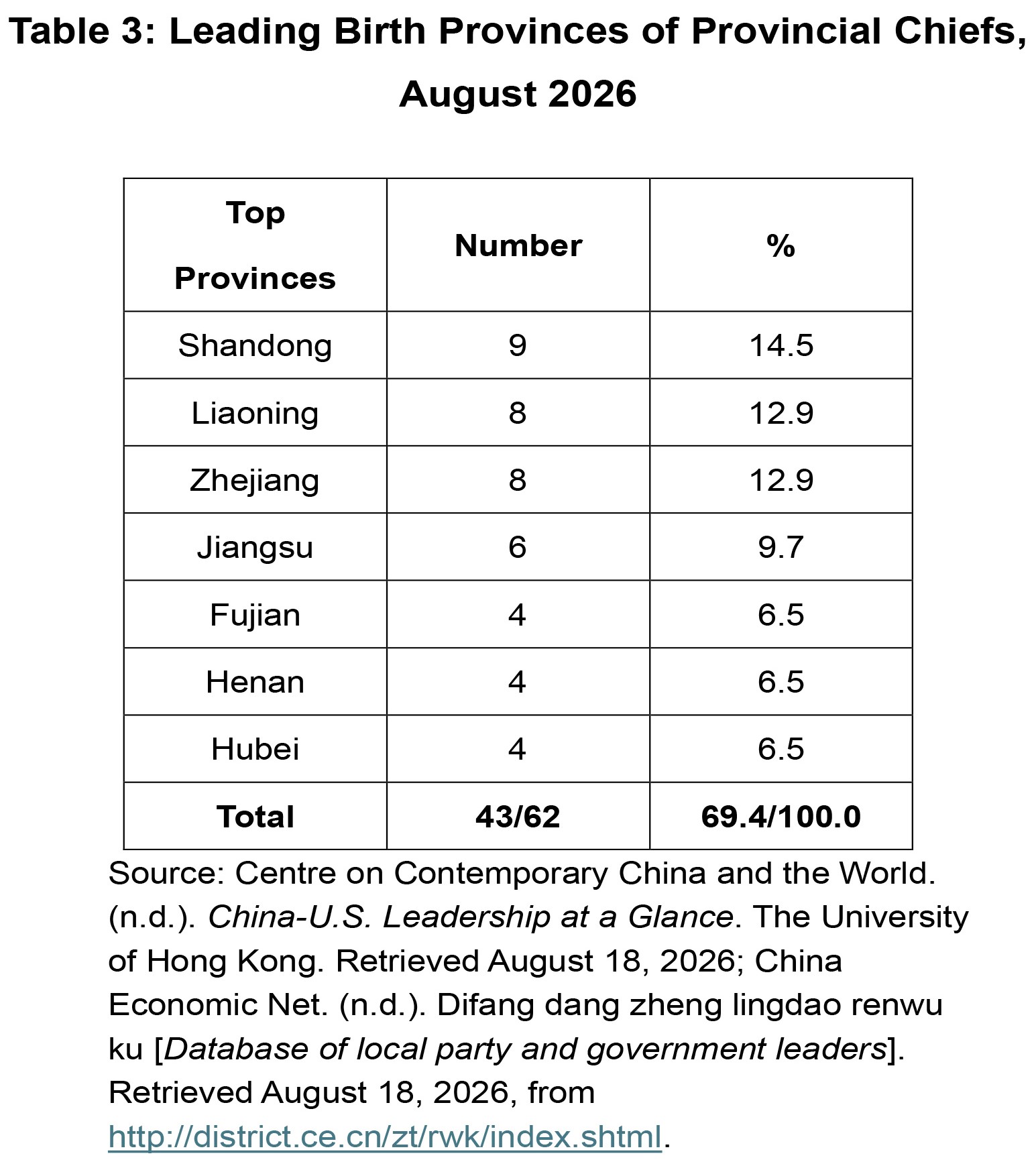
This notable concentration of Eastern China birthplaces is broadly consistent with earlier studies, although the samples represent different periods and leadership groups. A 2010 analysis found that six jurisdictions accounted for 36 of the 62 provincial chiefs at that time. Among them, four eastern jurisdictions—Shandong, Zhejiang, Jiangsu, and Anhui—accounted for 25 chiefs, or 40.3 percent. A 2022 study of the 18th and 19th Central Committees similarly found that eastern birth jurisdictions accounted for 41.9 percent and 42.6 percent of full members, respectively, with Shandong and Jiangsu remaining especially prominent. Nevertheless, the current ranking is not exclusively eastern or coastal. Henan and Hubei, both in central China, each account for four chiefs and appear among the leading seven. Twenty of the 31 provincial-level jurisdictions are represented, while 11, shown in gray, have no representative (See Figure 1).
Figure 1: Birth Province of Provincial Chiefs (N=62), August 2026
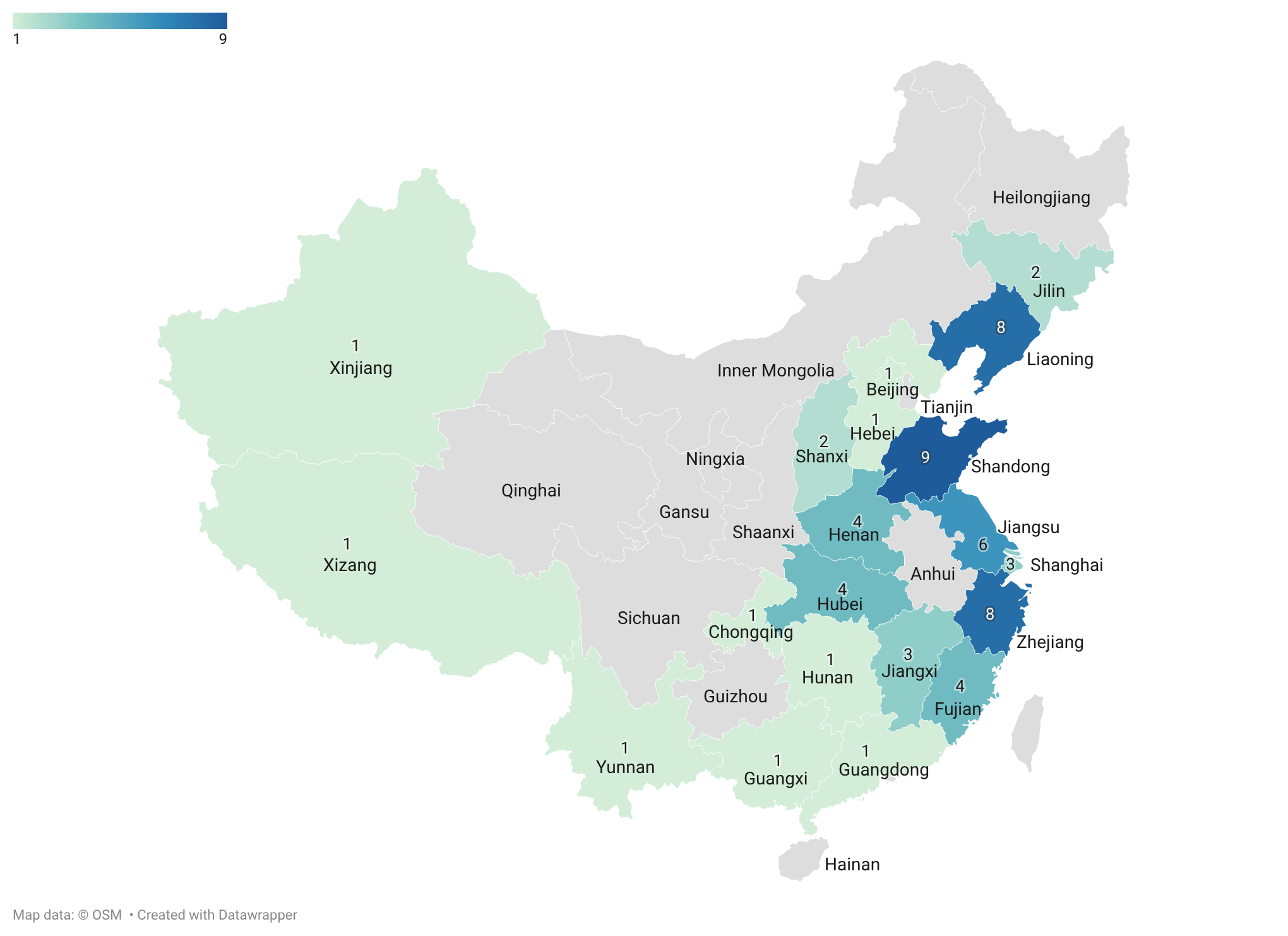
Source: Authors’ dataset. Map data © OpenStreetMap; visualization created with Datawrapper. Note: Gray indicates no incumbent provincial chief born in the jurisdiction.
The map also shows that broad regional labels can conceal considerable internal variation. Eastern China remains the most prominently represented region. The northeastern concentration is driven primarily by Liaoning: Jilin accounts for two chiefs, while Heilongjiang has none. The south is much less prominent, with Guangdong and Guangxi accounting for only one chief each and Hainan none. Inland representation is most visible along a central corridor extending through Shanxi, Henan, Hubei, and Jiangxi. Farther west, the pattern becomes thinner and more dispersed: Chongqing, Yunnan, Xizang, and Xinjiang each account for one chief, while several other western and northwestern jurisdictions have no representative. Thus, while there is an eastern coast concentration, it is accompanied by a geographically broad but numerically limited inland presence.
Earlier research has highlighted several factors that may shape regional birthplace patterns in personnel composition, including local subcultures, historical legacies, education systems, political socialization, economic development, and the influence of individuals. Examining these factors would help explain why certain jurisdictions appear more prominently in the provincial leadership.
Final thoughts
Mapping China’s provincial leadership brings a central pattern into focus. Beijing sends its chiefs away from their home provinces, while also drawing a disproportionate share of them from the eastern coastal corridor. This is where policy priority and political trust appear to converge: these provinces encompass much of the advanced manufacturing, technological innovation, dynamic economic development, and industrial upgrading central to the current leadership’s drive for “new quality productive forces,” while parts of this corridor have also carried significance extending beyond provincial governance and economic administration.
