
China and the Asia-Pacific are projected to out-earn the U.S. within ten years, but that doesn’t mean America is going out of business. Will financial power follow the money?
Asia is on course to become the world’s largest financial-services engine. But the more consequential question is whether that economic shift will translate into a comparable redistribution of global financial power. A new Deloitte report projects that Asia-Pacific could generate up to US$4.8 trillion in financial-services value added by 2035, compared with as much as US$4.3 trillion for the United States. The forecast reflects a broader transformation underway across the region, driven by rising wealth, expanding middle classes, deeper capital markets, technological change and the growing sophistication of Asian financial ecosystems.
The headline figures, however, should not be interpreted as a prediction that Asian financial centres are about to displace Wall Street. Financial influence depends on considerably more than the value generated by banks, insurers and other financial institutions. It rests on the depth and liquidity of capital markets, the international role of currencies, financial infrastructure, institutional credibility and the ability to attract, price and allocate capital across borders. The United States continues to possess extraordinary advantages on each of these dimensions, meaning that Asia-Pacific becoming the largest contributor to financial-services value added would not automatically translate into a corresponding shift in global financial power.
This distinction is particularly important for the China-U.S. relationship. For decades, America's financial influence has been significantly greater than would be suggested by its share of global economic output. The dollar remains the dominant international currency, accounting for roughly 57 percent of global official foreign-exchange reserves at the end of 2025, while the U.S. remains the world's deepest and most liquid financial market. The dollar was also involved in almost 90 percent of global foreign-exchange transactions in April 2025. These advantages create powerful network effects that are difficult for emerging financial centres to replicate, even when their underlying economies are growing rapidly.
Yet the foundations of that financial dominance are being tested by Asia's economic transformation. The region is accumulating wealth at extraordinary speed, creating both a larger pool of savings and a growing demand for sophisticated financial products. Deloitte estimates that more than US$10 trillion of personal wealth will be transferred across generations in Asia-Pacific over the next two decades. At the same time, Asian economies require enormous amounts of capital to finance infrastructure, technological development, energy transition and urbanisation. The question is increasingly not whether Asia will generate more capital, but where that capital will be intermediated, invested and managed.
China will inevitably be central to that process. It already possesses one of the world's largest banking systems and capital markets, while its bond market has become the world's second largest. The internationalisation of the renminbi has also progressed, although from a relatively low base. In April 2025, the Chinese currency accounted for 8.5 percent of global foreign-exchange turnover, making it the fifth most traded currency. China's expanding trade and investment relationships, together with initiatives designed to facilitate cross-border use of the renminbi, provide a foundation for further internationalisation.
The gap between China's economic scale and its international financial influence nevertheless remains considerable. At the end of 2025, the renminbi represented less than 2 percent of global official foreign-exchange reserves, compared with almost 57 percent for the dollar. China's financial markets have also not yet achieved the same degree of global openness, liquidity and institutional integration as those of the United States. This suggests that China's financial rise should not be measured simply by the size of its domestic banking system or capital markets. The more consequential question is whether Chinese financial institutions and markets become sufficiently internationalised to influence investment decisions, financial pricing and capital allocation beyond China's borders.
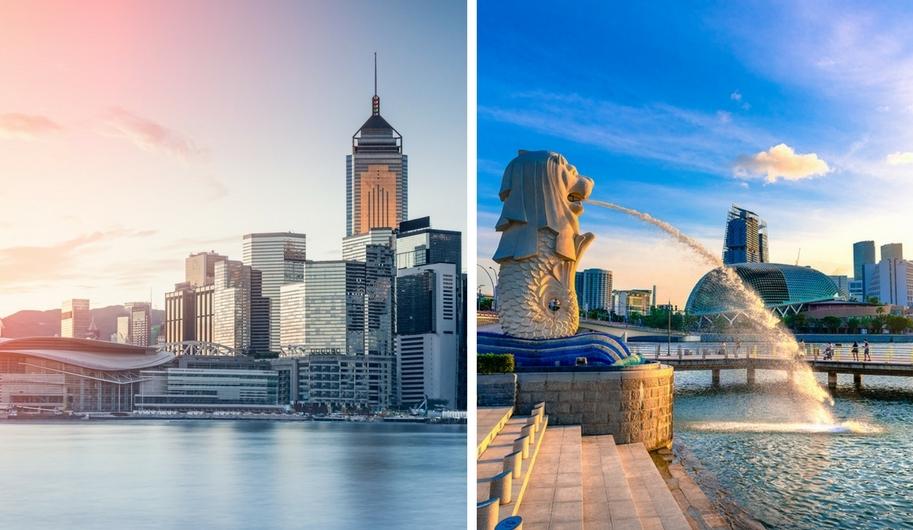
Hong Kong illustrates both the opportunity and the challenge. Its strategic value lies in its ability to connect China's enormous domestic economy with international capital, while providing foreign investors with access to Chinese markets. Singapore offers a different but complementary model, combining financial sophistication with its position at the centre of Asian trade and investment flows. Tokyo remains a major source of institutional capital, while Mumbai is gaining importance as India's economy and middle class expand. Asia's financial future is therefore unlikely to be dominated by a single centre. It is more likely to emerge as a network of increasingly interconnected financial hubs, with China, India, Japan, Hong Kong, Singapore and other centres performing different but complementary functions.
This development could gradually alter the balance between economic and financial power. More Asian companies will raise capital closer to home, more Asian households will accumulate investable wealth, and a growing share of regional savings will be managed by Asian institutions. Asian currencies may become more relevant for trade and investment, while financial infrastructure designed around Asian markets could gain greater international importance. None of this requires the dollar to lose its dominant position. The more plausible outcome is a gradual diversification of a financial system that has historically been unusually concentrated around the United States.
For Washington, this represents a strategic challenge, although not necessarily an immediate threat. American financial markets retain advantages accumulated over decades, including deep pools of institutional capital, sophisticated financial products, strong legal infrastructure and unparalleled dollar liquidity. These characteristics create a degree of financial inertia that economic competitors cannot easily overcome. But inertia should not be confused with permanence. If an increasing proportion of global economic growth, wealth creation and capital formation takes place in Asia, the relative weight of Asian financial markets will inevitably increase as well.
For Beijing, the challenge is different. China does not simply need a larger financial system. It needs a financial system that becomes more internationally useful and influential. Greater international use of the renminbi, deeper links between Chinese and global capital markets, stronger institutional confidence and the continued development of Hong Kong as a financial bridge could all contribute to this objective. But international financial influence ultimately depends on trust, accessibility and liquidity as much as economic size. China's ability to convert its enormous domestic economic weight into international financial influence will therefore depend partly on how effectively it addresses these structural constraints.
This is also where financial competition intersects increasingly with the broader China-U.S. strategic relationship. Payment systems, investment restrictions, capital-market access, financial technology and the international role of the renminbi are no longer purely commercial issues. They increasingly intersect with national security and geopolitical strategy. The fragmentation of global supply chains and the emergence of competing technology ecosystems could reinforce this trend, potentially encouraging countries and companies to diversify their financial relationships even while remaining deeply integrated with both Chinese and U.S. markets.
The result is unlikely to be a simple contest in which China replaces the United States as the dominant financial power. Nor is it likely that Asia's growing economic weight will leave the existing U.S.-centred system fundamentally unchanged. A more plausible scenario is the gradual emergence of a more multipolar financial architecture in which American markets remain indispensable while Asian markets become increasingly difficult to ignore. China will be one of the principal forces behind that transformation, but it will operate alongside India, Japan, Singapore, Hong Kong and other rapidly developing financial centres rather than acting alone.
Deloitte's forecast is therefore significant not simply because Asia-Pacific could overtake the United States in financial-services value added by 2035. Its deeper significance lies in the question it raises about the relationship between economic weight and financial power. Asia can become the world's largest financial-services engine without immediately becoming its most influential financial centre. But if the region's growing wealth increasingly determines where capital is raised, invested, managed and priced, the distinction between economic and financial power will gradually narrow.
For China and the United States, the central question will ultimately not be who replaces whom, but who can remain indispensable as the geography of global finance changes. America's financial century is unlikely to end simply because Asia becomes wealthier. But Asia's rise could make the next era of global finance considerably less concentrated, and the evolution of China-U.S. financial relations will be one of the most important forces determining what that new architecture looks like.
