
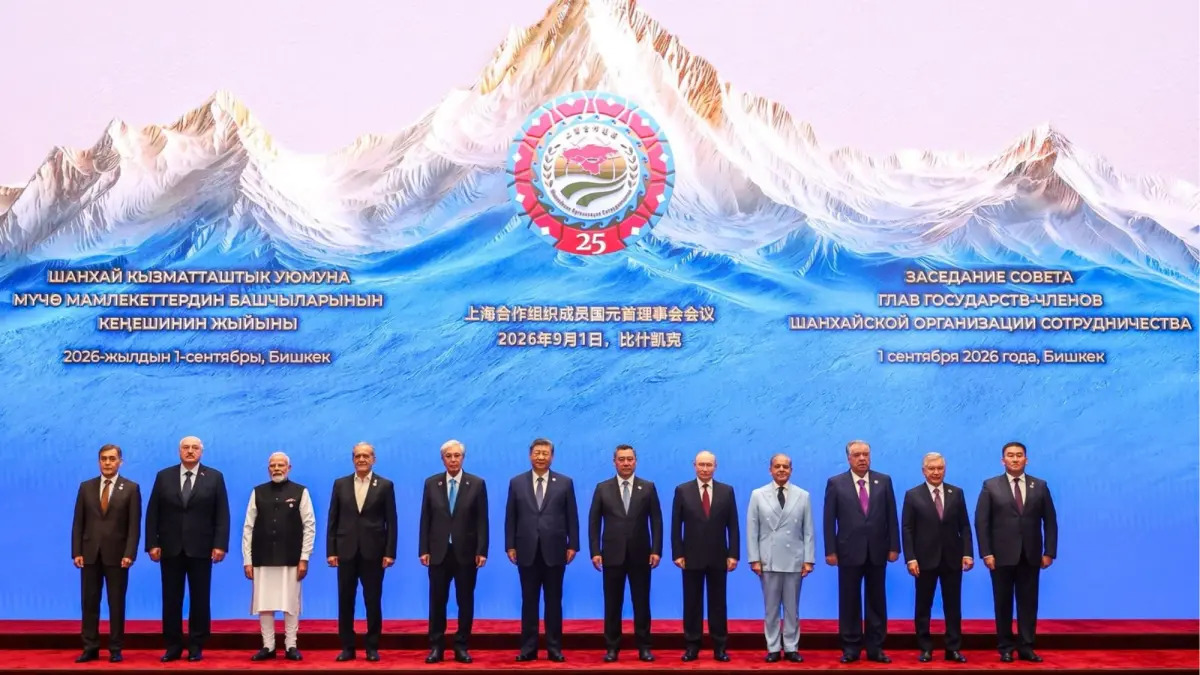
Chinese President Xi Jinping (Center) with other leaders and representatives attend the 26th Meeting of the Council of Heads of State of the Shanghai Cooperation Organization in Bishkek, Kyrgyzstan, on Sept 1, 2026.
Multilateral architecture rarely collapses with a dramatic bang; it hollows out often imperceptibly, victim to the growing weight of contradictions between real material conditions and outmoded institutional forms. In the span of a single recent 24-hour cycle, at the end of August and beginning of September 2026, the contemporary geopolitical landscape put two distinct models of regionalism on stark display.
The first was the Shanghai Cooperation Organisation (SCO), demonstrating a quiet, expansive unity of purpose built on shared objectives, non-interference and mutual respect. The second was the Pacific Islands Forum (PIF), where five heads of state stayed home from an annual summit increasingly dragged into a western-framed geopolitical fray. Where the SCO offers a model of inclusive statecraft, the PIF imbroglio lays bare a strategic dead end—a Primrose Path anchored to historical hegemony where regional bodies are enlisted into exclusive containment blocs.
For Southeast Asia, sitting at the crossroads of the Indian and Pacific Oceans, the lessons of this contrast could not be more pressing. ASEAN has long championed regional neutrality, but individual members face intense pressures to commit to a pro-Western security architecture. Yet, as the material limitations of Western power projection become impossible to ignore, as I have discussed previously, hedging must give way to proactive institutional design. Building a new ASEAN-centric, indivisible regional security and prosperity architecture remains elusive in the short term, but institution-building is never a one-off announcement. It is an ongoing, patient process of statecraft responsive to shifting material realities—and it can draw profound inspiration from the history, operational ethos, security principles, and economic architecture of the SCO.
A Tale of Two Trajectories: Genesis and Institutional Evolution
To understand the divergent trajectories of these two bodies, one must examine their origins and historical compositions. The Pacific Islands Forum possesses a deep history spanning over 60 years. Founded in 1971 as the South Pacific Forum by seven nations—including Australia, New Zealand, Fiji, Nauru, Samoa, Tonga, and the Cook Islands—the organisation was established to give small island states a collective voice on regional trade, shipping, and sustainable development independent of colonial oversight. Over time, its membership expanded to 18 nations and territories across Oceania. Yet, despite its origins as an autonomous space for Pacific voices, the PIF's structural dependence on funding and security coordination from Canberra and Wellington has increasingly allowed its developmental remit to be hijacked. A languid insouciance dominated the disposition of the Western sponsors, and Pacific development could not be described as a roaring success. In recent years, Western allies have sought to re-engineer the forum into a frontline containment mechanism against external investment, triggering intense institutional friction and causing sovereign Pacific leaders to disengage.
Conversely, the Shanghai Cooperation Organisation presents a study in functional, outward-facing evolution. Originating in 1996 as the "Shanghai Five" to settle post-Soviet border disputes, it was formally established as the SCO in 2001 by China, Russia, Kazakhstan, Kyrgyzstan, Tajikistan and Uzbekistan. Initially, its remit was tightly focused on the "three evils" of separatism, extremism, and terrorism along Central Asian frontiers.
However, over the past quarter-century, the SCO’s institutional mandate has dramatically expanded. Recognising that security is inseparable from economic stability, the organisation broadened its purview from narrow counter-terrorism collaboration to comprehensive economic security. Today, its operational agenda encompasses cross-border infrastructure interconnectivity, transit corridors, joint energy consortia, and integrated payment rails. A development bank is also in the pipeline.
This institutional maturity has been matched by a massive expansion in geographic and demographic scale. Having grown to 10 full member states—with the additions of India, Pakistan, Iran, and Belarus—alongside observer states and over a dozen dialogue partners, the SCO framework now spans 27 nations. It covers over 60% of the Eurasian landmass, encompassing more than 3.4 billion people—nearly half the global population—and generating roughly 36% of global GDP in purchasing power parity terms. Crucially, the SCO has managed this unprecedented scale while adhering to strict consensus, demonstrating that vast, diverse powers can coordinate on physical trade corridors, natural resource allocation, and regional stability without demanding ideological uniformity.
The Dead End of "Exclusive Clubs" vs. The SCO Ethos
The friction plaguing the PIF stems from a fundamental collision of frameworks, as Sandra Tarte has recently observed. Traditional Western strategies in the Pacific Basin have long treated the region as an exclusive security zone—"America's Lake." When declarations meant to herald a sovereign "Ocean of Peace" are operationalised into security pacts designed to lock out external economic partners, smaller nations vote with their feet.
The SCO operates on an entirely different paradigm. It successfully navigates complex inter-state coordination—including managing significant bilateral friction among its own members—without insisting on a zero-sum, "us-versus-them" bloc framing. By anchoring its security paradigm in indivisible security—the foundational principle that no state can enhance its security at the expense of others—the SCO provides an inclusive umbrella.
For ASEAN, drawing strength from this ethos means returning to the spirit of Bandung while updating it for the 21st century. It requires rejecting minilateral zero-sum security frameworks, such as AUKUS or exclusive maritime containment lines, and instead asserting an inclusive regional security architecture that engages all major powers without requiring sub-regional states to act as forward military buffers.
The RCEP Bridge: Cutting Across the Geopolitical Divide
If the SCO offers the security philosophy, the Regional Comprehensive Economic Partnership (RCEP) provides the institutional bridge that cuts directly across the "West versus the Rest" dichotomy. RCEP brings together China, Japan, the Republic of Korea, Australia, New Zealand, and the ten ASEAN states into a single, cohesive economic framework.
This presents a profound strategic invitation for ASEAN statecraft. By inviting Western allies like Australia and New Zealand to sit at the same table as China and Northeast Asia under ASEAN stewardship, ASEAN issues a quiet yet firm challenge: will regional states prioritise tangible economic integration and sovereign trade rules, or will they subordinate their commercial interests to external containment strategies?
RCEP forces Western-aligned regional states to confront the material reality of their own supply chains. Its unified rules of origin and deep tariff integration lock in production synergies that penalise decoupled trade structures. When nations are bound by shared economic interdependencies accounting for nearly a third of global GDP, security can no longer be treated as a zero-sum game without incurring self-destructive economic costs. RCEP acts as a practical test of regional commitment, proving that pragmatic economic co-dependence can anchor peace far more effectively than ideological security alignment.
Material Foundations, Financial Infrastructure, and Energy Security
Security architecture is a mirage if it is not underpinned by material depth and economic sovereignty. Beyond RCEP's trade integration, the SCO’s enduring strength lies in its alignment of physical infrastructure, energy corridors and autonomous financing mechanisms. The ongoing development of specialised multilateral financial platforms, including mechanisms for an SCO development bank, mirrors the structural needs of Southeast Asia. By aligning regional supply chains—such as Indonesia’s downstream critical mineral processing and regional EV ecosystems—ASEAN economies can similarly anchor their prosperity in real-economy production rather than financialised speculation.
Perhaps the most critical dimension of this emerging architecture is the financial and payment infrastructure required to sustain sovereign autonomy. The weaponisation of traditional Western clearing mechanisms like SWIFT and dollar-denominated settlement systems has exposed middle powers to profound systemic risk.
Fortunately, ASEAN is not starting from scratch. The region’s deployment of Local Currency Transaction (LCT) frameworks, cross-border QR code interoperability, and integration into broader multilateral payment experiments—such as and emergent BRICS-aligned settlement platforms—provide the plumbing for a de-dollarised trade future.
When ASEAN’s internal digital payment rails are linked to China, the broader SCO footprint, and BRICS financial architecture, the structural foundations of coercion crumble. Local-currency settlement eliminates foreign exchange friction, insulates regional trade from secondary sanctions, and ensures that commerce between developing nations is financed by their own capital rather than Western intermediary banks.
Statecraft for a Multipolar Era
A new ASEAN-centric architecture that combines indivisible security principles with integrated economic collaboration and sovereign payment rails will not materialise overnight. It requires deliberate, patient statecraft that internalises the material limits of traditional hegemony and embraces the possibilities of multipolarity.
The region faces choices. It can continue down the Primrose Path of subordination to external security blocs that fracture regional cohesion, or it can forge an autonomous path. By synthesising the historical spirit of Bandung, the inclusive security ethos and expanding economic scope of the SCO, the production depth of RCEP, and the financial resilience of sovereign payment rails, ASEAN can construct a durable architecture that guarantees regional stability through economic interdependence rather than exclusive containment.
In doing so, it can also open a door for engagement with the Pacific Island nations that open new possibilities for development and security. The current imbroglio at the PIF, contrasted with the orderly development of inclusive security across Eurasia, shows distinct possibilities for an Asia Pacific architecture suited to the needs of the 21st century. An inclusive operational ethos, inspired by the ongoing work of the SCO, lends encouragement that such an approach is possible. It also shows that the zero-sum bloc politics that has dominated the post-WW2 is neither natural nor inevitable.
