
The age of robots is here, and the race to dominate the field is clearly led by America and China. Each country’s distinct advantages provide critical insights into the future of industry.
As the recently announced U.S. ban on the import of Chinese-made "humanoid and quadruped robots" made vividly clear, the Robot Revolution is upon us. We have squarely entered the Fourth Industrial Revolution during which machines increasingly learn, adapt, and collaborate with humans. This revolution is based on the merging of physical, digital, and other technologies, such as AI, traditional robotics, 3D printing, biotechnology, and the Internet of Things (IoT).
The advancement of “thinking machines” will require big leaps in “embodied intelligence,” the integration of AI, computing power, sensory systems, and advanced mechanics. So far, the biggest developments in AI are occurring in “disembodied intelligence,” specifically the advent of agentic AI.
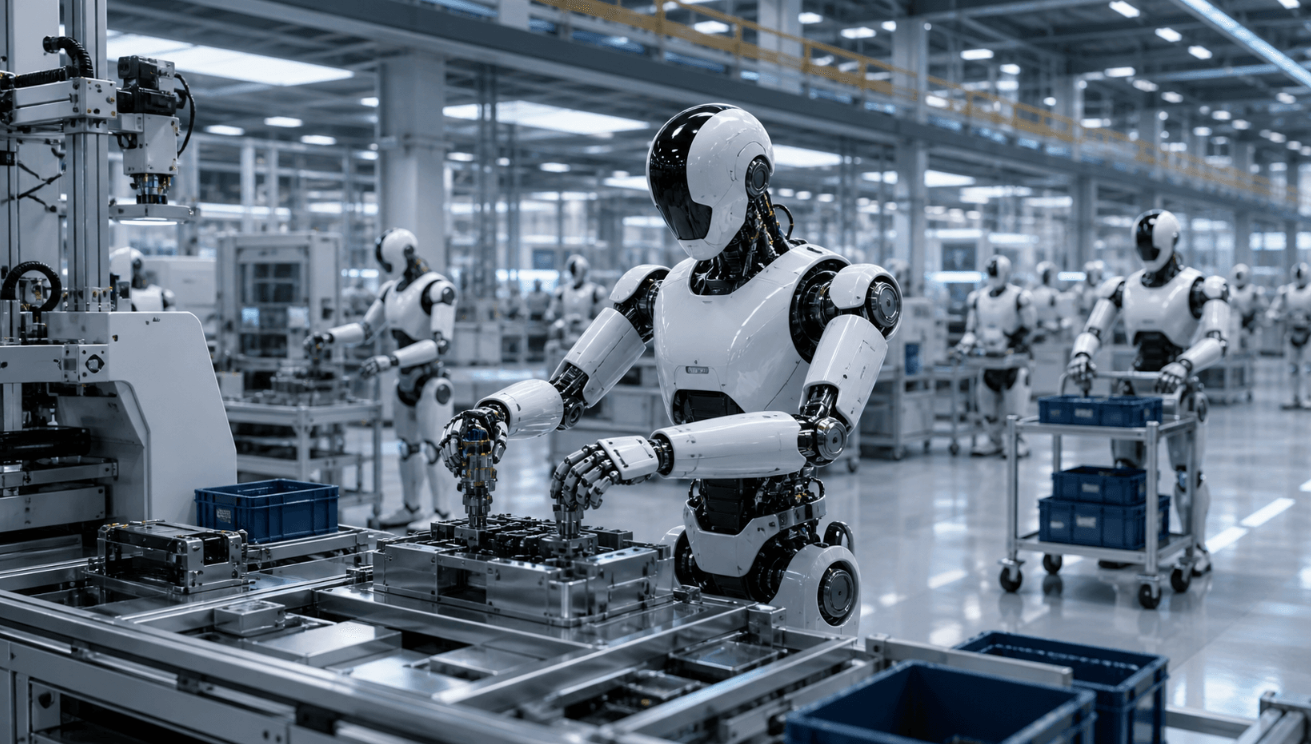
Evidently, the first steps in this technological evolution are unlikely to be centered on the development of robots that mimic human beings in appearance and behavior. Rather, intelligent robots with embodied AI are now appearing in highly controlled industrial settings. Dark factories (or lights-out factories) are a prominent example, since the entire factory operates as a closed-loop system at extreme levels of automation with near-zero on-site humans.
Dark factories are becoming more commonplace in China, which is leading in commercial scaling. They rely on AI-supported cameras to handle quality inspection and guide robots, as well as integration via the Industrial Internet of Things (IIoT). Smart sensors are used to monitor machine health and collect real-time data feeding into maintenance and repair schedules that avoid unnecessary shutdowns.
In one fascinating example heralding the future a Xiaomi facility outside of Beijing is shifting away from rigid pre-programmed loops in favor of self-learning AI platforms and real-time virtual simulations, known as “digital twins. Nonetheless, actual working humanoids truly represent the pinnacle of this enduring evolution. Their human appearance with humanlike functions will enable them to seamlessly integrate into our world designed for the human shape.
The next big step beyond disembodied AI is thus a natural progression into embodied forms: ultimately, the development of working androids, as well as animal-like robots, that can perform tasks in spaces created for people.
Who is winning this pinnacle of the Robot Revolution? Or more precisely, who is winning the race to develop the first actual working androids, robots that look and behave like humans, able to perform coordinated movements in complex environments that require direct and close interaction with humans? At this moment in time, existing traditional industrial robots designed for fixed, controlled environments are still a long way away from being able to make real-time decisions to function smoothly in human-heavy environments like hospitals, offices, and homes.
One way to start this analysis is to look at the distinct elements required to create a humanoid robot. The first element is the mechanics of the body; the second, a variety of sensors that allow androids to see and perceive their environment; the third, the mechanical control systems; the fourth, actual computing power (brain hardware); the fifth, AI decision making and control algorithms (brain software); and finally, the power system (batteries and charging).
It turns out that different industrial ecosystems, based in different clusters of nations, hold distinct competitive advantages in each of these six elements. Early 19th Century British political economist David Ricardo would clearly see an enormous opportunity for collaboration in building the best humanoids possible. Alas, this is unlikely in this era, even though the main protagonists, chiefly the United States and China, possess distinct advantages and disadvantages that complement each other.
In terms of producing cutting-edge nuts and bolts – an average android encompasses thousands of mechanical parts – China absolutely leads. A J.P. Morgan analysis of June 2026 shows that China is driving nearly 80 percent of global humanoid robot shipments. Even more significantly, Chinese production costs are falling by roughly 40 percent annually, creating a first-mover advantage.
An earlier 2025 report by J.P. Morgan analysts illustrates that China has a massive cost advantage in humanoid robotics, with specialized supply chains allowing for sub-$10,000 production compared to Western models priced between $20,000 and $30,000. Therefore, bypassing Chinese suppliers of the nuts and bolts would increase hardware production costs for American manufacturers by double or triple per unit.
In terms of cutting-edge sensors, the ears, eyes, and other sensory systems required, the United States and its suppliers located in Europe, Japan and South Korea, remain ahead. China, on the other hand, leads in the ability to scale and mass manufacture at price competitive points.
The advantages for mechanical control systems look very similar to sensors: higher quality and price points in Western supply chains compared to mass manufacturing and scaling in China-centered supply chains. Nonetheless, in both of these areas the leads of Western manufacturers are shrinking. The scale, comprehensive industrial ecosystems, and intense competitive pressures in the Chinese robotics market are driving cost savings and technological upgrading at breakneck speed.
When we get to the fourth element, computing power, Western supplier networks are most clearly in the lead. Androids will require a certain amount of very high-capacity computing power combined with many legacy chips governing mechanical controls. The sanctions on the import of top-notch computing power that the United States levied against China directly impact what is available to Chinese android developers. In part, such bottlenecks can be overcome by work-around solutions. The unveiling of somersaulting, acrobatic androids during this year’s Spring Festival Gala made clear China’s ability to marshal sufficient computing power for humanoid robot development.
Nonetheless, as androids increase in sophistication, top-notch computing power might decide the race. This situation also holds for the fifth element: the quality of AI models. Those developed in the United States remain more capable than Chinese ones, but the gap is narrowing. Incongruously, those American companies deeply involved in robot development and embodied AI lag the top two U.S. labs, OpenAI and Anthropic, in AI model development.
Put differently, it is in the realms of computing power and the quality of AI models – the hardware and software driving android “brains” – that the race is America’s to lose. The AI ecosystem in the United States remains ahead and capable of producing top-notch embodied AI. But embodied AI cannot simply access the Internet to distill millennia of human data as Large Language Models have. Robots need to actually learn to move the hard way, by flailing, falling, and failing.
It is here that the recent ban on Chinese humanoid robot imports could backfire. Cheap Chinese robots are the best means to train American embodied AI at scale and speed. Might the U.S. squander its advantages by excluding key hardware components needed to train its embodied AI models?
Finally, in terms of power systems, China holds the advantage. Its battery manufacturers are now the world’s most advanced as impressive strides in the Chinese EV sector attest to. Yet, if the United States, Europe, Japan and South Korea collaborate effectively, their supply chains can approach Chinese competitiveness. This element is thus quite evenly matched, though access to Chinese battery technology will lower costs for whatever industrial ecosystem chooses to employ them.
This situation is undoubtedly depressing for anyone aware of the Ricardian argument. Seldom has there been an industry of the future where two leading technological rivals could cooperate to produce a superior economic outcome. But we live in an era where national security tends to trump economic efficiency.
The United States and Western supplier networks in general still have the opportunity to capture a large chunk of this industry of the future. But China possesses industrial scaling advantages that might allow it to become a world technological leader for the first time in modern history (post-1492). China already dominates total industrial robot installations. Its industrial ecosystem can aggressively pivot high-volume sectors like consumer electronics and electric vehicles toward dark factory configurations, jolting industrial robotic sectors into overdrive.
The Trump Administration’s recent ban on new imports of "advanced robotic devices" from China to "protect the U.S. AI build-out” is thus a double-edged sword. Some infant industry protection for U.S. manufacturers might be warranted, but the history of industrial policy does not look favorably upon full-scale attempts to ban more advanced technologies. Such policies always lead to the cozying of domestic competitors, ultimately portending their global obsolescence. If America wants to lead the future of embodied AI, its firms will have to compete with everyone on earth.
