China’s membership is not a threat. Rather, it is a sustainable framework for the United States to prosper. Both sides could well complement each other and grow together, benefiting our people and the world over.
As China’s World Trade Organization membership reached the 25-year mark, regrets came from Washington repeatedly. In a speech at the Ronald Reagan Library on May 26, Treasury Secretary Scott Bessent said that giving permission for China to join the WTO was a major strategic mistake of the United States. He asserted that the move hollowed out America’s industrial base and cost millions of manufacturing jobs across the Rust Belt. U.S. Trade Representative Jamieson Greer repeated that sentiment on the same day: “The original WTO accession bargain failed to drive the transformation we expected,” he told the Council of Foreign Relations.
Both remarks echoed Vice President J.D. Vance’s points almost two years ago, on July 24, 2024, when he addressed the Republican National Convention. He said that allowing China to join the WTO was one of the most serious strategic misjudgments ever made by several American leaders.
All the rhetoric has missed a simple fact: The WTO is not an American institution. It was a multilateral trade organization of 143 members when China joined, with the United States being only one of the 143. China had no final say about anything.
They have also missed a common-sense aspect international law: Accession to the WTO is the right of any economy upon accepting basic clauses of the WTO and its base, GATT, and agreement of all WTO members. China’s talks and final accession to the WTO was the continuation of its earlier efforts to resume its GATT membership.
GATT was founded in 1948, and China was a founding member. In 1986, the Chinese government applied to GATT for membership resumption. When the WTO was founded in 1995, replacing GATT, China’s application changed to one for WTO membership.
In late 1990’s, the United States was supportive to China’s accession to the WTO. The American business community was eager to tap into China’s vast market opportunities. In May 1999, the Chinese government called off WTO talks with the U.S., after the NATO bombing of the Chinese embassy to Yugoslavia. It was the Clinton administration and Senator Diane Feinstein, who requested the resumption of talks.
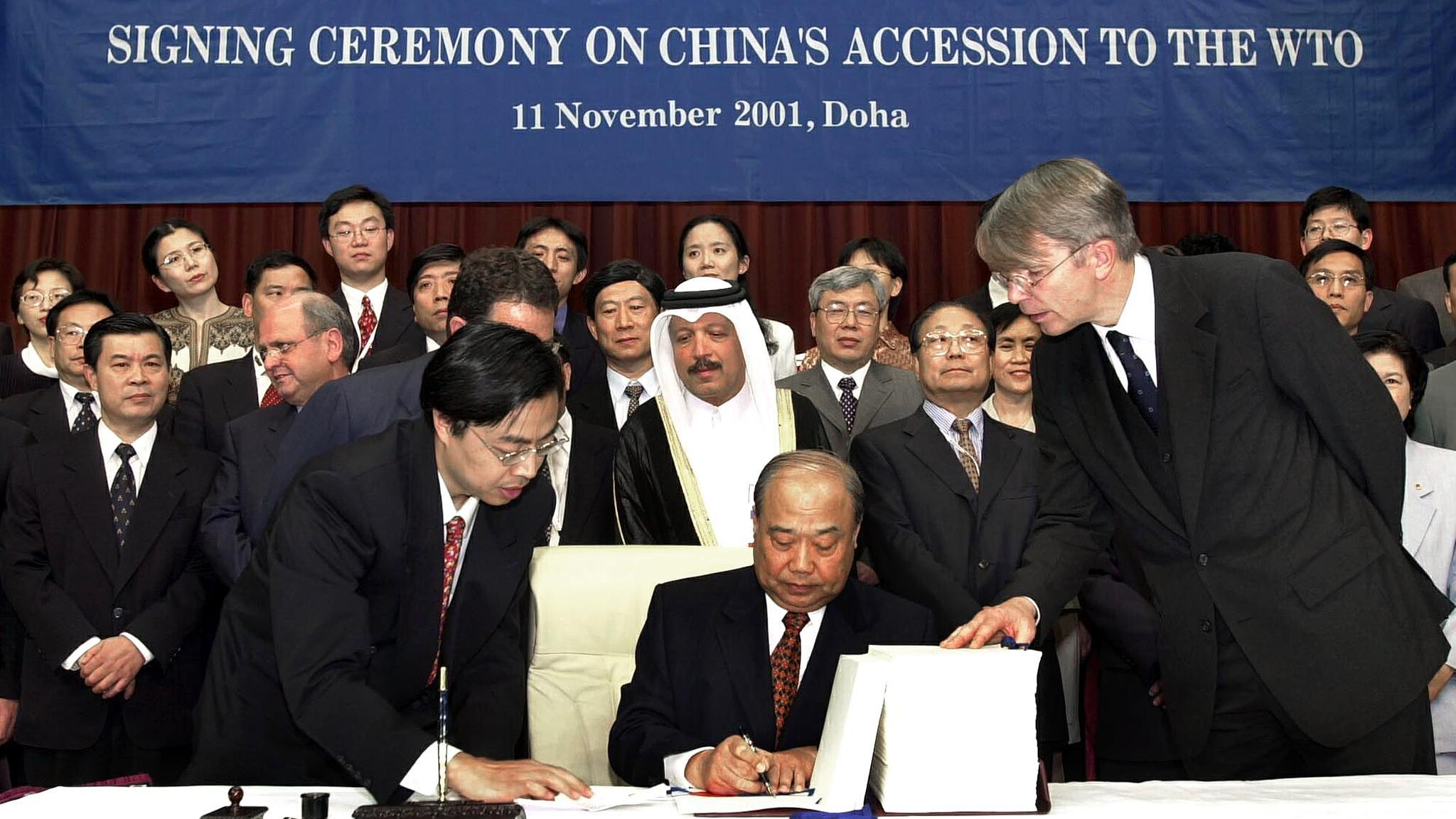
The conclusion of the China-U.S. WTO agreement on Nov. 15, 1999 did not take China into WTO right away, as the U.S. was only one member, albeit the most important one. It was only two years later, after completing talks with other WTO members, that China was admitted at the organization’s fourth ministerial conference in Doha in November 2001.
Hence the simple facts: The United States was in no position to decide China’s WTO membership, nor to block China out.
The basic legal document of China’s WTO accession was the 15-point protocol stipulating the Chinese commitment to implementing WTO rules (GATT rules and final documents of the Uruguay round) for a 15-year transition period ending in December 2016. China fulfilled all the commitments in the protocol and was rated A+ by the WTO.
It is also up to WTO to review and conclude if China’s industrial policy and trade practices have violated the multilateral rules and if the American manufacturing sector has been hurt. Since China’s accession, the WTO has conducted nine midterm reviews on Chinese trade policy (every three years) and all reviews reached positive conclusions.
Both China and U.S. have benefited from China’s WTO accession. Undoubtedly, it helped China integrate into the world economy and markets and provided a strong push to China’s opening-up and reform, leading to strong economic and trade growth. In parallel, American businesses and families also gained tremendously.
The changes in China-U.S. trade over the past 25 years since China’s accession to WTO so far can be divided to two periods—2002-17 and 2018-25. The first period showed strong trade growth both ways, with the U.S. gaining more. The second period, because of Washington’s tariffs and trade tensions, showed a trade falloff, with the U.S. suffering less.
According to the U.S. Commerce Department, during 2002-17 period, U.S. merchandise exports to China grew by 487.0 percent, almost four times faster than its global exports (up 123.1 percent), and much higher than its imports from China (up 303.8 percent). U.S. exports to China gained more.
During the 2018-25 period, U.S. global exports grew by an aggregate 40.9 percent, and global imports rose by 52.0 percent. But its exports to China fell by 18.5 percent, and imports from China fell by 42.4 percent. In other words, U.S. exports fell less than Chinese exports.
The vast and fast-growing China market has provided infinite opportunities to American businesses, especially the multinationals. The U.S. Bureau of Economic Analysis reports that total U.S. direct investment in China reached $500.5 billion by the end of 2023, with sales volume of $475.2 billion, higher than its trade deficit with China. The China market accounted for 51 percent of Tesla global sales. The share was 20 percent for Apple, 29.2 percent for Intel, 30.4 percent for GM and 46 percent for Qualcomm. In the USCBC member survey in 2026, 80 percent said that their existence and operation in China is very important to keep their global competitiveness.
Rust Belt distress not by China
Bessent criticized China’s accession to WTO by saying it “hollowed out” America’s industrial base and “cost millions of manufacturing jobs across the Rust Belt,” but he failed to provide any facts or data to prove it.
First, the U.S. Rust Belt’s decline started to evolve in late 1970s or early 1980s, after the oil shock of 1973 and the transition of U.S. industry—long before China’s WTO accession in 2001.
Second, China is somewhat irrelevant to import-related Rust Belt job losses over the past 10 years. The Rust Belt is mostly a cluster of traditional steel and automotive industries. Washington always blames the competition of imports, and refuses to acknowledge any problems of its own.
Even so, during the 10 years from 2015 to 2025, U.S. steel imports actually declined from $33.27 billion to $28.20 billion. Steel imports from China were no higher than 2 percent of the total, at $212 million for 2015 and $443 million in 2025, or 0.6 percent and 1.6 percent of total imports respectively—well within the USDOC “minimal” range (no higher than 3.0 percent). During the same period, U.S. automobile imports increased from $195.08 billion to $227.92 billion. The imports from China were $ 227 million (0.1 percent of the total) in 2015 and $ 1.57 million in 2025 (0.7 percent) in 2025. China had little impact on the steel and automobile industries there.
Third, the decline of traditional industries, including their job losses, is not the whole picture of the Rust Belt. I was invited to International Trade Week in Cleveland, Ohio, as the economic and commercial counselor for the Chinese Consulate General in New York, in May 2002—six months after China’s WTO accession. My colleagues and I were warmly received there. With streams of visitors, our printed materials on China were gone on the first day.
I made a speech on market opportunities in China to more than 80 business leaders and received very warm response. The vice president of Eaton Industries presented a report on his company’s fast-growing investment and operations in China. I overheard two gentlemen chatting. A: “Have you any business in China?” B: “Not yet.” A: “Think about it!”
Even then, Ohio was already in transition to advanced technologies and industries, including solar energy, aerospace and robots. Today, the Rust Belt is no longer an appropriate name for the State of Ohio.
Fourth, the Rust Belt (even if we still call it that), or the Great Lakes region generally, is not the whole picture of U.S. industry. It accounts for about one-fifth of the nation’s total. The large industrial states are along the Pacific coast, including California and Washington, and along the Gulf of Mexico, including Texas, Louisiana,Alabama and Florida. Most of them have business cooperations with China.
WTO not an organization of social systems
One of the regrets in Washington is that China “failed to drive the transformation we expected”—that China would change to a system similar to the U.S. This is an apparent misunderstanding. The WTO is only a trade organization; the social systems of its members is irrelevant. Up until today, none of the 166 members have changed their systems. The same is true with the UN. None of the UN member states changed their social system because they joined the UN, as the UN Charter respects the sovereignty and internal affairs of each member state. So does the WTO.
China and U.S. should join hands
President Donald Trump’s successful state visit reaped, together with Chinese President Xi Jinping, a landmark result—a constructive China-U.S. relationship with strategic stability. Both sides agreed to set up joint boards of trade and boards of investment to stabilize and enhance mutually beneficial business cooperation. The American side could well refer all of its concerns—industrial and trade policies, job creation, high-tech and rare earth export controls and possible collaboration on AI and frontier industries—to these bodies.
China’s WTO membership is not a threat. Rather, it is a sustainable chance for the United States to prosper. Both sides could well complement each other and grow together, benefiting our people and the world over in the process.
