
The current USMCA review is expected to introduce new China-related restrictive provisions across four key areas: labor enforcement, rules of origin, economic security coordination and external tariff alignment. Taken together, these measures would substantially narrow market access for Chinese capital, goods and technology in North America.
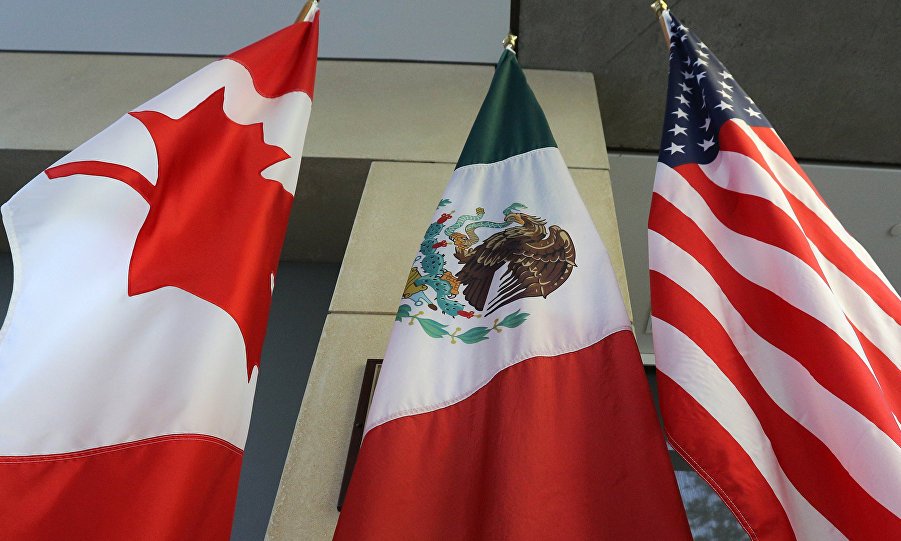
The United States-Mexico-Canada Agreement reached its mandatory six-year joint review milestone on July 1. Because the Trump administration explicitly refused to extend the agreement for another 16 years as originally provided, the agreement’s built-in periodic review mechanism was triggered. At the same time, Washington shifted toward parallel bilateral consultations with Mexico and Canada, aiming not merely at addressing bilateral trade imbalances between the United States and its two neighbors but at redefining the economic security boundaries of North America.
By leveraging the USMCA’s built-in “poison pill” clause and its rules-of-origin framework, the United States is using this round of review to further tighten restrictions on China-linked supply chains, making China the non-party most significantly affected by the ongoing restructuring of the agreement’s rules.
Perceived loopholes
When President Donald Trump renegotiated the North American Free Trade Agreement during his first term and oversaw the conclusion of the USMCA, he hailed the new pact as the best trade agreement in U.S. history. Yet at the 2026 review he publicly stated that he had no intention of extending the agreement.
At the same time, U.S. Trade Representative Jamieson Greer issued an official statement rejecting the agreement’s automatic extension as provided in the original text. He argued that the existing rules-of-origin regime and foreign investment oversight mechanisms had failed to close loopholes that allow Chinese goods to enter the U.S. market indirectly through Mexico and Canada.
During the 2017-19 renegotiation of NAFTA, the United States incorporated two mechanisms aimed at constraining China, yet neither produced the intended results.
On one hand, the agreement raised the automotive rules-of-origin threshold by increasing the regional value content requirement for passenger vehicles from 62.5 percent to 75 percent, while mandating a higher proportion of North American-made components. The objective was to reduce the role of Chinese parts in North American automotive supply chains.
From Washington's perspective, Mexico—currently the largest trading partner of the U.S.— has increasingly become a key transit hub for Chinese auto parts and finished vehicles entering the North American market. As a result, U.S. policymakers argue that the existing provisions of the agreement contain security vulnerabilities that are inadequately addressed.
On the other hand, Article 32.10 of the USMCA—the provision restricting free trade agreements with non-market countries—stipulates that if any party to the agreement concludes a free trade agreement with a non-market economy, either of the other two parties may, upon six months’ notice, withdraw from the trilateral agreement and replace it with bilateral arrangements. Although this provision formally applies to all three parties, it was widely understood to be aimed primarily at Canada, which at the time was advancing the possibility of negotiating a free trade agreement with China.
The clause establishes a three-tiered constraint mechanism consisting of prior notification, full-text review and unilateral withdrawal. The Trump administration now argues that these provisions function only as an ex ante deterrent, lacking complementary mechanisms for ongoing oversight and ex post enforcement. Consequently, Washington has refused to grant an unconditional extension of the USMCA, instead using the renegotiation process as leverage to press Canada and Mexico into aligning their trade and economic control measures toward China with U.S. standards.
Fortress against China
Judging from the positions of key stakeholders and the official negotiating agenda, the current USMCA review is expected to introduce new China-related restrictions across four areas: labor enforcement, rules of origin, economic security coordination and external tariff alignment. Taken together, these measures are intended to substantially narrow the scope for Chinese capital, goods and technology to access the North American market.
First, harmonizing the import control regime on forced labor. The United States is pressing Canada and Mexico to follow the model of America’s Uyghur Forced Labor Prevention Act by incorporating unified labor enforcement provisions into the USMCA and establishing coordinated cross-border mechanisms for the detention and prohibition of goods. Canada has already launched parliamentary hearings on the issue, acknowledging that its current import controls related to forced labor are significantly less stringent than those of the United States and that legislative alignment could help address U.S. concerns over regulatory gaps.
Mexico, however, faces greater obstacles in implementation. Having long been the subject of criticism over its labor standards, Mexico would face higher operating costs for its manufacturing sector if it were to broadly align its labor regulations with U.S. standards. In its report to Congress on the USMCA review, the Office of the U.S. Trade Representative argues that both Canada and Mexico must strengthen enforcement of import bans on goods linked to forced labor. The report suggests that such provisions may ultimately be incorporated into a supplementary memorandum to the agreement, drawing on the labor enforcement models found in the U.S.-Malaysia and U.S.-Cambodia bilateral free trade agreements.
Second, systematically tightening rules of origin across industries. The U.S. proposal would raise regional content requirements for automobiles, batteries and metal products, while making clear that the agreement's tariff preferences should be reserved exclusively for production capacity located within USMCA member states. The review is expected to provide Washington with an opportunity to revise the existing rules and close remaining channels through which Chinese components enter North American supply chains.
To reinforce these measures, the United States may introduce digital traceability tools, including blockchain-based end-to-end origin verification and a U.S.-Mexico joint artificial intelligence trade intelligence system capable of identifying, in real time, transshipped goods containing Chinese components. This would enable more targeted and effective enforcement.
Third, establishing a trilateral economic security coordination mechanism. On investment, Washington has continued to press Mexico to enact a national security investment screening regime covering all foreign capital, with particular scrutiny directed at Chinese investment in the automotive sector, critical minerals and semiconductors.
On digital security, the three parties are expected to adopt a coordinated approach to restricting market access for Chinese connected vehicles and next-generation telecommunications equipment. Canada has already moved to align with the U.S. restrictions on Chinese vehicle software. Washington is simultaneously urging Mexico to introduce comparable regulatory measures.
In addition, a government-industry data-sharing mechanism is expected to be incorporated into the revised framework. Under the proposed arrangement, the three countries would map China's investment footprint across the entire North American automotive parts supply chain and regularly update inspection lists of Chinese-invested manufacturing facilities.
Fourth, advancing coordination on external tariffs to close transshipment loopholes arising from differences in the three countries' tariff treatment of China. Although a fully unified common external tariff remains unlikely in the near term, recent tariff increases imposed by Canada and Mexico on Chinese imports have been viewed by Washington as a foundation for closer policy coordination. For example, a working group has proposed a common external tariff framework for the steel industry, alongside greater alignment in the three countries' anti-dumping and countervailing duty investigations, with the stated aim of addressing global overcapacity and preventing Chinese steel products from reaching the North American market via third countries.
At the same time, the United States may seek to lower Section 232 tariff barriers within North America, encouraging Canada and Mexico to engage in intra-regional trade for a more unified external trade defense. In doing so, Washington would seek to reconstruct a protected North American steel supply chain.
Outlook
From an economic perspective, the manufacturing sectors of both Canada and Mexico remain highly dependent on Chinese supplies of intermediate inputs and industrial goods. Neither country has adopted a comprehensive strategy for economic decoupling from China. Maintaining trade and investment ties with China at a certain scale remains a practical necessity for the operation of their industrial sectors.
Geopolitically, however, North American economic integration remains the cornerstone of external economic relations. Canada and Mexico are deeply dependent on access to the U.S. consumer market and the preferential trade rules embedded in the regional framework. Any significant divergence from Washington's China-related trade and economic control standards would directly jeopardize the ongoing USMCA review and renewal process. As a result, both countries are likely to find themselves under growing pressure to accommodate the economic security agenda of the United States.
This underlying tension ultimately defines the policy boundaries of the current USMCA review. None of the parties appears intent on erecting a comprehensive trade barrier that would sever economic ties with China. Instead, the anticipated regulatory adjustments are likely to follow a targeted and selective approach, imposing differentiated market access requirements in five sensitive areas: automobiles and parts, the power battery supply chain, strategically critical minerals, next-generation telecommunications infrastructure and foreign investments with national security implications. The objective is to narrow the scope of China’s industrial presence in North America through calibrated regulatory controls, not to bring China-North America economic and trade relations to a halt.
In the longer term, if the current review results in an updated and extended USMCA, the United States, Mexico and Canada are likely to build a coordinated regulatory framework based on a unified set of trade rules, aligning their approaches to both the movement of goods and cross-border investment. By supporting mechanisms such as rules-of-origin verification, coordinated foreign investment screening and harmonized tariff measures, the three countries will seek to further restrict channels through which Chinese goods and capital enter the U.S. market via Mexico and Canada.
Against this backdrop, the USMCA will likely evolve beyond a conventional regional free trade agreement into an institutional framework that reinforces the bloc-based reorganization and regional fragmentation of global supply chains. In doing so, it could significantly reshape the pattern of economic and trade relations between North America and China.
