
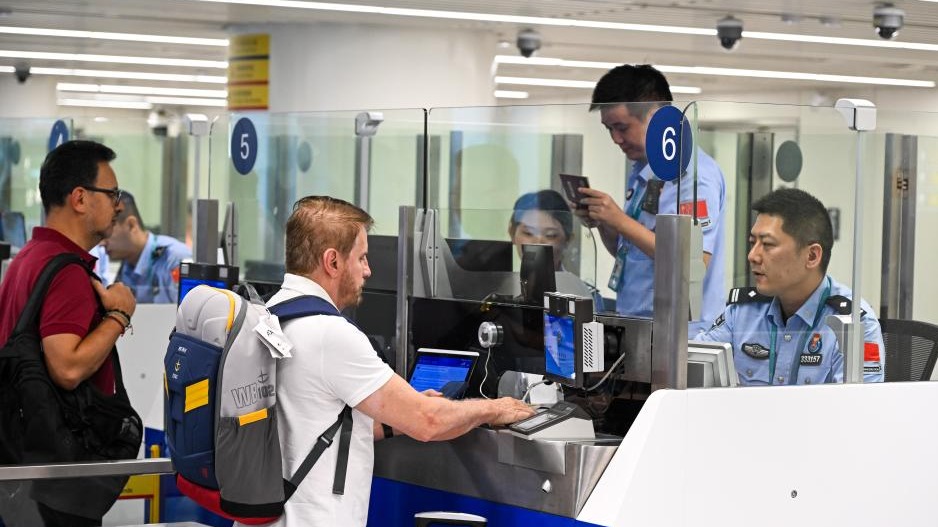
China’s expanding visa‑free regime is no longer just a tourism measure; it is emerging as one of Beijing’s most agile tools of economic statecraft, deepening global connectivity at a time when many countries are turning inward.
From 17 February 2026, ordinary passport holders of the UK and Canada can stay in China for up to 30 days without a visa. During their January 2026 visits to China, Prime Ministers Mark Carney and Keir Starmer both highlighted the move toward visa‑free travel as a key outcome of their talks with Chinese leaders and promoted it at home as a major gain for business and middle‑class travellers.
Out of the Five Eyes, only the U.S. is left without this facility, Australia and New Zealand had already obtained visa-free entry to China for its citizens in 2024. With Britain and Canada, the number of countries availing China’s unilateral visa-waiver policy has risen to around 50.
In addition to unilateral visa-free facility, China has other schemes as well. It has reciprocal visa-free entry with around 29 countries. In addition, ordinary passport holders of about 55 countries can enter China for short visits schemes of 24‑, 72‑, 144‑ and 240‑hour (10‑day). In October 2025, China also rolled out a K‑visa to attract young STEM graduates. Many regarded this scheme as a rival to the U.S. H‑1B visa. Some countries appear to fall into two or more of these categories at the same time. Taken together, China now has a more open door policy than at any other point in its modern history.
Along with visa-free entries, China introduced a comprehensive suite of measures for international travelers, including more generous tax refund arrangements at departure and participating stores, an expanded network of duty-free and tax-refund shops in major commercial districts and transport hubs, wider mobile payment access for foreign bank cards through Alipay and WeChat Pay, and a continued rollout of streamlined electronic arrival cards and automated immigration channels at key ports of entry.
To incentivize travellers, Beijing reduced the minimum purchase required for tax refunds from 500 yuan to 200 yuan, increased the cash refund ceiling to 20,000 yuan, and broadened the range and geographic spread of accredited tax-refund shops to tourist districts, major transport hubs, airports, seaports and land crossings. This expanded access to high-value tax-free goods. These measures almost doubled the sales of tax refund goods.
In addition to these visa and travel facilitations, China’s civilizational depth, world‑class scenic and cultural heritage sites, and hyper‑modern urban experiences are powerful sources of attraction that jointly pull a growing number of international visitors to the country.
China is a living museum of global heritage. Thousands of miles long, the Great Wall snakes over mountain ridges; the Forbidden City stands at the heart of Beijing; the ancient Silk Road grottoes at Dunhuang and the Terracotta Army in Xi’an are just a few examples. Similarly, China offers much to nature enthusiasts. It is filled with lush green rice terraces that ripple across the hills of Guangxi and Yunnan, snow-capped peaks and grasslands stretching from Tibet to Xinjiang, and serene river valleys like Guilin and the Yangtze, classical gardens in Suzhou, West Lake in Hangzhou, and well-preserved ancient towns like Pingyao and Lijiang.
Moreover, China has a lot to offer the new generation, and Gen Z. Choices range from ultra-modern metropolises like Beijing, Shanghai, Shenzhen, and Guangzhou. Beyond the bustling cityscapes, China presents a dynamic blend of futuristic innovation and contemporary trends, from Chengdu’s creative youth and vibrant bar culture to the neon‑lit streets of Changsha, a major hub for TV and media entertainment, and Xi’an’s fusion of ancient cityscapes with trendy cafes and spectacular night‑time light shows. The combination of this timeless beauty with streamlined, traveler-friendly policies has produced obvious results.
Data released by late January showed that China’s immigration authorities processed 697 million inbound and outbound crossings in 2025, a 14.2 percent jump from 2024 and an all-time high. More than 82 million of those crossings were made by foreign nationals, up 26 percent year-on-year. Out of the foreign travellers, over 30 million entered China under the visa-free scheme. This was an almost 50 percent increase compared to 2024. China, long the world’s largest source of outbound tourists, is also becoming an increasingly important destination for inbound tourism.
These visa‑free schemes are not merely tourism facilitators; they are well‑structured instruments of statecraft, designed through close coordination among multiple ministries (foreign, interior, economic, tourism) and reflecting China’s growing confidence as a global hub for travel and business. They will benefit China economically, socially and diplomatically.
Visa-free policies are a relatively low cost but highly visible tool to stimulate China’s post-pandemic economy. The surge in visitors directly benefits a wide array of sectors such as hotels, airlines, restaurants, tour operators, and retailers. This leads to increased revenue and denser business ties.
These schemes will have a strong soft power impact as well. Seeing is believing. Through facilitated visits, international travelers can gain a first-hand understanding of China’s systemic development and planning. They can experience rich Chinese culture, history, language, and diverse cuisine directly. This will help counter negative portrayals, allowing people to see China for themselves, strengthen people-to-people exchanges, showcase Chinese brands and modernization, and yield modest improvements in China’s image.
Geopolitically, the visa-free policy strengthens China’s diplomatic ties with other countries at a time of a fragmented global landscape, subtly repositioning Beijing as an open, connectivity-driven power rather than a closed, security-focused one. These schemes are likely to improve China’s passport ranking, especially through reciprocal visa-free policies. Passport ranking is a recognized metric of soft power and international prestige.
In the late 1970s, China began opening up by reaching out to the world—a process that has never been reversed. Today, China is opening in another way: by widening its door to welcome the world. This mutually beneficial interaction is occurring at a time when the world is facing deglobalization, protectionism, and unilateralism."
Considering China’s deliberate policymaking process, the visa-free schemes do not arise from sudden impulses or haphazard events; instead, they emerged from well-thought-out considerations. Therefore, these schemes are not only likely to be sustained but may also expand to more countries.
