
As China advances its Global Development Initiative through the United Nations, it is increasingly shaping discussions around the post-2030 development agenda. While the initiative raises legitimate concerns over transparency and strategic intent, it also highlights the absence of a comparable U.S. vision for the future of global development governance.
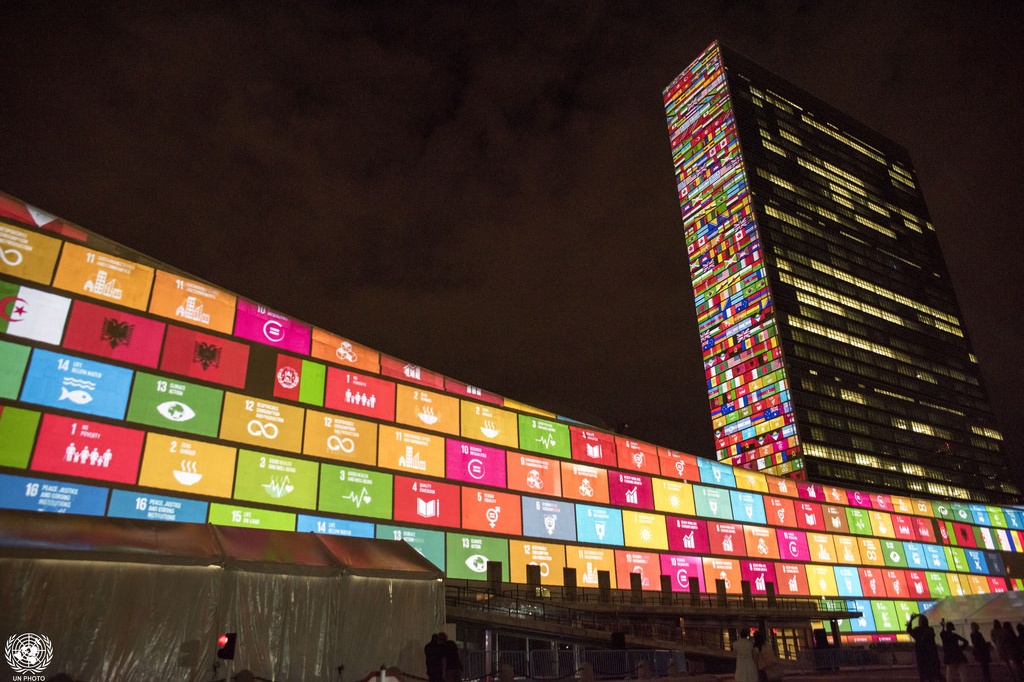
The 2026 session of the UN High-level Political Forum on Sustainable Development (HLPF) took place in July 2026.
This July, as the 2026 High-Level Political Forum on Sustainable Development (HLPF) convened at UN headquarters, China’s Global Development Initiative (GDI) put forward an ambitious agenda.
On July 14, Ambassador Sun Lei, Chargé d’Affaires a.i. of China’s Permanent Mission to the UN, delivered a joint statement on behalf of the Group of Friends of the Global Development Initiative—a coalition of over 80 countries. The statement was framed as a complement to the UN-centered development architecture, aimed at closing implementation gaps in the 2030 Agenda. But the recommendations went beyond complementarity.
The Group called for accelerating the World Bank shareholding review and realigning quota shares at the International Monetary Fund. It urged the UN to deepen dialogue with emerging multilateral financial institutions. It called for forward planning for the post-2030 development framework. And it explicitly identified “unilateral coercive measures” as a structural obstacle to global development cooperation, a direct critique of U.S. sanctions policy.
According to Beijing, the GDI has mobilized more than US$23 billion since 2021. It has launched over 1,800 cooperation projects across eight priority areas: poverty reduction, food security, pandemic response and vaccines, financing for development, climate change and green development, industrialization, digital economy, and digital-era connectivity.
These are not trivial figures, but neither are they transparent. The GDI does not publish a standardized, publicly accessible registry providing project-level financing terms, implementation status, outcomes, and independent evaluations. While some GDI-branded projects are implemented through UN agencies and may inherit their safeguards, the scarcity of systematic public data makes the initiative difficult to assess.
China’s dual strategy is worth analyzing. On one hand, Beijing embeds the GDI within UN frameworks and affirms the UN’s central coordinating role. On the other, it builds the GDI’s own coalition and promotes deeper UN engagement with China-backed multilateral institutions, such as the Asian Infrastructure Investment Bank (AIIB) and the New Development Bank (NDB).
Scholars have described this as “institutional layering,” a strategy of simultaneously working within and alongside existing structures. The distinction is visible in the two institutions themselves: the AIIB, with over 100 members including many U.S. allies, and a record of co-financing with the World Bank, operates largely within the established system. The NDB, by contrast, remains BRICS-centered and has been constrained by the Russia sanctions situation. Together, they reflect China’s dual approach of embedding some institutions inside the existing order while keeping others ready as alternatives.
The GDI’s call for the UN to deepen dialogue with these institutions is a subtle yet clear message: China’s preferred institutions should be treated as legitimate nodes of the development system, not peripheral alternatives.
This is not a rejection of the multilateral system. Rather, it resembles institutional hedging—a long-term bet that if the Western-led order fails to deliver, an alternative architecture is already in place.
The timing is not coincidental. The 2026 HLPF convened with only four years left until the 2030 deadline. Only 36 percent of the 139 Sustainable Development Goal (SDG) targets are on track or making moderate progress. The forum’s ministerial declaration acknowledged that progress is under pressure from widening inequalities, financing gaps, conflict, climate change, biodiversity loss, debt burdens, food and energy insecurity, and weakening trust in multilateral cooperation.
Into this implementation gap, the GDI offers a concrete, funded proposition. But one may ask: is it a genuine contribution to sustainable development, or is it a vehicle for Chinese influence-building?
The answer is both. Chinese officials have been candid about the GDI’s alignment with the Belt and Road Initiative and its role in advancing China’s foreign policy objectives. Development assistance has always been an instrument of foreign policy for major powers. China is not unique in that regard. But the fusion of development and strategic competition in the GDI is unusually visible.
Which raises a sharp question for Washington: Where is the American answer?
The U.S. was elected to a two-year term on ECOSOC beginning January 1, 2026, on the same day China began its three-year term. Both countries now sit on the UN’s principal organ for economic and social cooperation.
On the HLPF sidelines, the U.S. Mission hosted a high-level forum on Trade Over Aid, an initiative that has attracted 46 signatory countries. It is a declaration of principles and a platform for connecting governments with private-sector and institutional partners. In comparison, the GDI is a state-coordinated umbrella bringing together multiple funds, a project pool, training programs, bilateral cooperation, and international partnerships.
These are not competing equals but different categories. Washington offered a market-led doctrine, while Beijing put forward a state-coordinated delivery system embedded in SDG-aligned diplomacy.
The softening of U.S. leadership reflects a retreat from a domain in which China is actively expanding its presence. The GDI’s call for IMF quota realignment and World Bank shareholding reform is a direct challenge to U.S.-dominated institutions. The U.S. holds effective veto power over major structural decisions at both. How Washington responds to these demands, whether through engagement, resistance, or indifference, will signal its willingness to share power or risk being bypassed.
The GDI’s opacity is not incidental. It is a structural feature that complicates potential U.S. engagement. Without clear project-level data, independent evaluation, or stakeholder consultation, the GDI remains a black box to a certain extent. Washington cannot partner with what it cannot scrutinize. Nor can it ignore what it cannot understand.
Yet the transparency gap is not unsolvable. There is a quiet convergence around the sustainability disclosure standards developed by the International Financial Reporting Standards (IFRS) Foundation’s International Sustainability Standards Board—standards that China itself has already begun adopting. No one currently requires GDI projects to report against any such framework. That is precisely the opening. Could Washington push for project-level disclosure under standards Beijing has already endorsed? It would not solve all the GDI's shortcomings. But it would be harder to dismiss as a Western imposition.
The stakes extend beyond the current SDGs. The GDI is already planning for the post-2030 development framework. The framework that extends, or replaces, the 2030 Agenda after 2030 will shape global development for another generation. However, the U.S. is not active at the table. Whether this reflects U.S. disengagement or a lack of priority is an open question.
Critics may argue that the GDI’s scale is modest compared to decades of U.S. aid. They will point to its alignment with Chinese geopolitical interests and its lack of independent oversight. These criticisms are valid but incomplete.
Beijing frames the GDI as part of its broader vision for a “Community with a Shared Future for Mankind,” a blueprint for how countries can transcend differences to confront shared global challenges. Yet it can also function as a hedge against a future in which Western-led institutions, paralyzed by zero-sum games, fail to deliver.
For a post-2030 world, the politics of sustainable development governance are unfolding in the UN corridors and in the quiet rise of parallel and regional institutions. China is shaping it. The question is whether the U.S. will start to see it as a priority—and if so, whether it will have anything more to offer than a trade initiative.
