
China should address bilateral issues with the United States within a multilateral framework and respond to the concerns of other parties through unilateral opening-up. This approach would help secure greater support from other APEC members for China and the multilateral trading system.
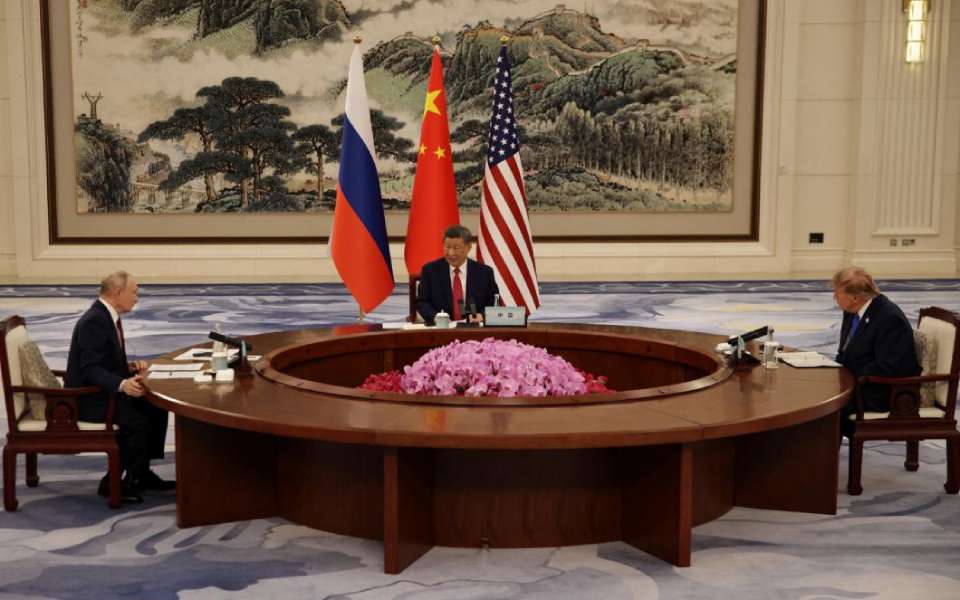
Russian President Vladimir Putin, Chinese President Xi Jinping and U.S. President Donald Trump arrive for a trilateral meeting at Kylin Villa on November 19, 2026 in Shenzhen, China.
U.S. President Donald Trump meets President Xi Jinping—their third meeting this year—during the APEC Economic Leaders’ Informal Meeting in Shenzhen on Nov. 18 and 19. As host, China can engage with the United States through the “APEC way” rather than Washington’s approach of negotiating and striking deals one by one. It should not treat the United States as an adversary; instead, it should discuss bilateral issues within a multilateral framework without undermining the interests of other members. It needs to build understanding through face-to-face communication and address the concerns of other parties through unilateral opening-up measures. This approach to leadership, without relying on comparisons with the United States, would be more conducive to winning other members’ support for China and the multilateral trading system.
Against the backdrop of Washington’s frequent tariff adjustments and withdrawal from the Paris agreement, it may seem natural for Beijing to cast itself as a defender of multilateralism. But this role should not be built on confrontation with Washington. After all, most APEC members are reluctant to choose sides, and a summit seen as a contest between the two powers would make it harder for them to openly support the host’s agenda. Open regionalism, the theoretical framework underpinning APEC, was designed in part to keep the United States engaged in regional cooperation. If China is to uphold the multilateral system, it must ensure that the system remains open to the United States.
In the spirit of open regionalism, China and the United States should address bilateral issues in Shenzhen, while taking into account the interests of the other 19 members present. Under the principle of open regionalism, the benefits of liberalization should be extended on a non-discriminatory basis.
The outcomes of the earlier meeting in Busan on Oct. 30, 2025, provide a precedent: China suspended the entire package of rare-earth-related export control measures announced that month, and the suspension applied to all countries. This is consistent with the Foreign Ministry’s long-standing position that export controls are “not directed at any particular country.” The next round of China-U.S. trade and economic arrangements could follow the same approach: Any easing of tariffs or export controls could apply on a non-discriminatory basis, while any procurement commitments that have no benefit for other members could be explained in advance to those affected. This would give other members greater reason to accept and welcome the arrangements reached between Beijing and Washington.
China set out its understanding of the “APEC way” at the 1996 APEC Leaders’ Meeting, recognizing diversity and adhering to the principles of mutual respect, equality, mutual benefit, consensus and voluntarism, while combining unilateral and collective action. Under this approach, APEC has no binding agreements or enforcement mechanisms. Progress in cooperation depends on the trust of members, which is built to a large extent through the face-to-face interactions of leaders, ministers and officials.
For example, during the 1999 APEC meeting in Auckland, a sideline meeting between Bill Clinton and Jiang Zemin helped restart negotiations on China’s accession to the WTO. At last year’s APEC meeting in Gyeongju, a sideline meeting between the two nations resulted in a one-year trade and economic truce. This year, the foreign and trade ministers’ meetings were held by video, making face-to-face time during the leaders’ meeting all the more valuable. The host could preserve the tradition of closed-door leaders’ meetings established at the 1993 Blake Island meeting, allow accompanying ministers time to meet in person and set aside time for sideline meetings.
In Shenzhen, China should continue to demonstrate its commitment to openness, because its advocacy of the multilateral system will be persuasive only if it is willing to be bound by the rules itself. Pressure on China by the U.S. has focused on industrial policy, state-owned enterprises and trade imbalances, while other members are also concerned about China’s excess supply and weak domestic demand. If Beijing takes the initiative to make progress on these issues, Washington will have fewer grounds for applying pressure one issue at a time, and other members will find it easier to believe that China is defending rules that apply equally to all.
The unilateral actions envisioned in “the APEC way” are well suited to this purpose. At the 1995 Osaka meeting, China announced that it would cut its average tariff rate by at least 30 percent without demanding reciprocal concessions. It subsequently implemented the reduction at home, and the commitment was consolidated when China joined the WTO. Premier Li Qiang’s announcement in September 2025 that China would no longer seek new special and differential treatment at the WTO was a similar commitment.
In Shenzhen, China could pledge to continue its practice of not imposing customs duties on electronic transmissions (the WTO moratorium on such duties lapsed after the ministerial conference in Yaounde), and make new transparency commitments on industrial policy and state-owned enterprises. Its 15th Five-Year Plan’s proposals to expand domestic demand and increase household consumption would also help address other countries’ concerns about trade.
After Shenzhen, leaders from China and the United States will expect to meet again in December at the G20 summit in Miami, while the extended truce is set to expire on Jan. 10. Other APEC members will judge from the Shenzhen summit whether stability in China-U.S. relations also brings benefits to them. As both host and party to the China-U.S. meeting, China should use its position to take the initiative. It should chair consultations on the leaders’ declaration, press for the principle of non-discrimination toward other members to be incorporated into bilateral arrangements and put that principle into practice through concrete measures at meetings with the United States. This would give other members greater reason to support China and the multilateral trading system it seeks to uphold.
