
The focus of the Russia-Ukraine war is shifting from front-line engagements to deep-strike operations, while the central arena of competition is increasingly defined by each side’s capacity to sustain the war effort. In this evolving landscape, drones have emerged as a pivotal force.
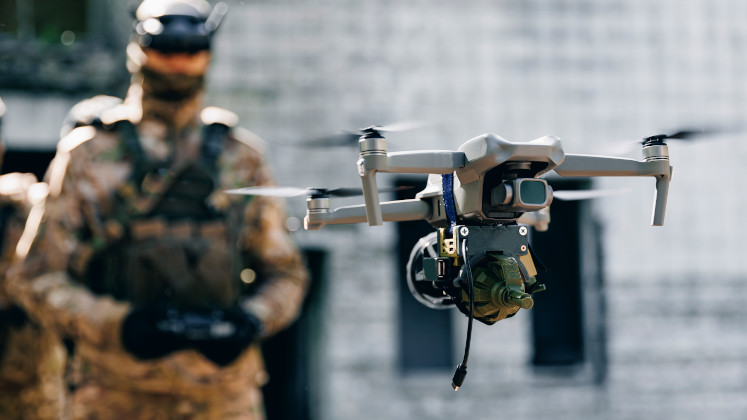
U.S. President Donald Trump’s recalibration of American policy toward Ukraine has introduced new variables into the war, but the more fundamental change lies in the war itself. The focus of the Russia-Ukraine conflict is shifting from front-line engagements to deep-strike operations, while the central arena of competition is increasingly defined by each side’s capacity to sustain the war effort. In this evolving landscape, drones have emerged as a critical force reshaping the battlefield. This does not, of course, mean that conventional ground operations have lost their relevance; rather, the importance of a sustained fighting capacity is becoming more pronounced.
The drone factor
Since the beginning of this year, Ukraine's deployment of long-range drones has moved beyond the tactical level and gradually become an important means of eroding Russia’s capacity to sustain the war. The scope of these drone strikes has expanded to encompass energy, transportation and defense industrial facilities deep inside Russian territory, while operational targets have shifted from the front lines to critical nodes underpinning Russia’s ability to continue. During the first half of this year, Ukrainian drones reportedly carried out 195 strikes against Russian oil refineries, 11 times the number recorded during the same period last year. Nine of Russia’s 10 largest refineries have come under attack. The International Energy Agency estimates that the strikes have reduced Russia’s oil refining capacity by approximately one-third.
The frequency and range of Ukraine’s deep-strike operations have also increased markedly. In June alone, Ukrainian forces reportedly struck more than 170 military and industrial targets, with its longest-range attack exceeding 2,700 kilometers. The operations have steadily raised Russia’s cost of sustaining its war effort. Moscow has been compelled to devote greater resources to the protection of critical energy infrastructure and transportation hubs. At the same time, the continuing costs of air defense deployments, infrastructure repairs and energy subsidies have further strained public finances. According to Russia’s Ministry of Finance, cumulative spending on such subsidies exceeded 1 trillion rubles ($13.5 billion) between April and June.
New phase for West
The NATO Summit in Ankara suggests that Western support for Ukraine is entering a new phase, marked by two major developments.
First, the Trump administration has adjusted its approach to Ukraine, signaling its intent to maintain support for Kyiv. Notable measures include authorizing Ukraine to manufacture the Patriot missile system domestically and publicly affirming the role of President Volodymyr Zelenskyy’s government. Although these defense industry projects are unlikely to generate meaningful combat capability in the short term, the policy shift carries considerable political significance. It indicates that the United States has not scaled back its support for Ukraine despite differences over Middle East issues. Rather, while pressing Europe to assume greater responsibility, Washington is further consolidating its leading role in shaping the international response to the Ukraine conflict.
Continued intelligence support from The United States has been a key factor enabling Ukraine to steadily expand the scope of its deep-strike operations. The focus of this assistance is no longer limited to providing battlefield intelligence. It now increasingly centers on enhancing the effectiveness and precision of Ukraine’s long-range attacks. For example, the United States has assisted Ukraine in planning drone flight routes and identifying paths that avoid Russian air defense systems.
Second, the declaration issued at the NATO Summit in Ankara once again identified Russia as a long-term security challenge and laid out a framework for assistance to Ukraine for 2026-27. Although differences remain within the alliance over the scale of future assistance, NATO continues to demonstrate a high degree of cohesion on the fundamental issue of supporting Ukraine. Even if fighting is expected to subside eventually, Europe’s long-term strategy of vigilance toward and deterrence against Russia is unlikely to change. Promoting the localization of defense industrial production in Ukraine represents a concrete extension of this strategy. It signifies that Western support for Ukraine has evolved from emergency assistance to an institutionalized posture, one that is likely to serve as a cornerstone of Europe's long-term response to the perceived Russian threat.
Russia adapts
In response to Ukraine’s deep-strike drone operations, the Russian military, under the leadership of Valery Gerasimov, has continued to adjust its operational structure and is transforming itself from a traditional heavy ground force into a high-tech, multi-domain, sustained-mobilization military. It has also established dedicated unmanned systems forces to adapt to the changing character of warfare.
Russia has not underestimated the long-term pressure created by Western support for Ukraine. On one hand, official statements have portrayed the U.S. policy adjustment toward Ukraine as a political show orchestrated by Trump, arguing that Washington still wishes to preserve room for improving relations with Moscow. On the other, Russia’s security establishment has continued to monitor what it describes as NATO’s movement toward “derussification.”
More noteworthy, however, is Russia’s steadily improving capacity to adapt to the evolving nature of the war. The strength of its active-duty armed forces has expanded to approximately 1.3 million personnel, while its drone production capacity has continued to increase. The current monthly output of tactical drones has reached the tens of thousands, enabling the military to sustain a high operational tempo in deploying unmanned systems on the battlefield.
At the same time, Russia has begun integrating the development of its drone industry into its long-term wartime mobilization strategy. The “Stalin’s Eagles” program launched in the Alabuga Special Economic Zone is designed to attract young people to drone-related industries. The broader objective is to incorporate unmanned systems into Russia’s future defense industrial base and personnel development, thereby strengthening its capacity to sustain a prolonged war effort.
In sum, the Russia-Ukraine war has entered a new phase in which the two belligerents are engaged in a renewed competition over their respective capacity to sustain the war effort. This does not mean that the outcome has become any clearer. On the contrary, it has made the trajectory of the conflict increasingly difficult to judge solely on the basis of gains and losses on the battlefield. What will ultimately determine the course of the war is no longer the outcome of any single campaign but which side can sustain its warfighting capacity over the long term while adapting to the changing character of warfare. The war in Ukraine will eventually come to an end, but the far more protracted process will be the reshaping of Europe’s security order.
