
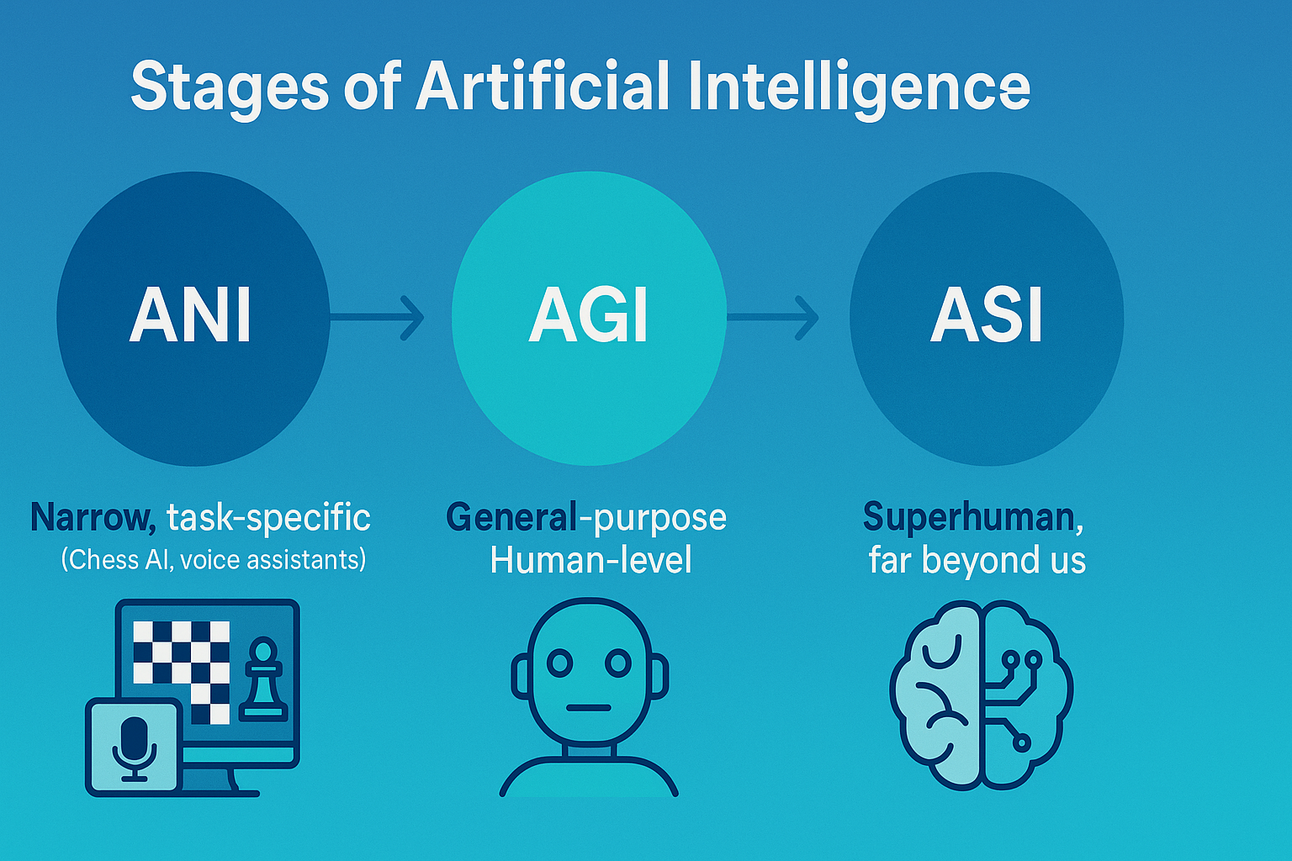
In recent years, Artificial General Intelligence (AGI) has re‑emerged as a central theme in artificial intelligence research and technology policy debates. In contrast to “narrow artificial intelligence” tailored for specific tasks or application scenarios, AGI is conventionally conceptualized as a general‑purpose intelligent system capable of cross‑domain learning, reasoning and adaptation. Its potential impacts are regarded as extending far beyond individual industries or technological spheres, and will profoundly reshape economic structures, social governance, and even international power configuration. For these reasons, AGI is no longer merely an engineering or academic problem, but has gradually evolved into a political‑economic issue of paramount strategic importance.
Contemporary discussion on AGI is primarily shaped by two dominant narratives. The first is the narrative of “technical feasibility” led by the technical community, which emphasizes a fundamental re‑understanding of the nature of intelligence through foundational layers such as cognitive modeling and learning mechanisms. The second is the narrative of “engineering feasibility” advanced by industry, which advocates incrementally approaching AGI by continuously scaling model size, computational power and data volume, based on the existing deep learning paradigm. These two narratives each command considerable support in both academia and industry. The divergence between Yann LeCun and Demis Hassabis over whether large models can lead to AGI, for example, vividly illustrates this debate.
Yet these two seemingly opposing narratives in fact share an implicit premise: the development of AGI is primarily a process driven by the internal logic of technology and industrial incentives, with the role of the state confined largely to “support” or “regulation”. While this assumption may still hold in the era of narrow artificial intelligence, it appears increasingly inadequate in the field of AGI, which is defined by extreme uncertainty, massive investment and far‑reaching externalities. AGI is confronted not with a single technical bottleneck, but with the compounding of multiple uncertainties: ambiguous technical pathways, unpredictable timing of its realization, and unquantifiable societal impacts. Under such conditions, exclusive reliance on market mechanisms not only risks inducing technological path locking and distorted resource allocation, but also proves inadequate to address the resulting societal risks and political pressures.
Against this backdrop, the development of AGI must be reconceptualized as a strategic issue. AGI possesses the distinct attributes of both a public good and a strategic asset. Its research and development require long-term, high-risk, cross-sectoral coordination of investment, entailing the systemic integration of computational power, data, talent, capital and governance frameworks. The critical role of the state lies not in substituting the market to make technological choices, but in establishing institutional arrangements that, under conditions of fundamental uncertainty, render technological exploration economically sustainable, politically acceptable, and socially risk-controllable.
From this perspective, the divergent pathways toward AGI exhibited by China and the United States acquire considerable analytical significance. As the two global leaders in contemporary artificial intelligence development, China and the United States not only stand at the forefront in technological capacity and investment scale, but also display substantial differences in institutional structures, state–market relations, and visions of technology governance. These differences are not merely rhetorical at the level of policy formulation; they have gradually become internalized into distinct modes of advancing AGI, forming two representative institutionalized development trajectories.
The United States began systematically laying the groundwork for AGI as early as 2016, with the release of Preparing for the Future of Artificial Intelligence during the Obama administration. The Executive Order on Maintaining American Leadership in Artificial Intelligence and The National Artificial Intelligence Research and Development Strategic Plan: 2019 Update issued during the first term of the Trump administration further reinforced the strategy of technological leadership in the AGI domain. In January 2025, the Executive Order on Advancing American Leadership in Artificial Intelligence Infrastructure leveraged the Stargate Initiative as its cornerstone, focusing on building ultra-large-scale data centers and computational power hubs to provide a continuously scalable computing foundation for next-generation general models. A comprehensive policy package consisting of four executive orders was released in July 2025, ranging from Winning the Race: An Artificial Intelligence Action Plan to measures aimed at preventing “woke AI,” accelerating data center construction, and promoting technology exports. This package sought to ensure breakthroughs in cutting-edge models while maintaining technological generational advantages through infrastructure investment and export controls. In November, the executive order Launching the Genesis Mission directly integrated frontier models into national-level scientific research projects in energy, materials, climate science, and life sciences. Its objective was to accelerate the translation of general capabilities into scientific discoveries and engineering breakthroughs through interdisciplinary computing power integration and collaborative model applications. This strategic layout relied heavily on the technological capabilities of a small number of leading enterprises, with the expectation of establishing global standards through technological leadership.
The current approach adopted by the United States can be summarized as a model-centric path. Under this model, AGI is regarded as the ultimate goal of technological innovation, and the core of institutional coordination lies in concentrating resources to drive continuous breakthroughs in model capabilities, while shaping de facto global standards through technological leadership. In this context, the government mainly functions through strategic planning, basic research funding and safety regulation, whereas concrete technological exploration and engineering implementation rely heavily on a handful of large technology enterprises. This model carries strong potential for breakthroughs and international competitive advantages in the short run, yet its inherent risks are equally pronounced. Most notably, its technological trajectory is highly concentrated and susceptible to path locking; its extreme concentration of computing power and data resources exacerbates ethical and security concerns; and its room for adjustment becomes relatively constrained once bottlenecks emerge in key technological pathways.
China’s strategic documents do not explicitly employ the concept of AGI, and its approach shares both similarities and differences with that of the United States. The two sides alike attach great importance to the technological and industrial development of artificial intelligence. Where they diverge is that China’s pathway toward AGI is led mainly by application-driven innovation, rather than betting exclusively on advancing cutting-edge model capabilities to reach AGI. The 2017 New Generation Artificial Intelligence Development Plan laid the foundation for a basic three-in-one framework of technology, industry and governance, around which all subsequent policy evolution has centered. A series of application-oriented policies issued between 2022 and 2025 exhibit a distinct infrastructure-focused orientation. By opening up application scenarios, building computing power networks and enhancing cross‑departmental coordination, these policies drive the systematic penetration of intelligent capabilities into the real economy and the field of social governance. The Global AI Governance Action Plan released in July 2025 and the Implementation Opinions on the Special Action for “Artificial Intelligence (AI) + Manufacturing” issued in January 2026 indicate that China is embedding the cultivation of AGI-capable competencies into its agenda of industrial upgrading and global governance.
In this process, China has gradually exhibited a “general-purpose infrastructure path”. Under this model, AGI is not conceived as a singular technological end‑point, but as a foundational capability that must be embedded into the national development system. Instead of wagering on the extreme breakthrough of a single technical route, the approach centers on the systematic integration of computing power networks, data systems, application scenarios and institutional mechanisms to drive the diffusion and accumulation of intelligent capabilities across a wider range of economic and social systems. The state assumes a more proactive role as overall coordinator, providing space for diverse technological pathways to thrive through infrastructure development, scenario openness and cross‑departmental coordination.
These two pathways are not simply a dichotomy between state-led and market-led models, but rather represent distinct responses to the same question: under conditions of high technological uncertainty and frequent market failure, how can institutional arrangements sustain the feasibility of long-term exploration? The U.S. model-centric path places greater emphasis on accelerating breakthroughs through market competition and technological concentration. Its strengths lie in innovation efficiency and global influence, while its risks center on instability at the technological and governance levels. China’s general-purpose infrastructure path, by contrast, prioritizes mitigating overall risks through systemic integration and capability diffusion. It offers advantages in terms of stability and controllability, while simultaneously confronting challenges such as escalating coordination costs and unpredictable breakthrough timelines.
Importantly, there exists no simplistic hierarchy of superiority or inferiority between the two developmental pathways. Rather, they embody rational strategic choices made by China and the United States regarding highly uncertain technology of AGI, constrained by their respective institutional contexts, developmental stages and strategic objectives. The developmental trajectory of AGI is by no means singular; its modalities of social embeddedness, structures of risk distribution, and reverse shaping effects on national capacity will all vary drastically in line with divergent modes of institutional coordination. From a broader analytical perspective, the divergence between China and the United States in the AGI sphere extends far beyond technological competition per se, and instead foreshadows divergent paradigms for integrating general-purpose technologies into national governance systems in the future. While substantial uncertainty still shrouds the ultimate realization of AGI, one conclusion is unequivocal: the exploration of AGI has already emerged as a critical testing ground for assessing states’ institutional coordination capabilities. Understanding the distinct pathways to AGI pursued by China and the United States not only facilitates a grasp of the tangible trajectory of artificial intelligence advancement, but also provides a pivotal analytical lens for deliberating on the interplay between cutting-edge technologies and national institutions.
