
The United States’ National Security Strategy reveals an administration grappling with the rise of China’s influence and the need to adapt to a world where America’s agenda can no longer be assumed by default in defense and trade.
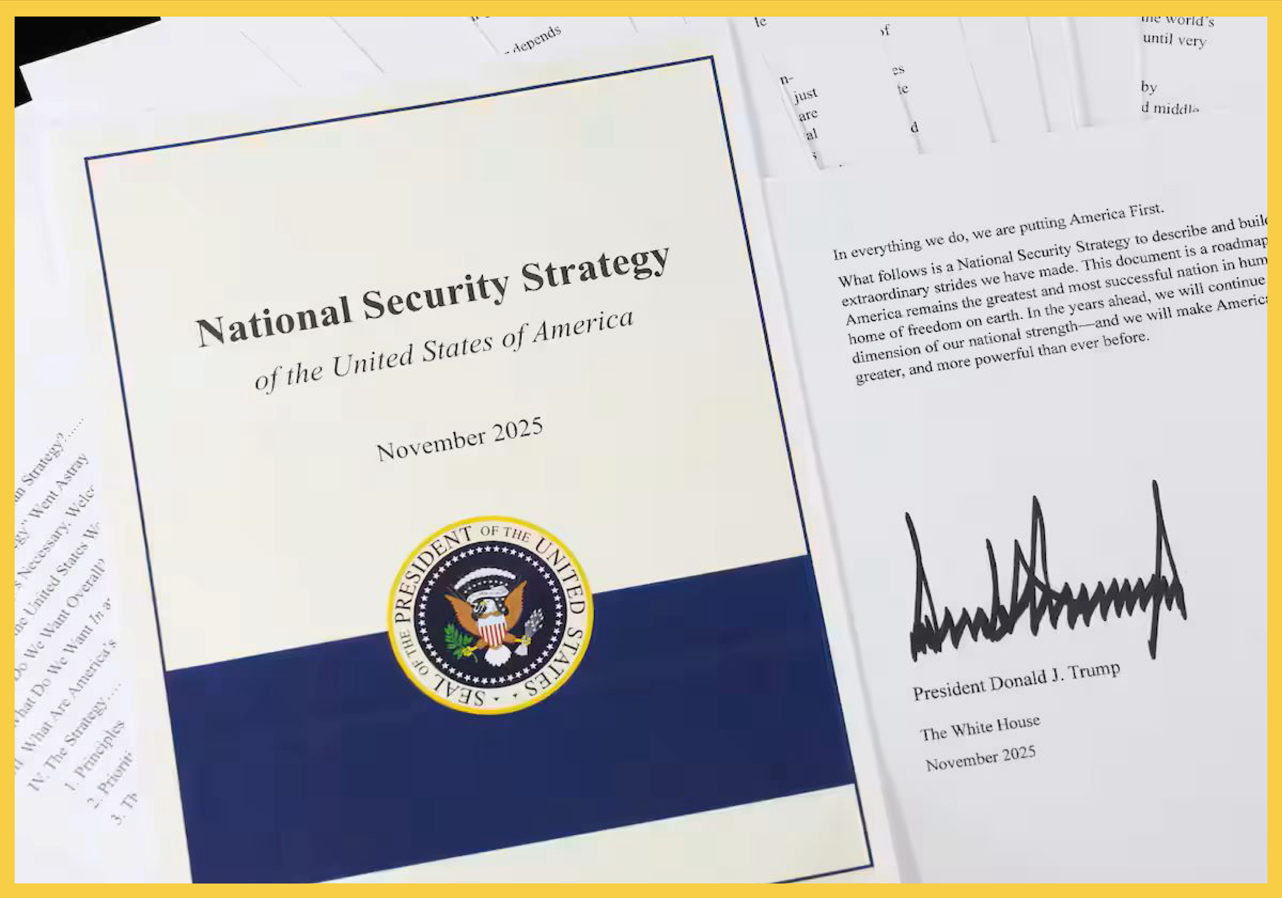
In a striking departure from three decades of post-Cold War orthodoxy, the United States' 2025 National Security Strategy (NSS), unveiled in December, explicitly rejects the pursuit of "global domination" in favor of "global and regional balances of power." This pivot acknowledges the inexorable return to a multipolar world – a reality underscored by Secretary of State Marco Rubio's January 2025 declaration that unipolarity was merely a "transient anomaly" born of the Soviet collapse, now supplanted by competing great powers like China and Russia. For the first time in generations, Washington is recalibrating its ambitions not as the world's indispensable hegemon, but as a preeminent actor in a fragmented order. This strategic introspection could support domestic renewal for America while presenting potential challenges in maintaining influence, particularly vis-à-vis China, and prompting adjustments in alliances in Europe and regional dynamics in Asia.
At home, the NSS embodies a pragmatic "America First" ethos, prioritizing economic vitality and homeland security over expansive global commitments. President Trump's second-term blueprint elevates reindustrialization, energy dominance, and border fortification as bulwarks against deindustrialization and overextension, attributed to elite-driven globalism since the 1990s. By narrowing focus to "core national interests," the strategy mandates "strategic selectivity," sidelining democracy promotion and climate multilateralism in favor of transactional alliances. This inward turn could bolster U.S. resilience: reshoring supply chains and modernizing the defense industrial base promise to mitigate vulnerabilities exposed by pandemics and trade wars. Yet it exacts a psychic toll, eroding the exceptionalist narrative that has sustained American primacy. Rubio's multipolarity framing – where nations pursue "what's in the best interest" of their own peoples – signals intellectual maturity, but risks domestic polarization if perceived as capitulation. In essence, the NSS trades imperial overreach for sovereign prudence, potentially fortifying America's long-term power projection if paired with fiscal discipline.
Yet early signals in 2026 call into question the extent to which the United States is genuinely embracing strategic restraint. Trump’s extraordinary measures against Maduro, intensified pressure across Latin America, revived strategic interest in acquiring Greenland, and renewed maximalist pressure on Iran suggest that “strategic selectivity” may function less as institutional restraint than as episodic, leader-driven coercion. Rather than retreating from dominance, Washington appears to be redefining it – privileging unilateral leverage, hemispheric control, and symbolic assertions of power over sustained multilateral engagement.
For China, the strategy's implications are Janus-faced: conciliatory rhetoric masks a zero-sum contest for influence. The NSS frames Beijing not as an existential "pacing challenge" (as in Biden's 2022 iteration) but as a partner for "rebalancing" economic ties, emphasizing U.S. standards in AI, biotech, and quantum computing to "drive the world forward." This softer tone – eschewing "major power competition" entirely – hints at pragmatic coexistence, aligning with Rubio's view of multipolarity as spheres of influence rather than ideological crusade. Yet beneath lies a hawkish undercurrent: deterring Chinese "deployment" in the Western Hemisphere via a "Trump Corollary" to the Monroe Doctrine, while bolstering Indo-Pacific denial capabilities. More consequentially, Washington's deprioritization of Europe and Africa – regions now ranked below the Americas and Asia – creates vacuums ripe for Chinese exploitation. The NSS calls for European NATO allies to assume full defense burdens by 2027, effectively signaling U.S. withdrawal from continental security guarantees. In Africa, long a low-priority theater, reduced U.S. engagement – coupled with the strategy's dismissal of "global burdens" – invites Beijing's Belt and Road Initiative to deepen infrastructure footholds, from ports in Djibouti to minerals in the Congo. This retrenchment, while freeing U.S. resources for Asia, paradoxically empowers China: a multipolar order where American selectivity amplifies Beijing's relational diplomacy.
These dynamics echo Trump's first-term retrenchments, where U.S. withdrawals from multilateral frameworks handed Beijing unbidden windfalls. On January 23, 2017, mere days into his presidency, Trump formally exited the Trans-Pacific Partnership (TPP) – a 12-nation pact championed by Obama to embed U.S.-aligned rules in Asia-Pacific trade. This vacuum propelled China to consummate the Regional Comprehensive Economic Partnership (RCEP) in November 2020, the world's largest free-trade bloc by GDP (encompassing 30% of global output across 15 Asia-Pacific economies), sidelining American standards on labor, IP, and environment. Similarly, Trump's July 2020 notice to quit the World Health Organization (WHO) – effective November 2021, though later reversed – amid COVID-19 recriminations ceded global health leadership to Beijing. China amplified its influence through vaccine diplomacy and funding pledges, filling the void with soft-power initiatives like the Health Silk Road. Today, deprioritized theaters in Europe and Africa beckon expanded Chinese inroads, from EU green tech pacts to African mining concessions, entrenching Beijing's parallel order at Washington's expense.
Compounding this asymmetry, China's economic resilience underscores the limits of U.S. containment. As of November 2025, Beijing's annual trade surplus in goods eclipsed $1 trillion for the first time in history – up 21.6% from 2024 – with projections for further expansion through December amid robust export momentum. President Trump's tariffs, intensified post-inauguration, scarcely dented this trajectory: U.S.-bound shipments plummeted 28.6% year-on-year in November, yet overall exports surged 5.9%, propelled by deft redirection to non-Western markets. ASEAN nations bore the brunt of this pivot, registering the steepest import spikes as Chinese manufacturers flooded neighbors with diverted goods from American shelves – Vietnam and Thailand alone absorbing over 20% of the rerouted volume. Europe, too, saw a 14% uptick in Chinese inflows, fueling Brussels' alarms over industrial erosion and prompting preemptive safeguards. This agility – not mere volume, but strategic circumvention via currency depreciation and supply-chain reconfiguration – exposes the NSS's rebalancing aspirations as aspirational at best, illusory at worst. In a multipolar economy, Beijing’s surplus supports domestic stimulus while subtly challenging the alliances Washington seeks to manage selectively, making U.S. strategic selectivity inadvertently facilitate Chinese influence.
Macron's state visit to China from December 3-5, 2025, exemplifies Europe's frantic recalibration amid this U.S.-induced disequilibrium. Amid deepening EU-China trade imbalances – Beijing's surplus with the bloc ballooned over €300 billion in 2024 – Macron issued a stark ultimatum: redress the asymmetry or face "strong measures" like U.S.-style tariffs on Chinese goods. In interviews post-visit, he lambasted China's surplus as "unsustainable," and warned of "de-coupling" if unaddressed. Discussions with Xi Jinping spanned trade, geopolitics, and environment, yielding pacts on nuclear cooperation but no surplus concessions. For France and the EU, this portends a rupture: Macron's tariff threat – coordinated with Commission President Ursula von der Leyen – signals a shift from "strategic autonomy" to protective mercantilism, eroding the bloc's normative appeal as a rules-based counterweight to U.S. unilateralism. Yet it underscores transatlantic divergence: while the NSS eyes economic rebalancing with China, Europe's response risks escalation, potentially diverting Beijing's overcapacity westward and straining Franco-German unity. In a multipolar Europe adrift from U.S. security umbrellas, Macron's gambit buys time for industrial revival but invites Chinese retaliation. Ultimately, it exposes the EU's vulnerability: sans American ballast, Europe's China policy veers toward fortress economics, diminishing its leverage in a Beijing-Washington duopoly.
U.S. multipolar rhetoric itself, however, jars against the escalatory imperatives enshrined in the National Defense Authorization Act (NDAA) for 2026. $900.6 billion in defense spending will prioritize Indo-Pacific fortification, allocating over $1 billion to the Taiwan Security Cooperation Initiative for training, medical support, and casualty care. It mandates a joint U.S.-Taiwan program for co-developing unmanned aerial vehicles and counter-drone systems by March 1, 2026, alongside expanded coast guard coordination and assessments for regional munitions stockpiles. All in all, these allocations collectively amount to what U.S. authorities have framed as an unprecedented $11 billion package in security and arms-related support for Taiwan, underscoring the growing dissonance between Washington’s multipolar discourse and its operational security commitments in the region. Provisions explicitly target Beijing's exclusion from U.S. military supply chains, while bolstering allies like the Philippines with $500 million in Foreign Military Financing. Paradoxically, it reinforces European entanglements – allocating $800 million over two years to the Ukraine Security Assistance Initiative and barring U.S. troop reductions below 76,000 in Europe, clashing with NSS burden-sharing – while funding $175 million for Baltic security and mandating annual Russian threat assessments to NATO. Senator John Curtis (R-UT) hailed it as reflecting "the evolving security landscape," ensuring readiness to "deter adversaries like China and Russia" through deepened Taiwan ties.

Beijing's official response to the $1 billion Taiwan funding in the U.S. NDAA was one of vehement condemnation. Foreign Ministry's Guo Jiakun echoed this, vowing "resolute measures" to safeguard territorial integrity amid U.S. "provocation." This rhetoric signals escalating tensions, priming gray-zone escalations.Herein lies the profound dissonance: the NSS's embrace of balanced multipolarity – eschewing zero-sum rivalry for selective engagement – clashes with the NDAA's unyielding hawkishness, which treats China as the preeminent threat in a multi-theater confrontation, with Russia as a tacit co-adversary. Where the strategy hints at economic coexistence and hemispheric restraint, the Act operationalizes a de facto frontline in the Taiwan Strait, pumping arms and infrastructure into the region under the guise of "cooperation." Taiwan is positioned not primarily as a sovereign partner in a pluralistic order, but as a key strategic outpost, potentially exposed in the event of escalation. At the same time, the slow pace of legislative action, shaped by bipartisan congressional priorities, can complicate the executive branch’s strategic adjustments, creating the possibility of unintended tensions with China. In Graham Allison's Thucydidesian lens, such incoherence – between rhetorical maturity and budgetary belligerence – does not diffuse the trap; it primes it, inviting miscalculation in an order where U.S. selectivity demands, above all, doctrinal coherence.
The 2025 NSS signals growing multipolar maturity for the United States, though it presents challenges of trade-offs and internal tensions. By acknowledging great-power pluralism – reflected in Rubio’s realism – Washington creates opportunities for others to fill emerging gaps. At the same time, the NDAA’s more assertive provisions highlight potential tensions, where legislative momentum can reinforce established patterns even as strategic guidance emphasizes caution. Navigating these dynamics successfully depends on aligning these vectors; otherwise, a fragmented order may emerge, where U.S. retrenchment could inadvertently strengthen rivals rather than stabilize balances. History's trap now manifests not merely in clash, but in the chasm between aspiration and implementation.
