
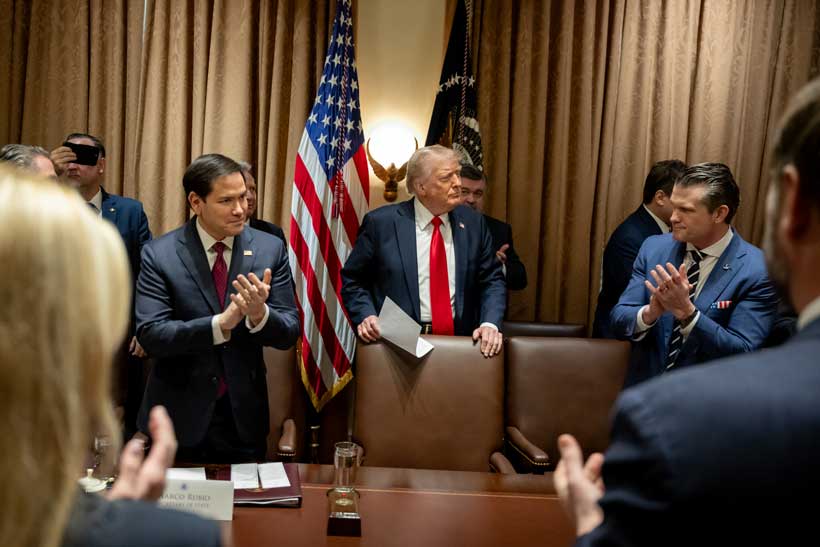
On December 5, 2025, the Trump 2.0 administration released the new National Security Strategy (NSS).
The new US National Security Strategy is not, in any meaningful sense, a strategy. A strategy connects means to achievable ends. What President Donald Trump’s White House published last week is something else: a 33-page confession that this administration does not believe in the future – and therefore sees no point in investing in it.
Trump’s NSS oscillates wildly between triumphalism and declinist anxiety. America is the greatest nation in history; America is being invaded. We are winning; we are losing it all. This is not simply incoherence: It is the cognitive signature of a movement that experiences demographic and cultural change as existential catastrophe.
The NSS announces sweeping objectives without specifying resources, timelines, or mechanisms. Calling it “short-sighted” suggests that a long game is being neglected. But there is no long game. A movement convinced that its world is ending does not plan for the next generation. It smashes and grabs.
The grabbiness is explicit. “All our embassies must be aware of major business opportunities in their country, especially major government contracts,” the NSS instructs. “Every U.S. Government official that interacts with these countries should understand that part of their job is to help American companies compete and succeed.” Diplomacy has been formally converted into a business development operation.
The National Security Council is tasked with identifying “strategic locations and resources” in the Western Hemisphere for exploitation. Le Monde calls it what it is: prédation économique – economic predation.
The Council on Foreign Relations observes that great-power competition has vanished as an organizing principle in this NSS, replaced by economics as “the ultimate stakes.” The document is more polemic than strategy, Council members say, and non-Americans would be wise to discount it as a genuine statement of intent.
Still, the disappearance of great-power rivalry as a framework is not an oversight. It reflects an administration that has quietly abandoned the project of shaping the international order because shaping that order requires believing in the future.
Consider the treatment of allies. The NSS redirects rhetorical fire toward Europe while markedly softening its language about Russia and other adversaries. It warns that Europe risks “civilizational erasure” through immigration and “regulatory suffocation.” It demands that Europeans assume “primary responsibility” for their own defense—while simultaneously announcing that the United States will “cultivate resistance” to Europe’s current political trends by supporting nationalist and populist parties in European Union countries.
This is not alliance management. It is sabotage dressed as burden-sharing.
The administration claims to reject the liberal internationalist habit of lecturing others about their internal affairs. But it then announces a hemispheric sphere of influence that denies Latin American countries the sovereign right to choose their own trading partners and security arrangements. The “Trump Corollary” to the Monroe Doctrine is nineteenth-century great-power politics repackaged for a president who cannot distinguish between national interest and personal enrichment.
The Cato Institute, no friend of liberal internationalism, identifies another contradiction: the tension between rhetoric rejecting “forever wars” and an underlying insistence that the US must remain global arbiter. An “America First veneer” overlays a de facto hegemonic project. The administration wants the benefits of primacy without its burdens – deference without commitment, access without relationships.
This is not foreign-policy realism. It is the doctrine of someone who has never had to honor a promise. What holds its contradictions together is not a theory of international order or a vision of American leadership, but rather a shared enemy: the future itself.
The NSS is suffused with demographic angst. Migration is framed not as a policy challenge but as an “invasion.” The border is “the primary element of national security.” The document blurs the line between external threats and internal political competition, treating diaspora communities and demographic change as security problems on par with hostile states. This is the “Great Replacement” theory translated into official dogma.
Why does an administration preparing to withdraw from global commitments need to demonize immigrants? Why does a strategy focused on the Western Hemisphere devote so much energy to attacking European migration policy? It is because the fear that animates this administration is not China or Russia or terrorism. Its animating fear is that tomorrow’s America will not look like yesterday’s America. The NSS is not a plan for navigating the future. It is an expression of rage at the future’s inevitability.
This explains the predatory economics. If you have given up on building lasting relationships, you extract what you can while you can. If alliances are just transaction costs, you abandon them. If the international order impedes you in any way, you refuse to maintain it. The logic is that of a liquidation sale: everything must go.
Fear of the future also explains the Trump administration’s softness toward Russia. Vladimir Putin’s Kremlin shares Trump’s demographic anxiety, hostility to liberal institutions, and resentment of a cosmopolitan future, and he has what Trump wants: a revisionist ethnonationalist state that has embraced imperialism and suffered no meaningful consequences. The NSS does not name Russia as a serious threat because this administration does not experience Russia as threatening what it values.
What remains when policy cannot deliver what a movement craves? Demolition. Alliances that took generations to build can be wrecked in months. The NSS provides ideological justification – “civilizational” language, “great replacement” premises, “invasion” rhetoric – for severing the ties that allow democracies to work together to confront the grave challenges of the future.
The goal is not merely to ignore real threats but to redefine the threat itself as demographic change – the very presence of people Trump calls “garbage.” Why preserve alliances to manage the future if the future will not be white?
The NSS is what happens when foreign policy is drafted by those who experience the future as an enemy. Unable to stop time, they settle for smashing the clocks – and pocketing whatever isn’t nailed down.
Copyright: Project Syndicate, 2025.
www.project-syndicate.org
