
Last week, the Trump administration released its new national security strategy. It was quickly condemned by the neoconservatives — perhaps because it is more realistic about multipolarity.

For months, Pentagon officials had been working on a new national security strategy (NSS) proposing the Trump administration prioritize protecting the homeland and Western Hemisphere over the neoconservatives’ “China threat.”
It is a striking reversal from the military’s years-long mandate to focus on the “threat from China,” ever since the Obama-Clinton “pivot to Asia.” The new NSS, developed by the Trump loyalists, largely overturns the focus of the first Trump administration’s 2018 National Defense Strategy, which placed deterring China at the forefront of the Pentagon’s efforts.
Leading the NSS drafting, Elbridge Colby, the Pentagon’s policy chief, played a key role in writing the 2018 version during Trump’s first term. Despite his long track record as a China hawk, Colby aligned with Vice President JD Vance on the desire to disentangle the U.S. from foreign commitments.
The new NSS conflicts with the massive needs of the colossal U.S. military-industrial complex, which has fueled America’s costly, deadly and counter-productive wars since September 11, 2001, with more than $8 trillion in costs and millions of dead and wounded.
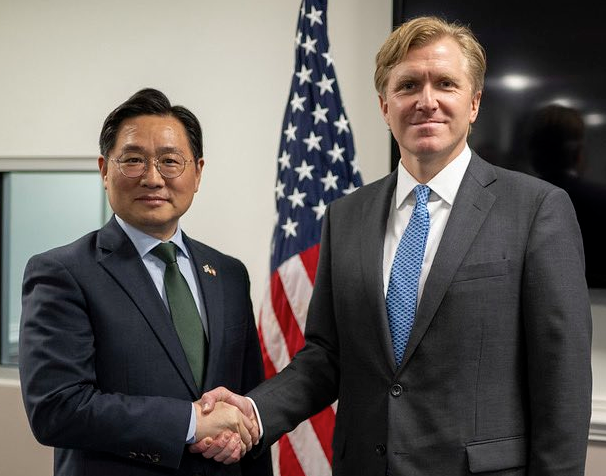
Colby with South Korean Deputy Defense Minister Cho Chang-rae in May 2025.
Source: Wikimedia, https://commons.wikimedia.org/wiki/File:Elbridge_Colby_Cho_Chang-rae_May_2025.jpg
Eclipse of American interventionism?
The NSS focuses on great-power competition and domestic renewal, rather than promoting democracy, global institutions, or an expansive U.S. role in nation-building.
As opposed to the Democratic administrations and most Americans who see climate change as a major strategic risk, the Trump NSS notably omits extreme climate as a national security threat. That's its gravest mistake.
The Trump NSS also marks a significant shift from the post-Cold War consensus of both Republican and Democratic administrations. It treats alliances as transactional instruments and calls for real burden-sharing, critiquing allies for "free-riding" on U.S. defense spending.
This skepticism about neoconservative interventionism is highly objectionable to those interests that tout America’s continued entanglements in international affairs. Typically, U.S. media outlets like The Atlantic, a longtime champion of transatlantic economic and military cooperation, dismissed the document as "incoherent babble," full of "sycophancy, lies, inconsistencies, and grotesque self-contradictions."
Typically, too, the author, Eliot A. Cohen, is a veteran of the U.S. Department of Defense and intelligence community, worked under the neoconservative apostle Paul Wolfowitz and was the co-founder of the Project for the New American Century (PNAC), the champion of the 2003 U.S. invasion of Iraq.
The NSS implications vis-à-vis Europe, Japan
The Trump NSS explicitly criticizes European allies as facing "civilizational erasure" due to immigration and "anti-democratic restrictions." Hence, the drastic tsunami of its rightful condemnations across Western Europe.
The NSS emphasis is on Europe becoming self-reliant for its defense, with warnings that the US might not honor collective security commitments unless allies meet specific spending targets. The strategy emphasizes "burden shifting" and a rebalancing of economic relationships.
In May, Colby told British officials that the United States wanted the British Armed Forces to focus less on the Indo-Pacific and more in Europe. In the view of the NSS, the UK’s job is to focus on Europe, not Asia.
The U.S. expects Japan to take on more of the defense burden in the Indo Pacific. Hence, the U.S.-Japan alliance is moving away from the consistent postwar pattern of U.S. leadership and security guarantees that did not always require strict reciprocity from allies. They were generous and their time is now over.
NATO as a cashcow
In June, Colby pushed for the Department of Defense to launch a review whether to scrap the AUKUS agreement with Australia and the UK. Colby also pushed for Japan to increase its military spending to 3.5% of its GDP, which led Tokyo to cancel a meeting between U.S. secretary of state Marco Rubio and defense secretary Pete Hegseth, and their Japanese peers.
These burden-sharing objectives are consistent with the NSS that allows the Trump administration to pressure its NATO allies and non-NATO partners alike to engage in greater military spending. But the goals are also shrewd. They will profit the U.S. and weaken its allies and partners. Washington provides 98% of arms supplies to Taiwan; 97% to Japan; 86% to the UK and South Korea, respectively; and 81% to Australia.
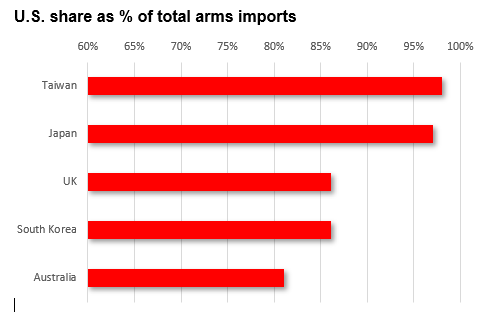
Source: SIPRI, author
The more these allies and partners share the burden, the more the Pentagon's defense contractors stand to profit. It is a multibillion-dollar racket. Since the U.S. is the greatest supplier of its allies and partners, the burden-sharing is very much in the interest of U.S. economic primacy and efforts to regionalize conflicts away from America.
To allies and partners, it's a double-whammy. They pay the bill and they shoulder the risks. Consequently, the deals must be sold with misguided patriotism and inflated threats.
Views from Russia and China
Some analysts agree that the emphasis on fiscal constraints and a return to the Monroe Doctrine in the Western Hemisphere are overdue shifts.
Perhaps that’s why reactions have been somewhat different in Russia, where analysts have been highly positive about the new U.S. strategy, with Kremlin officials stating it aligns with Moscow's own worldview.
Despite the assertive rhetoric on Taiwan, the NSS’s explicit declaration of U.S. preference for non-interference in other nations' affairs, respect for state sovereignty and prioritization of the Western Hemisphere might indicate a shift in regional focus.
Colby advocates for the U.S. to shift its military planning and resources to prepare for a conflict over Taiwan. Last March, he confirmed his intention to increase U.S. military resources in the Indo-Pacific and called on Taiwan to nearly quintuple its defense budget to 10% of GDP.
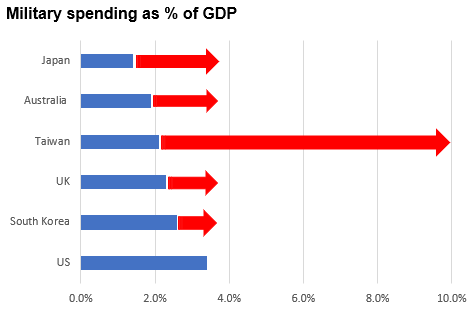
Blue: Military spending of US NATO allies and major non-NATO partners in 2024
Red: U.S. preferences of their level of military spending
Source: SIPRI, author
However, Colby has also called for the destruction of TSMC, the Taiwanese semiconductor giant and one of the world’s most valuable semiconductor conglomerates, to keep it out of Chinese control should Chinese military forces capture Taiwan.
In contrast to the neoconservatives, Colby rejects cartoonish accounts of the Chinese Communist Party and sees China as a rising power. As a nationalist realist, he supports efforts for a "genuinely mutually advantageous economic relationship" with China.
Reconciliation with multipolarity
Trump's NSS could, in some aspects, be reconciled with a multipolar view of the world, though its ultimate goal is still American preeminence.
The NSS acknowledges the existence of powerful great power competitors like China and Russia and focuses on managing competition with them, which aligns with the multipolar reality.
The "America First" approach rejects traditional unipolar primacy. Its emphasis on strategic restraint and burden-sharing implicitly accept that U.S. resources are not limitless.
Transactional engagement that deals with nations as they are, rather than trying to change them, is more suited to a multipolar system where various powers assert influence based on their own interests.
Interestingly, some of these views could be reconciled with those of the Democratic progressives. The greatest difference between the two centers of global cooperation versus nationalism. Nonetheless, both stress the primacy of domestic and economic issues – a common denominator to many American lower-middle class and laboring poor wavering between Trump and democratic leaders in recent elections.
Most importantly, there is a partial overlap in a shared restraint against and skepticism toward interventionism, as reflected by "forever wars" and military over-extension.
Continentalism déjà vu
There is a deep affinity between the Trump NSS and progressive ideas on continentalism, as envisioned by America’s pre-eminent prewar historian Charles A. Beard, a leading proponent of non-interventionism.
Beard advocated "American Continentalism" arguing that America had no vital interests at stake in Europe.
The core affinity between Beard's continentalism and the Trump NSS is the shared emphasis on prioritizing domestic interests while avoiding foreign entanglements and alliances.
Both doctrines promote a foreign policy rooted solely in the tangible, immediate U.S. interests, including “nonintervention in Europe.” In both, foreign policy has an inherent economic subtext and must serve the nation's economic well-being.
There is more to the Trump NSS than meets the eye. It features longstanding strains of American thinking, including progressive ideas, that could be modified with 21st century ideas of multipolarity.

