
The scale of U.S. military exercises continued to expand, mainly focusing on improving the combat capabilities of allies and partner countries and emphasizing strengthening military preparations and strategic deterrence for major power competition.
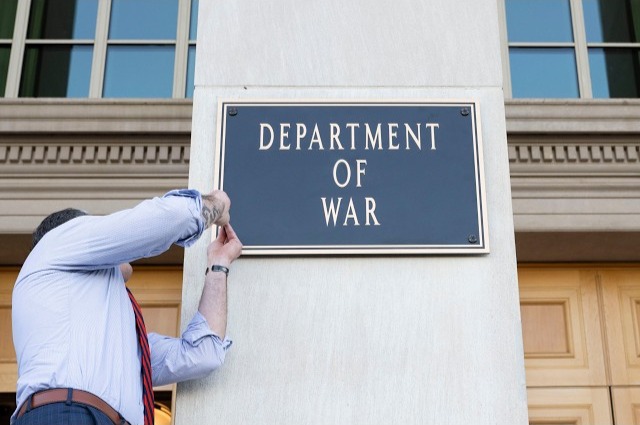
U.S. President Donald Trump signed an executive order authorizing the Department of Defense to use "Department of War" as a secondary title on September 5, 2025.
February concluded the first year of Donald Trump’s second term as president of the United States. Upon his taking office, the administration continued to advance Trump’s “America first” strategy, which he advocated during his first term, putting forward five key policy priorities: lowering costs for all Americans, ensuring border security, unlocking America’s energy advantages, pursuing peace through strength and making all Americans feel safe and secure again.
He created the unofficial Department of Government Efficiency and launched sweeping reforms, including abolishing federal agencies such as the U.S. Federal Executive Institute, the U.S. Agency for International Development and the Consumer Financial Protection Bureau. The Trump administration also imposed the so-called reciprocal tariffs on goods exported to the United States, a move firmly opposed and resisted by China, Canada, Mexico, the European Union and others.
This year, Trump successfully pushed the Republican Party’s One Big Beautiful Bill Act through Congress and released strategic documents including the National Security Strategy, National Defense Strategy, Acquisition Transformation Strategy and Artificial Intelligence Acceleration Strategy, putting forth the Trump corollary to the Monroe Doctrine. His administration was characterized by shifting the priority from global expansion to domestic issues, from unilateral burden-bearing to allied sharing, from incremental improvement to wartime speed, from balanced investment to a focus on disruptive technologies and from all-around confrontation to competing without confrontation against China, which reflect a realistic recognition of America’s relatively declining strength and embody the strategic prudence to avoid direct conflict with a near-peer competitor.
The 2025 defense budget was historic, surpassing the $1 trillion mark—a sharp increase of about 14.5 percent over the previous year’s $883.67 billion. Of this, the total authorized amount for weapons and equipment procurement reached $161.7 billion. Coupled with hundreds of billions of dollars in mandatory funds injected into shipbuilding, ammunition and drones by the One Big Beautiful Bill, the U.S. military ushered in the largest and most targeted weapons and equipment procurement wave since the end of Cold War.
The total number of U.S. active-duty military personnel was about 1.3 million, decreasing 7,800 from the 2024 fiscal year. Reserve forces stood at 765,700, an increase of 2,100 compared with the 2024 fiscal year. Civilian personnel numbered 694,000.
The U.S. military maintains at least 128 overseas bases in 51 countries or regions, of which 68 are long-term military bases:
• In the Indo-Pacific theater, the U.S. military has focused on construction centered on the Guam, Northeast Asia and Southeast Asia base clusters, seeking to deter China through strength rather than confrontation.
• In the European theater, taking advantage of the Russia-Ukraine conflict, the U.S. has courted Nordic and Eastern European countries, rapidly expanded the number of military bases and strengthened its overall deterrence posture against Russia.
• In the Central theater, the U.S. military has continuously reinforced its deployments in the Middle East to deter Iran, counter extremist violent organizations and engage in strategic competition with China and Russia.
• In the Africa theater, the U.S. military completed its full withdrawal from Niger while exploring new drone deployment sites in Benin, Ivory Coast and other locations to maintain a small-scale military presence.
• In the Southern theater, the U.S. military maintains several long-term bases and temporary military facilities in Latin America and the Caribbean with an expanded troop presence, aiming to consolidate and strengthen American influence in the region.
U.S. military research in 2025 exhibits three distinct characteristics:
First, the U.S. military is placing greater emphasis on research into conflict with China. All three articles that won first, second and third prizes in the Military Review’s 2025 General William E. DePuy Writing Contest, as well as two honorable mentions, are all China-related, underscoring China’s prominent strategic importance.
Second, the U.S. military is undergoing a transition that aims to outcompete China. In the past, the U.S. military research on China primarily focused on operational domains; however, in 2025, a significant portion of the research centered on how to outcompete China, accounting for two-fifths of the award-winning articles in Military Review that year.
Third, the research is strongly characterized by ideology. A clear example is the article “Steppes of Resistance: Mongolian Nationalism as a Strategic Resistance to Chinese Revanchism in the Indo-Pacific,” which distorts historical facts and undermines China-Mongolia relations.
The United States expanded its military presence in the Western Hemisphere, enhancing its ability to control strategic thoroughfares and resources. In the Asia-Pacific region, it urged Japan and South Korea to increase their defense spending, expanded its military presence in the Philippines and strengthened military deterrence against China. In Europe, it demanded that allies bear the main responsibility for military aid to Ukraine and European defense, and reduced its investment in Europe.
The scale of U.S. military exercises continued to expand, mainly focusing on improving the combat capabilities of allies and partner countries and emphasizing strengthening military preparations and strategic deterrence for major power competition. It continuously enhanced the application of new types of combat forces such as cyber, space and unmanned systems, and focused on verifying operational concepts through military exercises to promote the development of operational theory.
In fact, the most striking development in 2025 was U.S. military reform. To implement the “America first” strategy and fulfill the mission of “pursuing peace through strength,” the U.S. Department of War proposed three overarching strategic goals: restoring warrior ethos, reshaping the U.S. military and rebuilding strategic deterrence. It then kicked off its all-around military reform by emphasizing warrior ethos and focusing on war preparedness; increasing the defense budget to meet the needs of the U.S. military; adjusting organizational structures to improve work efficiency; building the Golden Dome system to strengthen strategic deterrence; eliminating the mentality of zero-defect and selecting talent based on merit; strengthening unit management to enhance cohesion and combat effectiveness; breaking legal restrictions to persist in deploying troops domestically; and transforming the defense acquisition system to accelerate the fielding of urgently needed combat equipment.
However, the Trump administration guided the military reform with executive orders of the presidente, not laws enacted by Congress. It thus lacked legal foundation. Dispatching the National Guard and active-duty troops to respond to domestic social unrest was widely questioned. Bypassing state governments to directly dispatch the National Guard aroused dissatisfaction among state governments. Merging combat commands and reducing the number of active-duty four-star generals by 20 percent triggered dissatisfaction among the military’s senior leadership. How far this unpopular military reform can go remains to be seen.
In addition, on June 21 and 22, the U.S. military launched an operation called “Midnight Hammer" against Iran, with what it characterized as “surgical strikes” on three Iranian nuclear facilities—in Fordow, Natanz and Isfahan. The strikes destroyed part of Iran’s nuclear facilities, delayed the progress of Iran’s nuclear program and had a negative impact on U.S.-Iran relations, the Middle East geopolitical pattern, the global nuclear non-proliferation regime and America’s own image.
