
The conflict and its surrounding issues are characterized by a series of interconnected paradoxes, none of which comes with a simple, direct or rapid solution. The United States and Iran appear destined for a prolonged strategic contest.
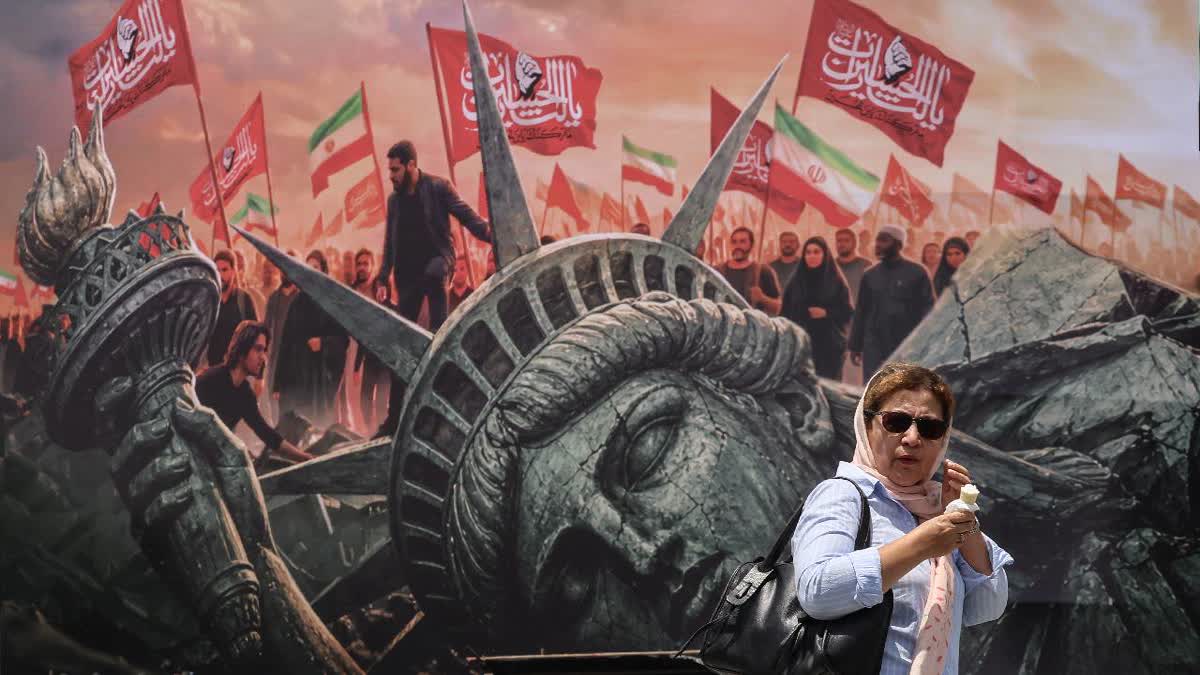
An Iranian woman walks past an anti-US billboard at Enghelab Square in central Tehran on August 3, 2026. (AFP)
When the United States and Israel launched military strikes against Iran in February, their overwhelming military superiority led both governments to expect a swift and decisive victory. The much-publicized rhetoric of a “100-hour campaign” reflected that initial confidence. Even after the conflict settled into stalemate, U.S. President Donald Trump continued to believe that the war could be concluded within four or five weeks. Yet six months on, there is still no end in sight.
The reason for this lies in the nature of the conflict itself, which is shaped by a series of interconnected paradoxes, each involving issues that defy simple, direct or rapid solutions. As a result, Washington and Tehran appear destined for a prolonged strategic contest rather than a quick military resolution.
The first paradox is that neither the United States nor Iran has been able to escape the logic of long-term confrontation. Whether through coercion or diplomacy, both sides have exhausted virtually every available option and yet remain trapped in a seemingly inescapable cycle of hostility. Iran regards the United States as its principal global adversary, while Washington sees Iran as its foremost strategic challenger in the Middle East. Their rivalry extends across political, economic and military domains, resembling what may best be described as a “mini Cold War.”
The United States has long sought to bring about regime change in Iran, while Tehran has consistently pursued the goal of driving the United States out of the Middle East altogether. For decades, Washington has imposed sweeping economic sanctions and maintained extensive restrictions on Iran. As a result, Iran’s oil production has still not returned to its 1979 level, which imposes enormous economic costs on the country. Meanwhile, Iran has sought to impose long-term costs on the United States. In the 1983 Beirut barracks bombing, 241 U.S. service members were killed. During the Iraq War, which began in 2003, another 4,600 U.S. military personnel lost their lives. Washington has long attributed these and many other losses to Iran, further deepening hostility between the two countries.
Over the past 47 years, successive U.S. administrations have tried virtually every available approach to break the deadlock, including economic sanctions, political isolation, limited military operations, full-scale military action, diplomatic negotiations and reconciliation agreements. Yet none has fundamentally resolved the problem. The two countries have failed to overcome their strategic rivalry or even to establish normal diplomatic relations.
The history of the U.S.-Soviet Cold War suggests that the collapse or fundamental transformation of one side’s political system was a necessary precondition for ending the Cold War. By the same logic, the current “mini Cold War” between the United States and Iran is unlikely to end unless either the U.S. undergoes a fundamental political transformation or Iran experiences a regime change.
The second paradox is that although the military superiority of the United States and Israel is overwhelming, the prospect of achieving regime change has become more elusive. The Economist once described the Iran war as “a stunning aerial success,” highlighting the overwhelming air superiority enjoyed by the United States and Israel. Together, those two countries have carried out more than 20,000 air sorties against Iran. Israel has not lost a single fighter aircraft, nor has it suffered a single military fatality. Judging by the combat loss rate recorded during the 2003 Iraq War, the United States would have been expected to lose at least 300 fighter jets in a campaign of this scale. In reality, however, only one U.S. fighter has been destroyed by crashing inside Iranian territory.
Despite possessing the ability to strike virtually any target, at any time and from any location, neither the United States nor Israel has succeeded in bringing about regime change in Iran. In both Iran and Yemen, neither country has deployed ground forces, yet neither the Iranian government nor the Houthi authorities have collapsed. In Gaza and Lebanon, by contrast, Israel has committed ground troops, yet neither Hamas nor Hezbollah has been eliminated as a military or governing force. This raises a broader question: Is this paradox now a defining feature of contemporary international politics, or is it merely an exception?
The third paradox is that the rapid proliferation of missiles and drones has enabled even small states and non-state armed groups to impose sustained economic disruption on major powers—and, in some cases, on the global economy itself. Not long ago, the ability to project military power over long distances was the exclusive domain of the world’s superpowers. Today, however, Iran and the Houthis are both capable of using missiles and drones to threaten targets more than 2,000 kilometers away with relative ease.
After the Strait of Hormuz was blockaded, Trump reportedly lamented that he had never imagined it could be so easy to shut down one of the world’s most important maritime chokepoints. A handful of missiles or drones, he remarked, could achieve exactly that.
More important, the widespread diffusion of missile and drone technology has made it virtually impossible for the United States and Israel to eliminate these capabilities altogether. Missile and drone stockpiles are dispersed across Iran, and so long as trained personnel remain, new drones can continue to be produced and launched against military bases and vital sea lanes thousands of kilometers away. As a consequence, the absolute security that Washington and Tel Aviv have pursued for decades has become increasingly unattainable.
The fourth paradox is that even though Iran has suffered severe military setbacks, the so-called Iran threat—confrontation of the United States—has become more acute, not less. During the Twelve-Day War in June last year, the United States and Israel launched large-scale strikes against Iran’s military leadership, nuclear scientists, missile infrastructure and nuclear facilities. Yet by the eve of the current war, in late February this year, Iran’s missile inventory had already recovered to roughly its prewar level.
In the current conflict, Iran has so far retained the capability to strike American and Israeli targets. This suggests that, so long as the regime remains in power, Tehran is capable of quickly rebuilding its leadership structure and restoring both its nuclear and missile capabilities.
More important, a weakened Iran may ultimately pose an even greater challenge to the United States. Recent intelligence reports suggest that Iran’s new leadership is even more determined to acquire nuclear weapons. In the past, attacking U.S. military bases, blockading the Strait of Hormuz and striking Arab states in the Gulf were regarded by Tehran as red lines that should not be crossed. In the future, however, such actions could become the new normal.
Previously, Iran feared that resorting to extreme measures would damage its national interests. Today, with little room left to retreat and increasingly convinced that it has little left to lose, Tehran may come to regard more extreme actions as the most effective means of ensuring both national survival and regime survival.
The fifth paradox is that while this war represents yet another major strategic miscalculation by the United States, it is equally difficult to conclude that Iran has emerged as the winner. Faced with the combined military pressure of the world's leading military power and the Middle East’s dominant regional military power, the Iranian regime has not only survived but has so far retained the capacity to launch effective retaliatory strikes against both the United States and Israel. It has even compelled Washington to make concessions by leveraging its ability to disrupt shipping through the Strait of Hormuz.
Some analysts argue that Iran has won the war simply by avoiding defeat, while the United States has lost simply by failing to achieve victory. Such a conclusion, however, overlooks an important historical lesson. The United States has previously committed major strategic miscalculations—in Iraq, Libya and Afghanistan. Although Washington ultimately paid a heavy strategic price, it was the people of those countries who bore the greatest human and economic costs. There is little reason to believe that the Iran war will prove any different.
If the conflict drags on, as appears entirely possible, the Strait of Hormuz may remain blocked for an extended period. The United States, the Arab states in the Gulf and the wider international community would undoubtedly bear significant economic and strategic costs. Yet the country likely to suffer the most would be Iran itself as it faces comprehensive isolation and blockade.
The sixth paradox is that even though Israel has won one military victory after another, the overall strategic environment has continued to deteriorate. The conflict between Israel and the so-called Axis of Resistance has increasingly become a lose-lose game for both sides. Since the outbreak of the Gaza war in October 2023, Hamas, Hezbollah and Iran have all suffered severe military setbacks. Yet the “total victory” repeatedly promised by Prime Minister Benjamin Netanyahu has become increasingly elusive, and Israel has found itself trapped in a protracted, multifront conflict.
In Gaza, Hamas has not been disarmed. In Lebanon, Hezbollah has not been disarmed. Although Israel has established partial control over parts of these territories, it is well aware of the heavy costs of prolonged occupation, having maintained a military presence in southern Lebanon from 1982 to 2000. Since 2023, Israel has carried out four rounds of strikes against Iranian territory. Such operations may well become a recurring feature of the regional security landscape.
Netanyahu has argued that Hamas, Hezbollah and Iran no longer possess the military capabilities they once had to threaten Israel, an assessment that may well be correct. Yet the prospects for reconciliation have all but disappeared. Instead of moving closer to lasting security, Israel risks becoming locked into an increasingly permanent cycle of confrontation, with no clear path out of the darkness.
The seventh paradox is that while both the United States and Iran seek to avoid a full-scale war, the risk of that continues to grow. After 42 days of large-scale fighting, both sides have come to recognize that military force alone cannot achieve their fundamental objectives. The United States cannot overthrow the Iranian regime through war, nor can Iran force the U.S. out of the Middle East by military means. A full-scale war would impose unbearable costs on both countries. Yet each side continues to pursue what might be called “the peace of the victor.”
The current situation is therefore marked by a dangerous paradox. Although both Washington and Tehran are paying a heavy price, each believes that the other is suffering even more and each hopes the other will blink first. The confrontation has evolved into a contest of resolve, endurance and strategic judgment. Iran looks to the historical precedents of the U.S. withdrawals from Iraq and Afghanistan, convinced that time is ultimately on its side. The United States, by contrast, looked to the eventual collapse of Saddam Hussein’s regime in Iraq and Muammar Gaddafi’s regime in Libya, believing that persistence will ultimately bring victory.
The eighth paradox concerns alliances: Are they ultimately a strategic asset or a liability? Neither the United States nor Iran has found an easy answer. For decades, Israel has been described by Washington as its “unsinkable aircraft carrier” in the Middle East, a forward outpost for safeguarding American interests in the region. For Iran, the Axis of Resistance has served as its forward line of defense, designed to keep threats away from its own borders.
Alliance politics has long been characterized by a fundamental dilemma: Smaller allies fear abandonment, while great powers fear entrapment. Developments in the Middle East over the past three years suggest that both the United States and Iran have become victims of entrapment. The Biden administration had sought to reduce America’s strategic commitments in the Middle East, but was drawn back into the region by the Gaza conflict, which consumed substantial political attention and military resources. During the current Iran war, many Americans have argued that Trump was drawn into the conflict by Netanyahu, leaving the United States trapped in an increasingly difficult strategic position.
Iran has faced a similar predicament. Its two missile strikes against Israeli territory in 2024 were both triggered by conflicts involving Hamas and Hezbollah, eventually leading to two rounds of large-scale U.S.-Israeli military strikes against Iran. Neither Washington nor Tehran likely intended to reach the current level of confrontation. Instead, both have found themselves increasingly drawn into a broader regional conflict by the actions of their respective junior partners.
