
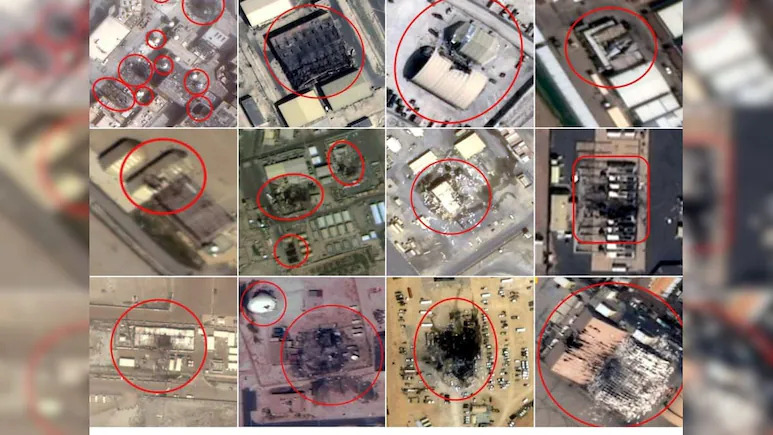
Satellite pics show Iran strikes damaged 228 assets across 15 U.S. bases. Among the sites was a satellite communications site at al-Udeid Air Base in Qatar.
Recent satellite imagery tells a sobering story. Iranian strikes during the 2026 conflict damaged or destroyed at least 228 structures and pieces of equipment across U.S. military sites in the Middle East. Hangars, barracks, fuel depots, aircraft, radars, communications nodes, and air defense systems were hit at around 16 installations spanning eight countries. This represents the majority of America’s regional footprint in West Asia. Analyses by The Washington Post and CNN, drawing on verified commercial and Iranian-released imagery, reveal far more extensive impact than initial Pentagon assessments acknowledged.
Iran achieved this with a saturation strategy: swarms of low-cost drones and older, less accurate missiles to exhaust defenses, followed by more precise systems. The Iranian inventory penetrated or overwhelmed layered U.S. protections, including Patriots and THAAD batteries. The lesson is unavoidable. Fixed, concentrated forward bases are extraordinarily vulnerable to modern precision and mass cheap autonomous systems. Runways remain stubbornly difficult to protect, and hardened aircraft shelters, while helpful, do not solve the broader infrastructure problem.
This is not an isolated regional anomaly. It is a demonstration with global implications, nowhere more so than in East Asia or the Western Pacific.
Asia’s Exposed Architecture
U.S. bases in Japan (notably Kadena), South Korea, the Philippines (EDCA sites), and even Guam sit within range of Chinese ballistic, cruise, and hypersonic missiles, supplemented by growing drone fleets. China’s inventory dwarfs Iran’s by orders of magnitude. Pentagon estimates, industry analyses, and open-source tracking put relevant Chinese theatre missiles in the thousands, with industrial capacity for rapid replenishment.
A detailed equilibrium model published by Anusar Farooqui (Policy Tensor) in early May 2026 quantifies the problem. Even in optimistic scenarios — U.S. aircraft dispersed across 24 bases, hundreds of additional hardened shelters, and highly effective electronic warfare degrading Chinese accuracy — equilibrium losses still exceed 200 aircraft in the opening week of intense salvos out of a total of approximately 400 air-frames. In more realistic cases involving mass cheap drones, the damage is worse. Suppression of defences and shelters consumes the bulk of Chinese munitions, yet the attacker retains enough to render sustained high-tempo operations from forward bases unsustainable. Should these optimistic assumptions — from the U.S.’ point of view — not hold, and electronic warfare is for instance not capable of significantly degrading Chinese accuracy and Chinese salvo delivery volumes are far higher than estimated — the outcome is even more stark.
U.S. air defence magazines, already strained by support to Ukraine, Israel, and now the Iran conflict, cannot match expenditure rates in a peer salvo. Replenishment timelines for key interceptors and precision munitions stretch into years. Directed energy weapons and improved decoys offer partial relief against drones, but they do not alter the fundamental cost-exchange ratio favouring the offence at scale. The physics and economics of modern warfare have rendered the old model of expansive forward bases anachronistic against capable adversaries.
The strategic consequence is profound. American extended deterrence in Asia, long premised on the credibility of forward-deployed forces able to survive and generate combat power, is undermined. Allies watching satellite imagery from the Middle East, alongside Israel’s experience with saturation attacks on its defences and the damage to cities like Tel Aviv, draw obvious conclusions. Talk of “Agile Combat Employment” and dispersal to austere locations is understandable and sensible adaptation, but it signals a shift away from reliable, high-volume presence at the points that matter most in the opening phases of conflict.
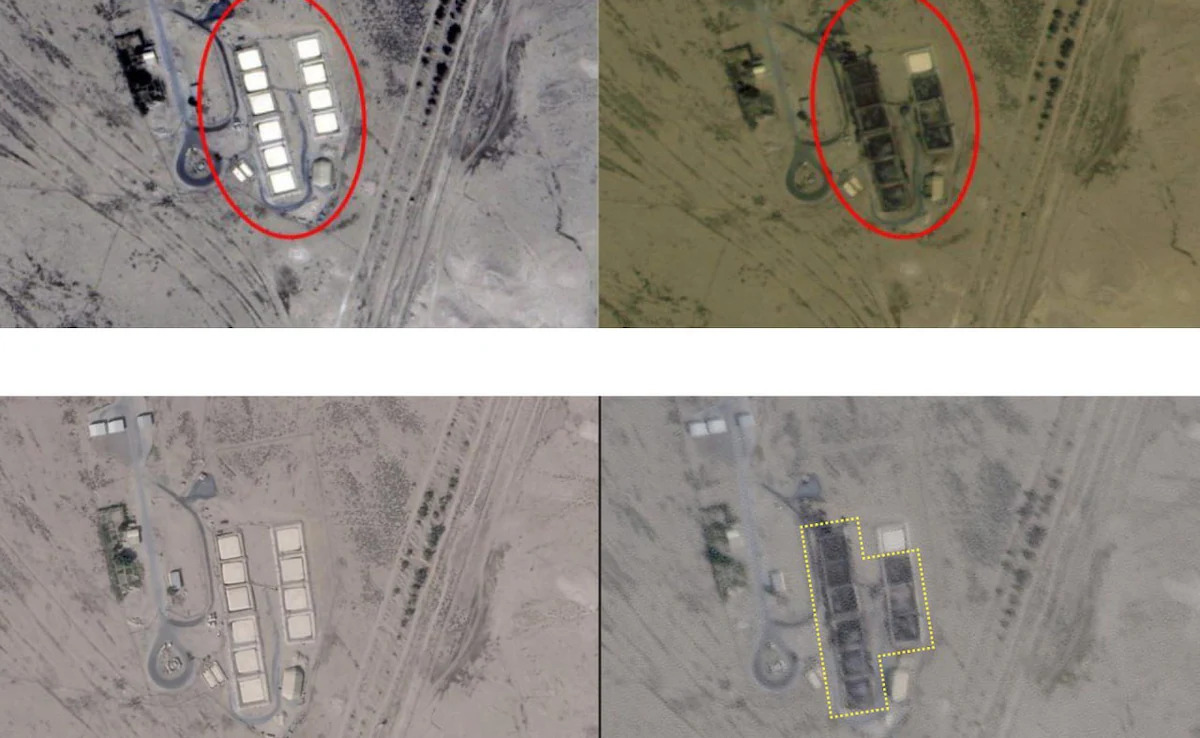
Nine fuel bladders at Ali al-Salem Air Base in Kuwait were damaged. Iran state-affiliated media released images with annotations, and The Washington Post used imagery from Planet to confirm the damage. (Photo: Press TV)
Energy Shifts, Russia’s Footprint and China’s Clean Tech Leadership
The material transformation extends deeply into energy security. Hormuz disruptions have accelerated diversification. Southeast Asian states and Japan have expanded hydrocarbon agreements with Russia. This is only one dimension. Russia, as a Pacific power with an Arctic coastline, is leveraging the Northern Sea Route (NSR) to forge new linkages. Russia’s Arctic LNG and oil projects target Asian markets, binding energy interdependence tighter.
Strategically, Russia deepens ties across the region. Its mutual defense treaty with North Korea gains a sharper edge as Pyongyang has formalised in its constitution the abandonment of reunification goals with South Korea. Russia maintains a comprehensive strategic partnership with Vietnam and strong connections with Indonesia, ASEAN’s “first among equals” and a master hedger. Jakarta buys Chinese J-10 fighters while maintaining explicit defence collaborations across all major powers. Putin and Xi have discussed extending a “security club” concept from the Shanghai Cooperation Organisation, which now covers much of the Eurasian continent, toward Southeast Asia.
At the same time, China’s commanding position in clean energy technologies offers a powerful parallel pathway. As the undisputed global leader in solar, wind, batteries, electric vehicles, and related supply chains, China is enabling the region’s dual energy hedge: Russian hydrocarbons for immediate reliability and Chinese technology for long-term electrification and resilience. Chinese solar panels, wind turbines, battery storage, and grid solutions dominate exports and investments across Southeast Asia, helping nations reduce vulnerability to chokepoint disruptions while advancing decarbonisation goals. Affordable financing and rapid deployment from Chinese firms accelerate this shift, deepening economic ties even as countries hedge politically.
This multifaceted energy dynamic — Russian fossils via sea and Arctic routes for baseload security, and Chinese clean tech for the future — further erodes dependence on traditional U.S.-guaranteed Middle East flows and strengthens cross-Eurasian linkages.
Retrenchment, Hedging and Self-Fulfilling Dynamics
Incremental American retrenchment is already visible. Efforts to force open the Strait of Hormuz faltered quickly, leading to a pause in favour of negotiations. In Asia, the U.S. emphasises burden-sharing, pushes allies toward greater frontline responsibilities, and promotes minilaterals. Japan accelerates remilitarisation — raising defence spending, acquiring strike capabilities, and deepening ties with the Philippines and Australia —while carefully framing it as alliance strengthening. The Philippines is being positioned as a southern anchor, a frontline state, yet domestic and logistical constraints limit depth. Arms flows to Taiwan continue but face delays amid competing priorities.
Some in the region may welcome reduced U.S. dominance, seeing opportunities for greater autonomy. Others view it with wariness. Some even see it with deep trepidation. The emerging vacuum creates new instabilities. Intensified hedging becomes self-reinforcing. Japan and Australia invest in autonomous capabilities and deeper bilateral ties, partly out of doubts about long-term U.S. steadiness. Taiwan’s domestic politics show greater flux, with KMT voices advocating engagement and hedging. Southeast Asian states diversify energy sources, with Singapore, Malaysia, Indonesia, and even Japan expanding hydrocarbon agreements with Russia amid Hormuz disruptions and broader pressures.
Nations across Asia are quietly contemplating futures with a less dominant — or at the outer edge, less engaged — United States. Minilaterals offer short-term utility for capability-building and signalling, but they risk crystallising bloc formation and a classic security dilemma. Exclusive arrangements can heighten tensions, marginalise inclusive forums, and force choices that smaller and middle powers prefer to avoid.
ASEAN’s Moment
This fluidity presents both danger and opportunity. The old hub-and-spoke architecture, built for a different era of American preponderance, is crumbling under material transformations. No clean U.S. withdrawal is likely — humiliation is not the American style — but adjustment is underway.
The natural convener for a new regional order is ASEAN. Too big and assertive to lead outright, China must handle its regional role with care if it wishes to avoid counter-balancing. Japan’s growing military profile generates mixed reactions; historical sensitivities and concerns about entanglement persist. ASEAN’s neutrality, consensus-driven diplomacy, and proven record in economic integration — most notably RCEP — position it uniquely to curate an “indivisible security and prosperity” framework.
ASEAN centrality has been rhetorical for years. The current crisis demands it become substantive. The group can expand confidence-building measures, advance a meaningful South China Sea Code of Conduct, deepen economic resilience, and facilitate dialogue that keeps great-power rivalry from fracturing the region. Success requires overcoming internal divisions (such as concerns about Myanmar and South China Sea claimant differences) and asserting agency against bypass by minilaterals.
There was an Asia before European arrival and American dominance. Geography, commerce, and civilisational ties bound the region long before external powers established their architectures. The proposition now is that Asian nations must forge an Asia after the Americans — one that leverages economic interdependence, respects sovereignty, and manages differences through diplomacy rather than relying on an external balancer whose material limits have been exposed.
This transition is unlikely to be linear or painless. Great powers will compete for influence, and hedging will continue. Yet the material realities — demonstrated in the skies over Middle Eastern bases and modelled for the Pacific—make return to the status quo ante impossible. The task of regional statecraft falls to those who live here. ASEAN’s moment to anchor a more inclusive, resilient order has arrived. The alternative is unmanaged fluidity sliding into dangerous fragmentation. History will judge whether Asia’s middle powers rise to the challenge.
