
A New Arena
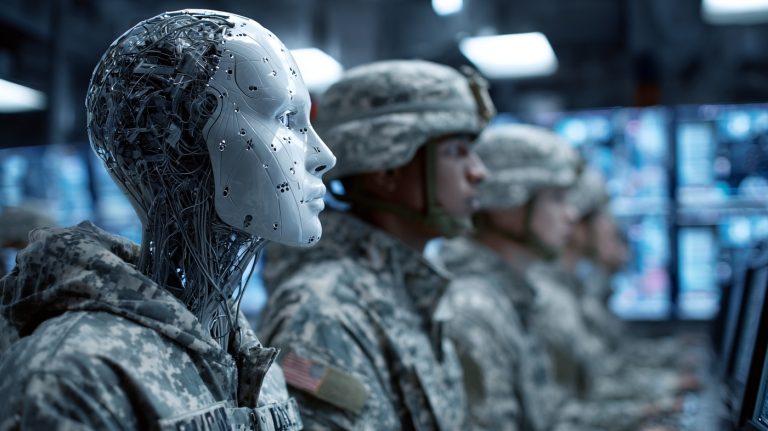
Artificial intelligence (AI) is rapidly becoming an indispensable part of the military relationship between China and the United States, with both countries viewing it as a key factor in shaping the future balance of military power. The United States emphasizes accelerating the application and deployment of AI in defense and military affairs in order to preserve its advantages on future battlefields. China likewise attaches great importance to the role of AI in national defense and security. President Xi Jinping has repeatedly stressed the need to accelerate “intelligentization” in military development, and has made clear that the People’s Liberation Army is to be basically modernized by 2035 and transformed into a world-class military by the middle of this century. Frontier technologies such as AI occupy an important place in that strategic objective. AI has been placed at the core of both countries’ military modernization strategies, transformation agenda, and has in effect, become a new arena of China-U.S. military competition.
Yet AI does not play a singular role in China-U.S. military relations as merely a “catalyst for conflict.” At a time when both countries face pressing demands for defense modernization, the impact of AI on their military relationship is multifaceted. Military applications of AI are inherently complex. They can drive revolutionary improvements in military effectiveness and changes in operational domains and areas, but they are also fraught with challenges, shortcomings, and uncertainties in delivering the empowerment they promise, while generating risks and threats that could undermine battlefield performance, national security and strategic stability. The application and deployment of AI in the military sphere is both a powerful tool for enhancing combat effectiveness and a new domain of competition between the two sides; at the same time, it can compel both countries to confront the common security risks they face. It is therefore necessary to examine China-U.S. military AI relations through the dual lenses of competition and cooperation. In addition, as two major powers of global consequence in the development of both AI and military might, China and the United States should jointly shoulder responsibility for addressing the structural security challenges created by the militarization of AI, seek dialogue and coordination mechanisms in relevant governance areas, and prevent technological and operational loss of control from harming national security, disrupting regional and global stability.
Empowerment and Risk Across Different Levels
AI affects military affairs in two ways – it can enhance military effectiveness and also generate multiple risks. These two aspects are like the two sides of a coin, running through the various levels and domains. On the side of empowerment, AI can help automate and optimize logistics, training, command, and other areas. In direct combat and battlefield management, the emergence of unmanned platforms combined with AI is likely at least in some areas, to change the paradigm of future warfare. At the same time, however, introducing AI into the military domain brings multiple potential risks. First, it may compress decision time and increase the probability of escalation. Second, current AI systems based on neural networks and data may induce human misjudgment because of algorithmic opacity and unreliable data, potentially leading to geopolitical conflict or humanitarian tragedy. Even more subtly, AI can be used in information warfare and cognitive warfare, generating massive quantities of false audio, video, or news content to disrupt the rival’s domestic public opinion and decision-making. In a context in which China and the United States are highly alert to each other’s strategic intentions, this kind of information-level manipulation may impose additional shocks on strategic stability. Third, the spiral of competition driven by the intelligentization of armaments is also likely to intensify. The artificial intelligence race has clearly become a new driver and new form of military-security competition between the two countries. In the absence of mutual trust and effective communication channels, both sides fear falling behind the other, and therefore accelerate investment in armaments and defense measures. Although senior U.S. military leaders have tried to send signals of restraint to avoid an uncontrolled arms race, and China has repeatedly emphasized that it does not seek an AI arms race with other countries, the objective reality is that neither side is willing, or likely, to appear weak in the military application of artificial intelligence. New deployments by one side are often perceived by the other as pressure, prompting it to devote equivalent or greater resources to catching up. This dynamic could trap the two countries in a situation in which they “win the race but lose security.” This predicament is not simply a “security dilemma.” Its potential negative effects are even greater, because neither side is motivated merely by a desire to preserve the status quo; rather, both seek to use new technological possibilities to produce changes advantageous to themselves.
More specifically, the military application of AI by the two countries has different effects from the tactical level up to the strategic level. At the tactical and technical level, AI has already been widely integrated into the weapons, support platforms, and systems of both countries. Its advantages are directly reflected in agility and precision at the micro level of the battlefield management, as well as in force development and management beyond the battlefield – for example, more real-time intelligence processing, more autonomous unmanned systems, and the faster closure of the chain linking battlefield awareness and firepower, all of which can improve sensing, decision-making, and strike efficiency, as well as that of logistical management and personnel training. This constitutes one of the most direct and intense arenas of China-U.S. competition. Both sides hope that AI will make their soldiers and weapons “smarter,” faster, and more effective than those of the other side. At the same time, the scope of these applications remains relatively limited. Whether in terms of empowerment or the risks of loss of control, there remains the possibility of spillover effects and escalation.
At the level of operations and theater, the effects of AI begin to grow more pronounced, and its influence on the shaping of the China-U.S. military posture becomes more significant. Both sides are exploring the use of AI to optimize command and control and battlefield management – for example, by using intelligent algorithms to integrate multi-source intelligence and assist commanders in decision-making, thereby creating “joint” and “all-domain” capabilities for perception and rapid response at the level of larger-scale operations, and enabling cross-service, cross-regional, and cross-domain information fusion and firepower allocation. At this level, the risks of AI applications for China-U.S. military relations also rise. Artificial intelligence-enabled rapid decision-making and joint strike capabilities mean that the offensive-defensive interactions between the two sides in potential confrontation becomes more intense, and the likelihood of loss of control and escalation increases in sensitive domains and regions. In the absence of effective mechanisms for communication and crisis management, a high-speed intelligentized battlefield could exceed the control of human commanders or “seduce” them and cause escalation from an isolated incident rapidly to into a military confrontation that is difficult to contain. AI is not only a “force multiplier”; it may also become a “risk amplifier.”
At the strategic level, the effects of AI on China-U.S. military relations become still deeper and more complex, bearing directly on strategic stability, nuclear deterrence stability, and the future direction of the global security order. First, AI may undermine strategic deterrence and stability. The development of intelligentized reconnaissance and strike technologies increases the possibility that the stronger side could detect the other side’s strategic deterrent forces and carry out effective strikes against them. The prospect of depriving the other side of a second-strike nuclear capability becomes both a possibility and a temptation. Meanwhile, if the relatively weaker side judges that the survivability of its own second-strike capability is in doubt, it could in theory face a “use it or lose it” dilemma. Either mechanism would weaken the deterrent balance between the two sides. In addition, the involvement of AI in strategic decision-making may lead to escalation through miscalculation. In a highly tense strategic context, if decision-makers rely excessively on information and recommendations provided by AI or AI-supported organizations or personnel, while those algorithms are biased or opaque, the training data on which they rely are flawed, or malicious manipulation, deepfakes, and cyberattacks occur, then the risk of strategic misjudgment will rise sharply. For these reasons, both China and the United States remain wary of AI at the strategic level, including emphasizing that nuclear weapons must remain absolutely secure, reliable, and under human control. For both countries, however, the most complex challenge is that AI’s involvement at the strategic level is not simply a matter of “controlling the button” or “replacing decision-making.” Rather, AI is broadly “embedded” in various ways and at multiple nodes within complex human-machine loops. What major powers such as China and the United States must manage is not merely a few AI-enabled strategic tools, but vast and complex systems. In short, in the strategic domain, artificial intelligence is seen by both countries as a key commanding height in the struggle for future strategic advantage, yet because it may also shake strategic stability, it should generate concern on both sides about the serious negative consequences of not only the loss of control but beyond that. The former drives competition, while the latter creates the basis for cooperation in risk management.
An Interwoven Pattern of Competition and Cooperation
The discussion above suggests that China-U.S. military AI relations currently display an interwoven pattern in which competition and cooperation coexist. On the one hand, competition is intense. Whether in frontier technological research and development, tactical applications, operational concept innovation, or systemic modernization and adaptation, both China and the United States regard the other as the principal competitor. Both view AI as key to securing future military advantage, and both are investing heavily, concentrating resources, and striving to stay ahead in technological breakthroughs and military applications. On the question of military AI advantage, neither side is willing or likely to make concessions on its own initiative, producing a classic zero-sum dynamic.
On the other hand, the need for cooperation and risk management is equally evident. As AI continues to penetrate the strategic domain, both countries have incentives to avoid drifting into a dangerous condition in which security guardrails are absent or ineffective. In recent years, China and the United States have both begun exploring the possibility of dialogue and communication on AI risk management at the track I and track II levels. And within both countries, there have been efforts on disciplining the riskiest applications.
On the U.S. side, restraint has been institutionalized through United States Department of Defense Directive 3000.09 on autonomy in weapon systems. It requires that autonomous and semi-autonomous weapon systems be designed to allow commanders and operators to exercise appropriate levels of human judgment over the use of force, and it subjects certain autonomous weapons to senior review before formal development and before fielding. Washington’s Political Declaration on Responsible Military Use of Artificial Intelligence and Autonomy calls for military AI to be used responsibly, in accordance with international law, and with safeguards that reduce unintended bias, accidents, and unintended escalation.
China’s recent attempts have taken a similar but somewhat more explicitly regulatory form. Beijing has repeatedly argued that states, especially major powers, should approach the military development and use of artificial intelligence with prudence and responsibility, keep such systems safe, reliable, controllable, and under human control, and avoid misuse, abuse, and uncontrolled proliferation. China has also pushed these ideas in multilateral forums, advocating the formulation of broadly accepted rules for military artificial intelligence governance under the framework of the United Nations. It has issued the Global Artificial Intelligence Governance Initiative and its Position Paper on Regulating Military Applications of Artificial Intelligence, explicitly arguing that all countries, especially major powers, should approach the development and use of military artificial intelligence with prudence and responsibility. China has emphasized that governance of military AI should be guided by the idea of a community with a shared future for mankind, adhere to the principle of balancing development and security, and prevent an arms race.
These positions are not fundamentally at odds, in spirit, with the “responsible artificial intelligence” principles advocated by the United States; both reflect concern for artificial intelligence safety and ethics. President Xi Jinping and President Biden explicitly emphasized in the two leaders’ statement at the Asia-Pacific Economic Cooperation meeting in December 2024 that humans, not artificial intelligence or machines, must retain control over nuclear weapons. This has laid an important political foundation for advancing future cooperation on relevant risk-control efforts.
There remains room for further China-U.S. coordination and cooperation on certain risk-management issues – for example, establishing communication hotlines and preventive mechanisms to avoid AI-driven crises of miscalculation, and perhaps even, in the future, limited and localized sharing of testing and validation practices and algorithmic safety-related information in order to strengthen limited two-way transparency and reduce the risk of major misjudgment. As AI technologies continue to develop, there is a real need for coordination and even cooperation between China and the United States in managing and governing risks of loss of control in military settings, human misjudgment and reckless action, and cooperation on ethical norms. It should also be noted, however, that rational recognition of common risks is not by itself sufficient to fully offset or eliminate the negative cycle of mutually reinforcing actions driven by suspicion.
This coexistence of competition and cooperation poses new challenges both for the military-security relationship between the two countries and for international security governance: how to avoid complete loss of control and unnecessary confrontation under conditions in which competition is both necessary and inevitable, and how to translate limited cooperative understandings into substantive risk management. For China and the United States, this is not only an issue between the two militaries. It is also a problem of coordination across multiple domains and departments, spanning the entire life cycle of AI development and the full network of application and deployment. It is not only a matter of high politics and frontline policy, but also one for Track II diplomacy and academic and scientific exchange and cooperation between the two countries.
Shared Responsibility and the Outlook for Governance
As the leading countries in artificial intelligence and military technologies, the competitive and cooperative relationship between China and the United States in military AI will have a profound impact on international security in the twenty-first century. This concerns not only the strategic interests of the two countries themselves, but also peace and stability in the region and the world at large. Historical experience shows that the militarization of new technologies often precedes the establishment of corresponding rules. Major powers therefore have a responsibility to think ahead and lead in shaping governance frameworks. As artificial intelligence is integrated into the military sphere with unprecedented speed, breadth, and depth, neither China nor the United States can remain untouched, nor can either respond effectively to the structural security challenges posed by artificial intelligence through unilateral action alone. As China’s white paper on arms control points out, outer space, cyberspace, artificial intelligence, and other emerging domains are new frontiers of global governance that require all countries, especially major powers, to participate jointly in formulating governance frameworks based on broad consensus.
This means that China and the United States should move beyond zero-sum mentality and engage in necessary dialogue, coordination, and even cooperation. First, the two countries should establish high-level dialogue and communication mechanisms. Drawing on the experience of the United States and the Soviet Union in establishing hotlines and signing agreements in the field of nuclear arms control, China and the United States could explore setting up regular communication channels on military applications of AI, discussing the signing of codes of conduct or the establishment of crisis communication mechanisms, and communicating promptly when AI-related accidents or anomalies occur in order to prevent escalation. It’s worth noting that, such mechanisms, if possible and feasible, should narrow the mission: not “solve the crisis,” but “verify whether a dangerous AI-related anomaly is real, local, degraded, spoofed, or spreading.” For instance, the channel should be optimized for anomaly clarification, and incident scoping, not to settle blame in real time, but to prevent spirals driven by uncertainty. It should be a minimal template for what can be exchanged quickly during an AI-linked incident, such as time window, affected sector, preliminary confidence in attribution, indicators of potential spoofing, and steps taken to contain spread.
Second, China and the United States should play constructive roles in multilateral settings by supporting discussion, and where possible even the formulation, of international rules and standards through the United Nations, the Permanent Five, Permanent Five Plus, or other effective platforms and frameworks. The starting point for such efforts is often low, the political resistance considerable, and the costs of coordination high. Yet even with something as minimal as jointly supporting the principle such like AI-enabled weapons and military systems should be deployed and used only under certain conditions and in certain ways, and even if such a principle lacks complete operational benchmarks for implementation, China and the United States still bear a responsibility – given the global diffusion risks of the AI race – to work together to initiate progress on the relevant agenda.
Third, China and the United States should encourage the continued strengthening of Track II exchanges and cooperation beyond official channels, and should permit and promote joint research by academic, think tank and broader epistemic communities in both countries, the development of policy initiatives, and influence on the policy cycle. They should work to build a foundational body of knowledge on the impact of artificial intelligence on military security and strategic stability, and produce practical policy recommendations. In fact, experts on both sides have already conducted extensive Track II dialogues through various platforms, and these have had tangible policy impact. The next step should be to further break through bureaucratic barriers and effectively incorporate the resulting ideas and findings into concrete military-security decision-making and capability-building processes.
In the military application of AI, China and the United States are both competitors and stakeholders facing shared risks, shouldering shared responsibilities. Both sides must avoid being drawn into a spiral of competition, while also engaging in dialogue and coordination on issues of common concern, even treating military artificial intelligence as a core issue in bilateral security dialogue on a par with nuclear weapons and strategic stability. How to strike a balance between pursuing military effectiveness, ensuring defense development and military security interests, and preventing security risks has become a common strategic challenge facing both countries and both militaries. While advancing military AI innovation and safeguarding their respective military security interests, China and the United States need to demonstrate the responsibility expected for major powers, jointly shape security frameworks and practical, context-sensitive norms and rules, and contribute to durable peace and stability in the relevant region and the world. This is not only in the long-term interests of both China and the United States, but also an inevitable requirement of acting responsibly toward the future of humankind.
