
Universal health coverage has driven major gains in public health, from China's dramatic improvements in life expectancy to Thailand's successful expansion of affordable care. By contrast, decades of resistance to publicly funded health care have left millions of Americans without adequate coverage.
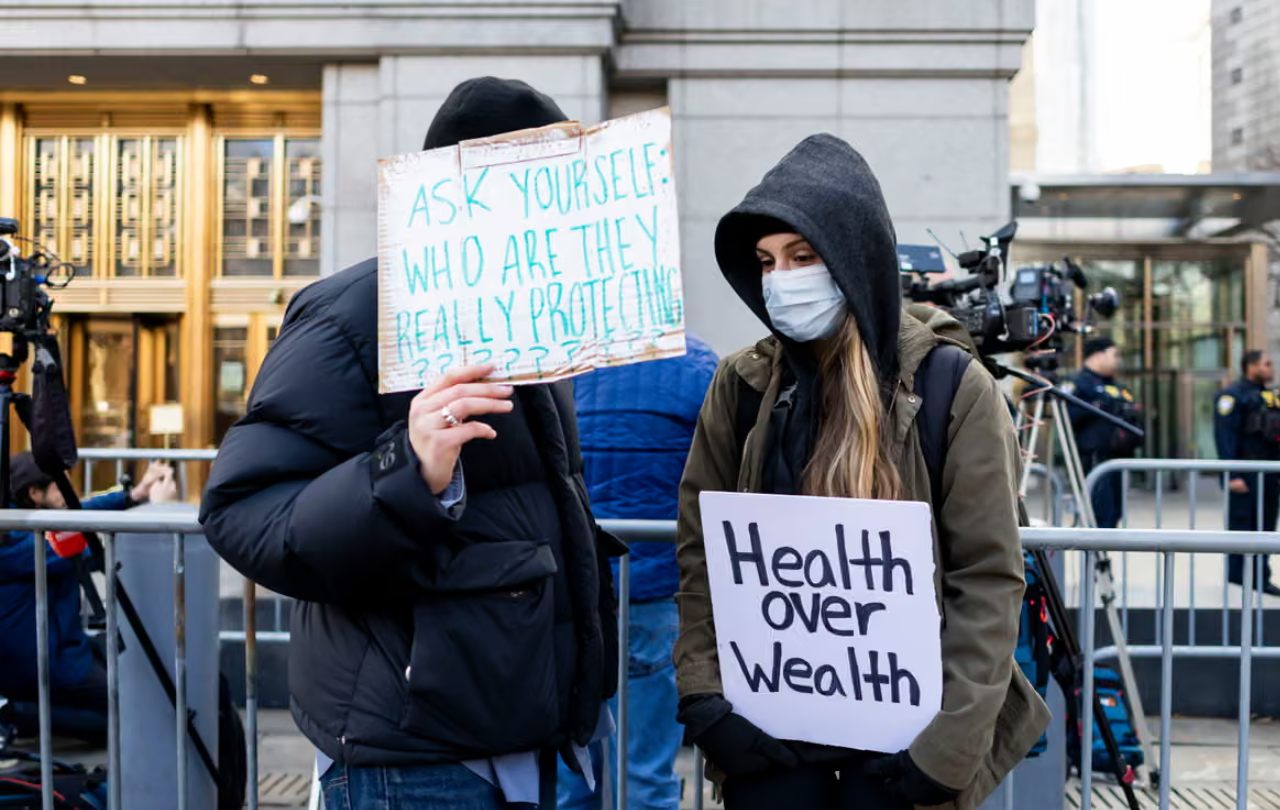
People hold signs protesting the healthcare industry outside of the federal court house where Luigi Mangione was arraigned in New York City on 19 December 2024. (Photo: Justin Lane/EPA)
Universal health coverage is one of the rare gifts the political left gave the modern world, but the United States, in its century-long war against “socialized medicine” has not been a beneficiary. The U
The Trump administration is accelerating the damage: cutting a trillion dollars from Medicaid, kicking millions off its rolls, and demolishing the affordable insurance schemes built under Obamacare. Trump ally, U
During the same period that U
Trump’s deliberate rollback on public health gains deprives a projected 17 million people of health coverage, and the numbers are going up.
It brings to mind an earlier episode of American hysteria about anything with a hint of red in it. U
It is not merely trivia to note that McCarthy’s lawyer, Roy Cohn, later worked for Donald Trump and served as his political mentor, introducing him to Roger Stone and teaching him ruthless tactics to belittle political opposition.
U
But the historical record is there to see: wherever universal health coverage took root — in postwar Europe, in Maoist China, in conservative LDP-ruled Japan or in neglected villages and rural outposts of Thailand after the uprisings of 1973 and 1992, the way was paved by left-wing citizen activism and sympathetic state power.
And wherever the red scare ran hottest, for example, in Cold War America, or in military-ruled Thailand, the wholesome and humanitarian idea that all people deserve access to health care was buried under accusations of communist sympathy.
Fear of socialism has led to millions of preventable deaths in countries where the slogan, Better Dead than Red, influenced public health policy.
The pros and cons of China’s communist revolution have been argued extensively since 1949. But what rarely gets acknowledged in all the heated ideological debate is that post-1949 China saw one of the most dramatic improvements in population health in documented human history.
Between 1949 and 1980, Chinese life expectancy rose from roughly 35 years to 65 — a gain of thirty years in three decades that no country of comparable size or income had ever approached. Infant mortality fell from an estimated 250 deaths per 1,000 live births to around 40. Smallpox was eradicated. Malaria was reduced from endemic to marginal. A country that had been, by any health metric, one of the most medically devastated on earth became, by the mid-1970s, a country already undergoing the shift from infectious to chronic disease that wealthy nations needed a century to complete.
The mechanism was not market competition. It was the barefoot doctor system that dispatched rudimentarily trained village health workers to the countryside in their hundreds of thousands, along with mass vaccination campaigns, and a commune-funded cooperative medical system that, whatever its other failures, got basic care to people who had never seen a doctor. It was, in short, socialist public health: collective, state-directed, ideologically committed to the proposition that peasant lives matter. That proposition was honored more in the breach than in practice, but as a mobilizing principle for public health it worked.
When the communes collapsed in the reform era and the coop medical system dissolved with them, coverage fell from roughly 90 percent of rural China to under 10 percent within a decade. The market didn't fill the gap. It took another twenty years of state intervention to approach universality again, bolstered by the New Cooperative Medical Scheme from 2003 onward. The lesson China's own history teaches is that the left-inspired system worked, and its dismantling by market logic produced a public health catastrophe that capitalism alone could not cure.
Thailand's path to universal coverage is often told as a technocratic success story: policy wonks and political reformers working under the pragmatic coalition-building of Prime Minister Thaksin Shinawatra. NHSO was founded to implement the scheme in 2002 and continues to administer the program today as an independent body.
But that's only half the story. The popular push for universal health care has deep roots in the left-versus-right struggles of 1970s Thailand. Serving the people through affordable health care bears the imprint of two generations of student activists from 1973 and 1992.
Even the Thai Communist Party, which collapsed militarily and politically in the 1980s, left an unexpected legacy: its jungle bases attracted a generation of idealistic medical students who eventually returned to society as doctors with a passionate commitment to serving the rural poor.
The foundational intellectual work was done by a generation of Thai public health officials who came of age in the 1970s. Although Thailand was the domino that didn't fall, it was shaped by a decade of intense leftist politics from the city to the jungle — regime-changing student movements, communist insurgency in the countryside. China's barefoot doctors and Cuba's community health model were in active circulation as inspiration. Figures like Krasae Chanawongse and Sanguan Nitayarumphong paved the way for the eventual 30-baht program.
The final push to political realization was achieved under the opportunistically populist Thaksin, whose chief policy advisor Pansak Vinyaratn coined the term and built the public case, working alongside a coalition of ex-communist doctors and left-leaning politicians who had spent years laying the groundwork.
Despite internal contradictions, these unlikely coalitions spread the word that health was a right rather than a privilege of the urban rich. They worked within a conservative state apparatus, not against it, but their convictions were recognizably left in origin.
The 30-baht scheme transformed health care from a privilege of the urban middle class and formal sector workers to a basic right of the rural majority, especially in Thailand's most populated but historically neglected region of Isan. It was, by any honest reckoning, a socialist policy by another name: tax-financed, non-contributory, and universally available.
That it survived military coups, constitutional crises, and the replacement of virtually every other Thaksin policy is testimony to how thoroughly the Thai people have internalized the idea that health care is a public responsibility.
Not so for the United States, where the right-wing struggle against universal coverage — and the implied equality of citizens regardless of race, region, or income — has employed scorched-earth tactics for a century.
Slave states gave rise to states' rights movements, segregation, and Jim Crow — a white supremacist through-line that found a natural ally in anti-communist hysteria. Rooted in the U
In keeping with Franklin Roosevelt’s New Deal spirit, Truman made a proposal in 1945 for expanding health care. But the idea was shot down with anti-Communist rhetoric at the precise moment the Cold War made that rhetoric lethal. The American Medical Association spent a historically unprecedented sum on a campaign that explicitly linked universal coverage to Soviet tyranny.
A sustained misinformation campaign was run by paid political consultants such as Whitaker and Baxter, a media-savvy team who flooded the media landscape with print advertising and direct mail campaigns to put pressure on physicians and the public alike. They introduced, as a pejorative term, “socialized medicine” to American political vocabulary in 1949, a phrase revived by Reagan’s campaign three decades later for the same manipulative reasons.
Similar paid media tactics were used to oppose Medicare in the early 1960s, push against Clinton's plan in 1994, and again against the ACA in 2009. The red-baiting propaganda offensive didn’t win every battle but stopped anything close to universal coverage from taking root.
The result of these constant interference campaigns is that the world’s richest country has a shockingly poor record in public health. Twenty-seven million Americans remain uninsured and Trump’s slash and burn policies will add many more millions to a humiliating state of precarity.
Medical bankruptcies destroy entire families; a phenomenon that barely exists in any other wealthy country. MAGA supporters in rural communities loudly opposed to "socialism" now find themselves without emergency care as hospitals close around them.
The U
Universal health coverage did not emerge from laissez-faire free markets. It has long been associated with political convictions shared by communists, socialists, social democrats, and left-leaning nationalists. But its historic political associations don't make it any less a good idea — especially for a society founded on the proposition that all people are created equal. Access to medical care is a humanitarian right, not a capitalist privilege. The belief that the nation is one big community drove the Thai reformers through twenty years of bureaucratic trench warfare. The same conviction drives China's ongoing effort to extend the reach of its hospitals and public health centers. The unvarnished principle of human equality is responsible for the partial victories of the NHS in Britain, Medicare in the United States, and every other functional universal system in existence.
The idea that laborers were no less worthy of health care than their employers, that a sick child in a poor village deserves treatment as much as a top government official, is in keeping with human decency.
The question, “Have you no sense of decency?” continues to haunt the American political establishment. The United States has rejected universal health care for a century, under the banner of states' rights, along racial lines, and in Cold War terms of opposing socialism. But the question is not whether universal health coverage has left-wing roots. It does. But it’s always been a good idea, and, as strides made in China and Thailand demonstrate, an idea whose time has come.
