
Even as tariffs lose their luster the emerging landscape does not herald stable commercial ties. Instead, it points to a durable, more technically sophisticated phase of containment—a set of new tools employed for the same old objective of containing China.
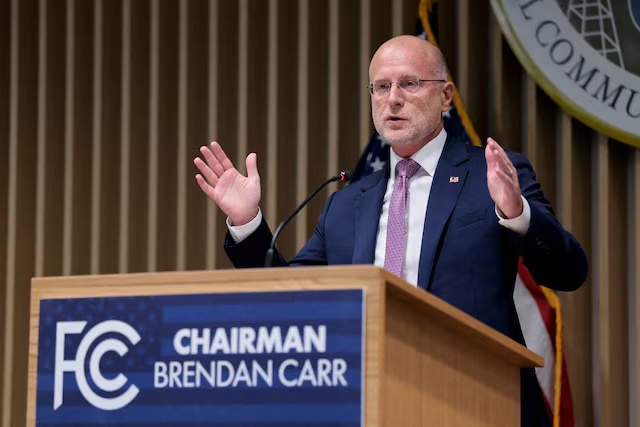
U.S. Federal Communications Commission (FCC) Chairman Brendan Carr speaks during a press conference, following an open meeting of the FCC, in Washington, D.C., U.S., July 22, 2026.
The meeting between presidents Xi Jinping and Donald Trump on the APEC sidelines in Shenzhen last week produced the usual familiar pledges: stepped-up cooperation and proper handling of economic and trade differences. The leaders also set in motion a bilateral action plan to implement those pledges.
The implication is that Sino-U.S. commercial ties are poised for stability over the remaining two years of Trump’s term. History, however, offers grounds for scepticism.
Optimism generated by summits has repeatedly failed to translate into tangible American policy restraint. Actions taken by the Trump administration in the eight weeks following the September summit in Washington illustrate this gap. The U.S. has rolled out a steady stream of restrictive measures targeting Chinese companies, advanced industry capabilities and cross-border supply chain access. It has added more than 80 Chinese entities to its restrictive Entity List, imposed a 100 percent tariff on optical modules and barred U.S. capital flows into China’s cutting-edge biotech sector, among other steps.
On the eve of the Shenzhen summit, the U.S. Commerce Department issued fresh export curbs on advanced AI chips and moved to block Chinese entities from remotely leasing large-scale computing power from overseas cloud data centers—a measure that took effect on the very day of the Shenzhen meeting.
Important policy shifts now gaining momentum point to an evolving playbook. Notably, punitive tariffs—once the Trump White House’s primary coercive trade instrument against China—are being gradually supplanted by alternative tools: Entity List designations, targeted export controls and opaque technical regulatory barriers.
Behind the fading bite of tariffs lies a layered reality: Trump’s tariff pressure has failed to force one-sided Chinese concessions, and Beijing has consistently deployed calibrated tit-for-tat countermeasures that inflict real pain on U.S. interests. At home, tariff-fueled inflation has stoked widespread voter frustration over household living costs (a factor that contributed to Republican losses in the November midterm elections) and has rendered sweeping new tariff increases politically risky.
Moreover, while direct shipments of Chinese goods to U.S. ports have declined, substantial volumes of merchandise originating in China continue entering U.S. markets via third-country rerouting, leaving America’s overall trade deficit stubbornly wide. An informal bilateral understanding between Beijing and Washington also creates a practical 20 percent ceiling for new punitive tariffs. Any meaningful breach of that threshold would trigger forceful Chinese pushback that would boomerang onto U.S. consumers and domestic businesses alike.
As a result, although the USTR-led Section 301 overcapacity probe originally scheduled to conclude in July is widely expected to issue findings critical of Beijing’s industrial policies, the White House appears set to lean heavily on non-tariff restrictions rather than on steep new duties.
But as tariffs move from center stage, Washington is expanding pressure along other axes:
First, its sector-specific targeting is broadening to designated critical domains including biotechnology, quantum algorithms and artificial intelligence, with more sectors likely to be added over time.
Second, artificial intelligence sits atop this target list. Restrictions are expanding beyond discrete chips toward full-stack superintelligence systems. Capitalizing on Nvidia’s alleged unapproved chip flows into China, the U.S. Congress is doubling down by advancing three key bills: the Chip Security Act, the AI Overwatch Act and the MATCH Act, aiming to plug the cloud-renting loophole, bar Chinese companies from foreign cloud-computing power and tighten curbs on advanced chips and semiconductor equipment. Meanwhile, the Trump administration is preparing, on its own, stricter advanced chip export rules paired with new prohibitions stopping U.S. cloud providers from selling large-scale computing power to Chinese actors. Trump has repeatedly framed unrivaled American AI supremacy as non-negotiable.
Third, restrictive measures increasingly stretch well beyond physical goods into rule setting and technical governance. A notable example is an FCC ruling barring China-based laboratories from performing electronics certification testing for the U.S. market. Nowadays, Washington’s constraints are no longer aimed only at imports. Rather, they target the regulatory infrastructure that grants or denies market access, allowing American authorities to erect effective barriers without raising customs duties at all.
With the dust now settled on the midterm elections, Trump has become a lame-duck president facing a Congress that will soon be under Democratic control, which will give the party substantial sway over U.S.-China trade strategy.
Containing China’s ascent has been a bipartisan pursuit in Congress and will remain so. The shift in congressional leadership will not soften the overall hard-line direction. Instead, this structural containment will persist and intensify, with U.S. trade policy toward China set to evolve into a more sophisticated, multifront campaign.
For starters, Democratic control will inject stronger geopolitical and ideological conditions into trade instruments. Upcoming legislative reviews of China’s Permanent Normal Trade Relations (PNTR) status are expected to attach non-economic conditions linked to human rights and governance concerns. Full immediate revocation of PNTR remains unlikely, given projected sharp increases in U.S. consumer costs. Even so, sustained legislative debate makes plain how trade-policy instruments are growing ever more politicized. While outright PNTR repeal is unlikely, U.S. lawmakers are poised to push for burdensome mandatory review procedures that generate heightened commercial uncertainty for companies on both sides of the Pacific.
In addition, a Democratic Party-led Congress is primed to press for coordinated multi-partner initiatives engaging allies and other countries coerced into joining targeted actions. This dovetails with a shift by the Trump administration away from its earlier unilateral instincts. The White House appears to have recognized that it cannot offset China’s economic weight by acting alone.
One such visible shift is a deepening alignment with the European Union, exemplified by the reconvening of the Transatlantic Trade and Technology Council after a two-year pause. Coordinated export-control criteria, joint investment screening and shared guardrails for third-market competition sit high on the agenda to amplify the practical bite of U.S.-led restrictions. With Democrats pushing to rally allies into collective action, the White House is positioned to elevate this coordinated posture as Washington’s trade policy default.
These shifts do not equate to full-scale decoupling, though. Treasury Secretary Scott Bessent has repeatedly characterized the administration’s posture toward China as “derisking, not decoupling.” In practical terms, this approach means that while keeping a tight lid on sensitive sectors, selective tariff relief for non-sensitive consumer and intermediate goods is emerging as politically plausible, driven largely by domestic pressure to ease persistent inflation.
This policy pivot marks a sharp reversal from earlier negotiating logic. Previously, U.S. trade negotiators withheld tariff rollbacks as leverage to extract concessions from Beijing. Today, the calculus has flipped. U.S. businesses dependent on low-cost Chinese inputs and consumers confronting elevated prices are generating stronger domestic demand for tariff cuts than Beijing’s urgency for export relief. Under these conditions, Beijing may reconsider its longstanding demand for full U.S. tariff removal and let domestic politics provide its own antidote.
The existing bilateral trade truce between Washington and Beijing has been extended until January and will likely be prolonged even further. Yet the outlook for Sino-U.S. economic ties across 2029-28 will in all probability prove to be no more stable than they were in 2026. U.S. sanctions against China appear set to multiply rather than recede. High-profile tariff announcements may become less frequent, but Entity List additions, regulatory hurdles, tech export curbs and coordinated allied action will become more common.
This shift in tool set exposes the core logic of current U.S. policy. Broad containment coupled with selective relaxation is not policy confusion but rather represents the architecture of so-called “competitive coexistence,” meaning entrenched high tariffs, reshaped supply chains and hardened technology boundaries coexisting with open communication channels meant to prevent accidental military or economic escalation. The emerging landscape does not herald stable commercial ties. Instead, it points to a durable, more technically sophisticated phase of containment.
