
Although small-scale rivalry and periodic tactical bargaining are likely to persist, a new equilibrium characterized by institutionalized cooperation—and occasional issue-specific divergence—may gradually emerge as the new normal in China-U.S. economic and trade relations.
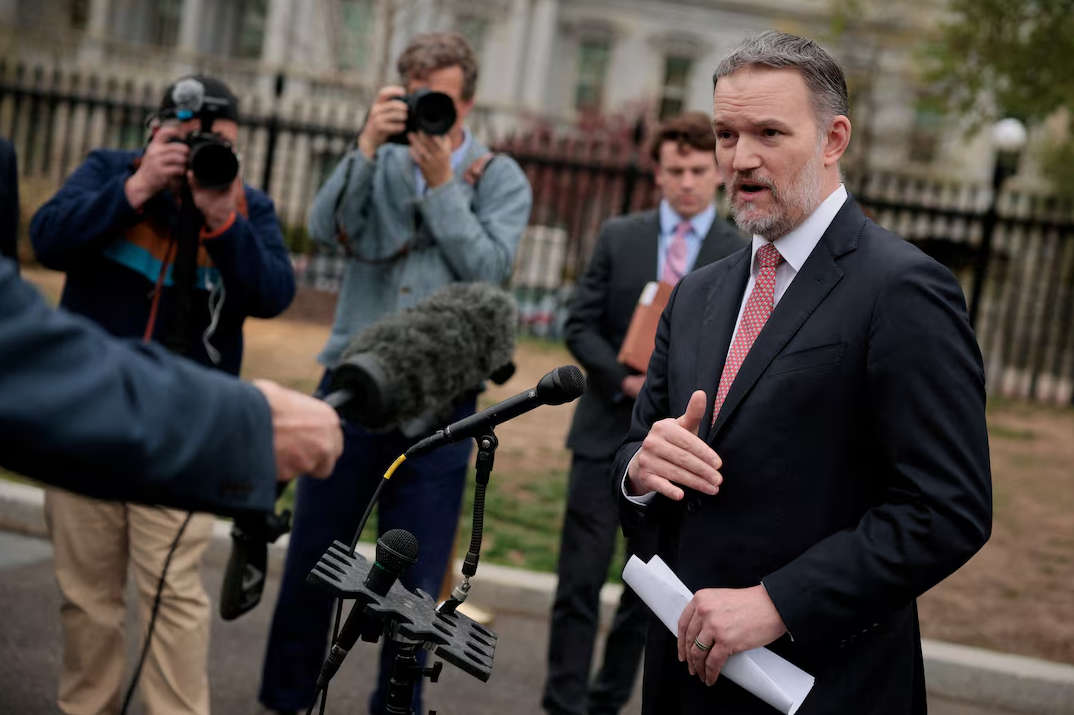
U.S. Trade Representative Jamieson Greer speaks before the media on April 2, 2026.
Recently, the Office of the United States Trade Representative launched a public consultation process in the domestic market to solicit views on potential adjustments to tariffs on Chinese goods. From high-level meetings that established the framework for bilateral trade and investment councils to the USTR’s introduction of a formal public comment mechanism, these developments suggest a gradual shift away from a short-term, transactional approach and toward a more consistent and predictable channel of communication.
The USTR’s latest move offers an important lens through which to examine the ongoing institutional transformation of China-U.S. economic relations. The public consultation on tariff adjustments represents a legally mandated step in translating the consensus reached by the two presidents into detailed policy arrangements. The deployment of a formal comment process to fine-tune tariff reduction measures suggests that bilateral economic and trade consultations are evolving from a largely episodic and negotiation-driven process into a more institutionalized mechanism.
The mechanism will provide a formal channel through which a wide range of American stakeholders can participate in shaping rules on trade with China. At present, the interests of U.S. agricultural groups, leading multinational manufacturers, and domestic small and medium-sized producers are increasingly divergent. Agricultural interests and multinational corporations generally favor expanding tariff reductions to include agricultural products, energy sources and consumer goods, while segments of domestic low-end manufacturing advocate maintaining strict constraints on the scope of tariff cuts.
By allowing these competing interests to be fully articulated through a legally mandated consultation process, the mechanism can help ensure that tariff negotiations conducted within bilateral councils are grounded in the realities of the U.S. industrial landscape, while narrowing the room for special interests to arbitrarily obstruct policy implementation. At the same time, subjecting trade policy adjustments to a more institutionalized process may help reduce the unpredictability of unilateral trade actions and mitigate the disruptive effects of frequent tariff changes on global trade and cross-border investment.
In the past, China-U.S. trade tensions were typically managed through ad hoc leader-level engagements or special-envoy diplomacy. Consequently, the agreements often proved vulnerable to domestic political shifts in the United States, as well as to lobbying pressures from affected industries and to fluctuations in congressional sentiment. For businesses engaged in bilateral trade, this environment made it difficult to assess medium- and long-term trade costs, and persistent uncertainty continued to dampen cross-border investment.
The creation of trade and investment councils marks a significant departure from this episodic approach. Rather than relying on fragmented negotiations conducted on a case-by-case basis, the two sides are beginning to build institutionalized platforms capable of providing continuity, predictability and policy follow-through. More important, such mechanisms will help delineate the boundaries between cooperation and competition and point toward a more specialized model of trade governance in which different sectors and issues are managed through tailored consultation frameworks.
The trade council divides traded goods into two broad categories. Non-strategic products—including agricultural products, liquefied natural gas, standard machinery and equipment, and everyday consumer goods—are expected to be placed on a list eligible for reciprocal tariff reductions. Expanding trade in these sectors would help boost U.S. exports of agricultural and energy products to China, while enabling China to import raw materials and agricultural goods at lower cost.
By contrast, strategic categories closely tied to national security, such as advanced semiconductors, critical minerals, defense-related components and leading-edge artificial intelligence hardware, would remain subject to existing tariff barriers and export controls and are therefore excluded from the current round of tariff-reduction negotiations.
This differentiated approach effectively draws a clearer line between areas where economic cooperation can be expanded and those where national security concerns continue to dominate.
The investment council is also expected to reflect a similar logic of differentiated governance. Chinese investment in the United States in areas such as infrastructure and consumer goods manufacturing could face lighter scrutiny (provided that regulatory compliance standards are met), thereby easing frictions in two-way flows of real-economy capital.
On the other hand, investment in the high-technology sector and strategic resource industries would remain subject to stringent review. The Wall Street Journal noted that such a classification-based system would allow multinational firms to recalibrate global production networks according to sector-specific risk exposure, rather than making abrupt disinvestment decisions driven by fears of sudden tariff shocks. This, in turn, could contribute to a gradual rebuilding of confidence in cross-border trade.
In contrast to a zero-sum trade war, this differentiated model of governance combines selective liberalization in lower-sensitivity sectors with firm constraints in strategic domains, thereby redefining the structural logic of China-U.S. economic engagement.
Whether the competition-cooperation model built around bilateral councils can become a new normal depends on not only the structural complementarity and mutual economic needs of China and the United States but also on variables such as U.S. domestic political cycles and intensifying major-country technological rivalry. Deeply integrated economic interests provide a key foundation for the long-term functioning of the councils. Agricultural regions, energy companies and retail businesses in the United States are among its direct beneficiaries and are likely to support the stability of the council-based consultation process.
At the same time, the institutionalization of the USTR’s public comment mechanism helps align trade policy more closely with domestic industrial and social realities, significantly reducing the room for extreme hawkish politicians to arbitrarily push for across-the-board tariff increases.
On the Chinese side, the imperative to stabilize foreign trade and maintain supply-chain resilience likewise provides an incentive to engage in institutionalized consultations. From the perspective of the broader international economic environment, amid a weak global recovery and continued strain on the multilateral trading system, expanding trade between the world’s two largest economies contributes to macroeconomic stability in both countries and provide a stabilizing anchor for global supply chains of commodities and consumer goods.
Uncertainty remains, however.
First, although the current U.S. government has agreed on the framework of the bilateral councils, deep divisions persist between the two major political parties in the United States over economic and trade policy toward China. Whether this framework can be sustained after a future change of administration, therefore, remains an open question.
Second, strategic competition in high-technology sectors continues to intensify. Rivalry in semiconductors, artificial intelligence and critical minerals is unlikely to ease simply because trade in consumer goods shows signs of recovery. Moreover, tighter controls in frontier technology sectors may spill over into the broader bilateral economic relationship, disrupting the overall trade environment and the pace of council-level negotiations.
In addition, geopolitical tensions could trigger unilateral policy shifts. Some members of Congress may seek to leverage emerging crises to pressure the executive branch, potentially leading to the temporary suspension or postponement of tariff-reduction measures.
Compared with the highly volatile cycle of confrontation and friction seen in the past, a model of competition and cooperation based on institutionalized consultation and differentiated, category-based management may help cushion short-term political disruptions. Although small-scale rivalry and periodic tactical bargaining are likely to persist within the councils, a new equilibrium characterized by institutionalized cooperation and occasional issue-specific contestation may gradually emerge as the new normal in China-U.S. economic and trade relations.
