While the U.S. Supreme Court struck down the Trump administration’s IEEPA tariffs, Washington has continued to pursue unilateral tariff policies through other legal mechanisms, creating ongoing uncertainty in global trade. China and the United States should therefore move beyond tariff confrontation and focus on stable, mutually beneficial cooperation in trade, investment, and emerging technologies.
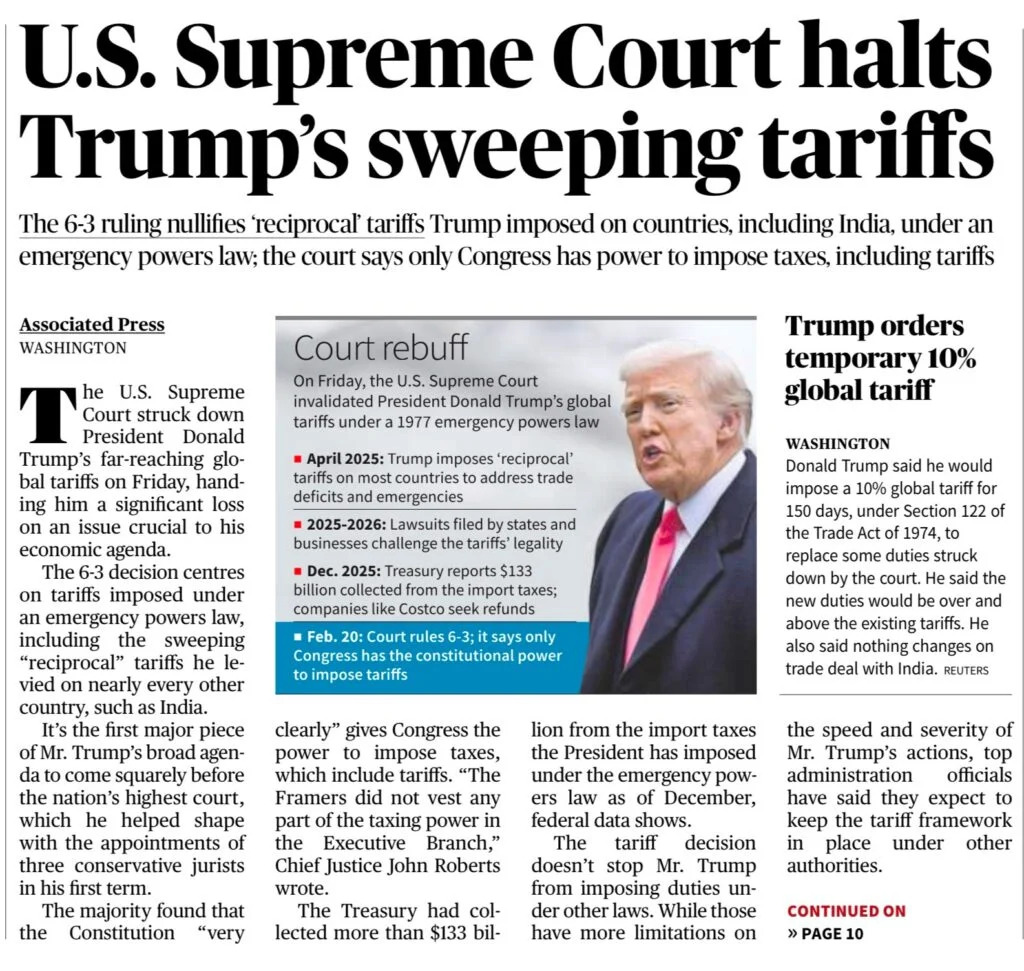
The most significant setback for Donald Trump during his second term so far was the U.S. Supreme Court’s ruling on February 20, 2026, declaring the IEEPA tariffs unlawful, leading to their almost immediate removal. The Supreme Court ruling is a victory for the U.S. Constitution, which strictly defines the power of the legislative, executive, and judicial branches and assigns tariff-setting authority to Congress, not the President. The IEEPA tariff, long opposed and negotiated by many countries around the world but unable to be removed, was wiped out immediately by the U.S. Supreme Court.
U.S. Supreme Court Ruling Does Not Topple Trump Tariff Agenda
However, within hours, the tariffs were replaced. Donald Trump announced a sweeping global tariff of 10 percent, which was raised to 15 percent the following day. This took the place of the killed IEEPA tariffs, which were approximately 17.3 percent on global average — a similar overall level. The new 15 percent tariff was authorized by Section 122 of the 1974 Trade Expansion Act, which permits the president to impose a maximum 15 percent global tariff up to 150 days. What is more, the tariffs on steel, automobiles and copper, under Section 301 or 232, remain effective.
Two observations: First, there has been no change in the Trump Administration’s unilateral tariff policy, based on the Republican’s 2024 Campaign agenda: resetting the global trading regime with “America First” and tariffs as the primary tool.
Second, the U.S. Constitution authorizes Congress to decide on tariffs. However, Congress has enacted a range of tariff tools for the administration, from the Smoot-Hauley Act (1930 Tariff Act) which led to a global disaster, to the 1962 Trade Act and 1974 Trade Expansion Act, which includes sections 232, 301, and 307, authorizing the President broad tariff powers. Those existing trade laws are enough to create world trade shocks and disturbances. The only difference is the trade policy of the president. A president in favor of a world multilateral trading system, like Bill Clinton, deploys very few of those restrictions, while a president deliberately aiming to undermine global free trade, like Donald Trump, can easily abuse those legal tools.
Washington’s latest decision on a 15 percent Section 122 tariff worldwide is a typical abuse of the law as well. Section 122 of Trade Act 1974 was enacted in the context of the delinking of the U.S. dollar to gold in 1971, which led to the dollar’s devaluation and the first trade deficit since the end of WWII. Section 122 stipulates that under such circumstances, the president may impose a temporary worldwide tariff of up to 15 percent for a maximum of 150 days in order to address the imbalance. Since the dollar was delinked with gold in 1971 and devalued in 1973, however, there have been no conditions necessitating such a measure. Hence, Section 122 had never been invoked until February 20, 2025.
Trump’s imposition of a global 15 percent tariff does not meet the threshold required under Section 122. First, the U.S. does not suffer from a sudden and large international balance of payment deficit. Although it had a substantial trade deficit in 2025 at $901.47 billion, it also recorded a significant surplus in the financial account ($1.27 trillion in 2024). Hence, the overall BOP remained broadly balanced.
The large merchandise trade deficit does not meet the threshold of Section 122 either. The huge merchandise trade deficit has been around for five decades; it's nothing new. In 2025, the U.S. merchandise trade deficit ratio (deficit by imports) was 36.1 percent, lower than in 2000 (36.3 percent), and also lower than four decades ago (38.9 percent in 1987). Yet section 122 was not triggered in 1987 nor 2000. Logically, a lower deficit ratio does not justify invoking the measure.
Additionally, there is no urgent dollar devaluation situation. The dollar nominal index (broad) was at 117.9917 on Feb. 20, 2026, and was 121.1828 on August 20, 2025, or 2.6 percent down over the past 6 months — a normal change.
The U.S. unilateral tariffs on more than $370 billion Chinese goods during 2018-2019 were also “legally based,” namely on a Section 301 investigation conducted by the Office of the U.S. Trade Representative (USTR). Again, however, this was an abuse of the law. Much of the report’s “fact finding” relied either on non-facts or on an extremely selective base. It asserted that a recent AmCham members survey had shown nearly 20 percent of them facing forced technology transfer. In fact, the survey asked if there was a forced technology transfer problem, and 81 percent of the members answered no. The investigation just picked up the remaining 19 percent and concluded a forced technology transfer problem, and hence triggered a 25 percent tariff on tens of billions of Chinese goods.
The USTR 301 investigation report on the Chinese shipbuilding industry was even more difficult to justify. The U.S. shipbuilding industry was only 1.5 percent the size of Chinese shipbuilding and thus there was little to no head-on-competition. Nevertheless, the 301 report came to the conclusion that “unfair” Chinese competition caused American “job loss” and thus charged $50 per ton on Chinese cargo ships — asserted based on section 301 of the 1974 Trade Law.
The widespread 25 percent tariff on automobiles is also questionable. The imports of automobiles and parts constitute a supply chain with the American auto industry, and the 25 percent tariff on imports actually hurt the American auto industry. The U.S. output of auto and light trucks in Q4 2025 fell to 9.49 million at annual rate, 9.8 percent down from Q3.
All the above displays the president has been, on most occasions, abusing trade laws for his own purposes, and that federal trade statutes provide him with a wide range of tools to do so.
New Tariffs Likely on Chinese Goods
The same is true with American tariffs on Chinese goods. The U.S. Supreme Court ruling removed the 20 percent tariff on Chinese goods (a 10 percent general tariff and 10 percent fentanyl tariff), leaving the actual tariff rate at 17 percent, which was imposed during Trump’s first term. The Section 122 tariff on Chinese goods is 10 percent, not 15 percent. USTR Jamieson Greer has said that there will be no additional 5 percent tariff, a gesture of goodwill ahead of the 6th bilateral trade talk, which is expected to take place before President Trump’s planned trip to China March 30-April 2. Therefore, the current tariff level on Chinese goods is 27 percent.
However, U.S. Treasury Secretary Scott Bessent has indicated that tariff levels on Chinese goods should remain in the range of 35 to 40 percent. The administration will almost certainly launch new investigations and take additional actions to reach that level.
Uncertainties and Certainties in 2026
The erratic tariff tools in Washington continue to create major uncertainties around the world. Most of the tariff announcements from Washington have been sudden, unpredictable, and subject to rapid change.
On the other hand, the past year suggests that the damage of Washington’s IEEPA tariffs and erratic tariffs on steel, automobiles, copper, and other products have been limited. The IMF World Economic Outlook in January 2026 put the 2025 global GDP growth rate at 3.3 percent, the same as in 2024. The UNCTAD report shows that in 2025, world merchandise and service trade hit a new record of $35 trillion, 7 percent higher over 2024. China hit 5.5 percent in export growth worldwide, similar to the 5.9 percent growth in 2024, as increased exports to markets other than the United States more than offset the decline in exports to the U.S. The EU also had a positive growth in global trade, and Japanese exports hit a record high, despite a fall in the U.S. market. On the contrary, the U.S. merchandise trade deficit hit a historic high, at $1.24 trillion, and its GDP growth rate slowed down to 2.2 percent, the lowest in 10 years (excluding 2020, the COVID-19 year). It’s extremely likely we’ll have continued growth in the world economy and trade throughout 2026 as well.
Another certainty in 2026 is the further resetting of the global trade landscape, with countries and regions other than the U.S. strengthening trade agreements or alliances. European leaders have been actively visiting China,enhancing the China-European trade relationship. China and ASEAN signed the CAFTA 3.0 Upgrade Protocol, further deepening the China-ASEAN Free Trade Area. Meanwhile, the EU and CPTPP have been discussing the possibility of forming the world’s largest cross Atlantic trade alliance.
China and U.S. Agenda should Scrap Tariff for Higher Level Cooperation
Against this backdrop, the 6th China-U.S. trade talks and President Trump’s China trip will soon take place. The key tone, as set by President Xi Jinping and President Trump, is a stable and constructive Sino-American relationship that benefits both nations and the world.
Under this guiding principle, the agenda of the 6th bilateral trade talks should focus on maintaining and expanding trade and investment cooperation, grounded in equality and mutual benefit. No new tariffs should be on the agenda. Any review of the Phase One agreement should lead to more constructive cooperation, rather than new tariff measures. If the U.S. decides to impose new tariffs, China will respond with counter-tariffs — and the U.S. would gain little from such actions.
China and the U.S. share tremendous common interests that go far beyond tariff disputes. The agenda should highlight cooperation on Artificial Intelligence and other cutting-edge technologies between the world’s two largest AI powers. Both countries share infinite common interests in this arena, and could discuss opportunities for trade and investment in AI open source application, big data, quantum computing, 6G telecommunication, robots, green transition and biomedical technologies. The forthcoming and subsequent trade talks should work towards a practical roadmap for cooperation at different levels. Beside an effective dialogue mechanism between Beijing and Washington, various exchanges and business deals should be encouraged at the state-provincial level and among the business communities of both nations.
China and the U.S. have turned the page on 2025 and opened a new chapter in 2026. Both sides should leave the tariff tension behind and pursue a new pathway for mutually beneficial cooperation from a broader strategic perspective, bringing substantial benefits to the peoples of both nations and to the world at large.
