

For decades, Western multinationals and tech firms built Malaysia’s export base while China financed its railways, ports, and industrial zones -- a balance Kuala Lumpur managed with unusual ease. Now, rare-earth ambitions are pulling that equilibrium in new directions, intensifying debates at home over control, national interest, and how far neutrality can stretch.
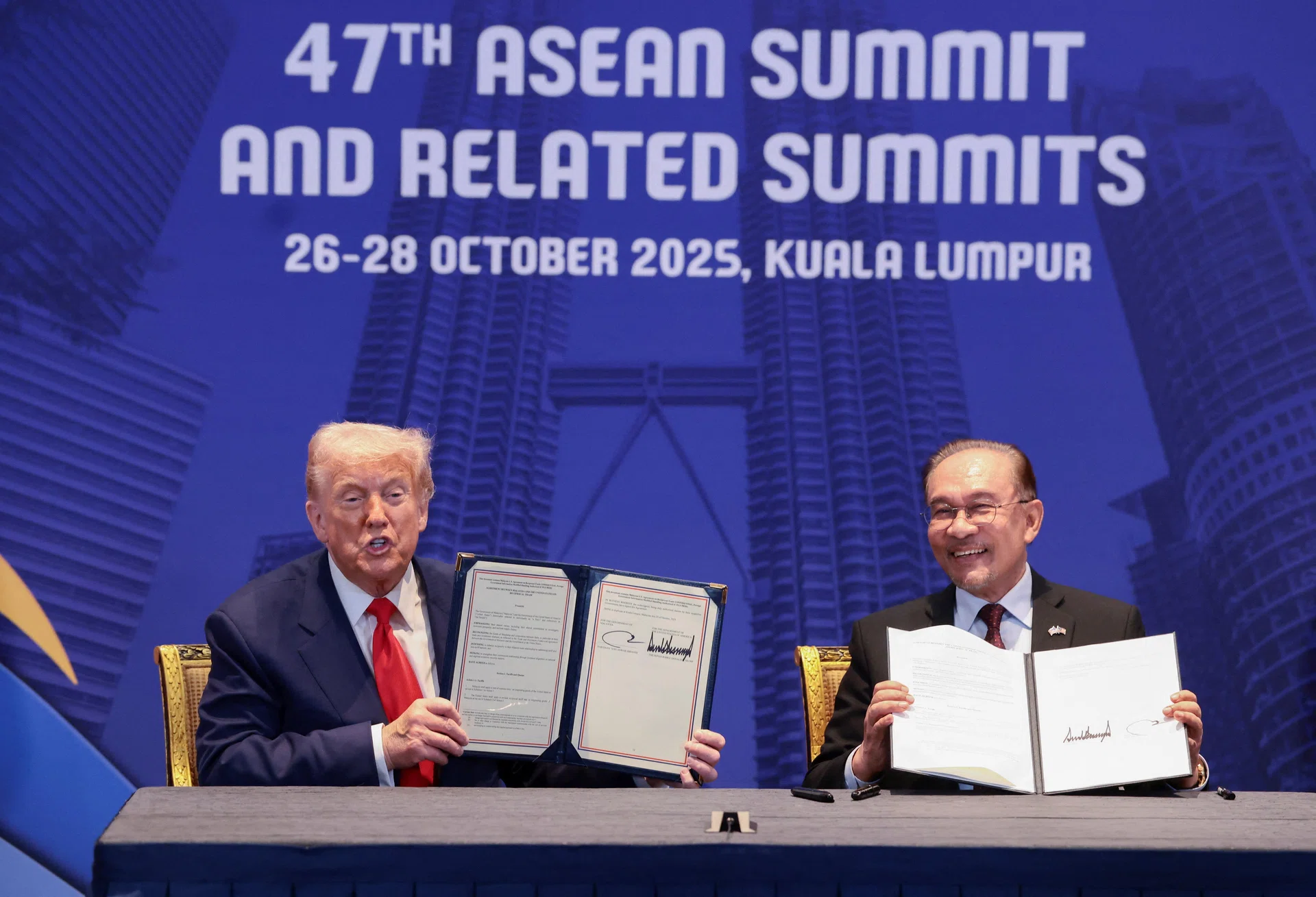
U.S. President Donald Trump and Malaysian Prime Minister Anwar Ibrahim held a bilateral meeting and signed trade deals during the 47th ASEAN Summit in Kuala Lumpur in October 2025. (Photo: Reuters)
When both Washington and Beijing come calling, neutrality stops being an ideal and becomes something proven in how a country behaves when superpowers knock at its door. U.S. President Donald Trump’s October visit to Kuala Lumpur produced a new rare-earth deal that Washington described as vital to “securing America’s industrial future” and “strengthening supply chains linked to national security.” It came just as China tightened its grip on rare-earth exports, a Beijing’s signal that the leverage in the clean-tech race still tilts its way.
Under the agreement, Malaysia pledged not to impose bans or quotas on shipments of critical minerals to the United States, even as it maintains its domestic moratorium on raw rare-earth exports, which took effect at the start of 2024. The move fits neatly into Washington’s broader playbook: rebuilding supply chains, hedging against Beijing, and keeping manufacturing allies close. But power doesn’t shift by signing ceremonies. China still refines nearly 90 percent of the world’s rare-earths, a dominance that worries Washington for its economic and military reach. Rare earths power the engines of both the green transition and modern warfare — from EVs and wind turbines to missiles and fighter jets. Each F-35 aircraft, for instance, contains more than 400 kilograms of rare-earth materials. It’s a dominance, China, built through decades of heavy investment, environmental risk-taking, and sheer industrial scale. These new partnerships, with Malaysia, Cambodia, and Thailand, show Washington’s intent to loosen Beijing’s grip, but they won’t rewrite the map overnight.
Malaysia understands this. Its leverage doesn’t come from replacing China, but from learning to work with both Washington and Beijing without being trapped by either. Malaysia is quietly testing the limits of its leverage. Reports, partly downplayed by Malaysia, suggest potential talks with Chinese state-linked firms, possibly through Khazanah Nasional, to establish a rare-earth processing facility in Malaysia. For Beijing, it fits a growing pattern: exporting its clean-tech firms abroad to extend influence beyond its borders. For Malaysia, it’s a calculated play: to turn its 16 million tonnes of reserves into an industrial base rather than another export pipeline.
That ambition places Malaysia squarely in the rare-earth bottleneck, not of ore, but of processing. By banning raw exports and backing a new RM600 million (≈ $142 million USD) magnet plant in Pahang, it hopes to climb the value chain. Its real leverage lies not in what it holds, but where it sits – at the intersection of American capital and Chinese technology.
For Kuala Lumpur, this diplomatic paradox is the art of survival. As Trade Minister Tengku Zafrul Abdul Aziz remarked after the signing, Malaysia “no longer wants to be a country that just digs and ships.” For now, Malaysia is managing the middle with uncommon finesse. The real test will be whether neutrality can still deliver relevance as it turns into a contested commodity.
An Economy Built on Balance
For half a century, Western firms have quietly underwritten Malaysia’s industrial rise, transforming Penang, Johor, and Kulim into vital links in the global electronics supply chain. Intel arrived in Penang as early as 1972, followed by fellow American chipmaker AMD in 1979, when Malaysia still exported mostly rubber and tin. Their investments built the technical base that later drew from Bosch, Infineon, to Western Digital. By 2024, the United States and Europe together accounted for roughly a fifth of Malaysia’s manufacturing exports, the backbone of its digital economy. China, meanwhile, has been Malaysia’s largest trading partner for sixteen consecutive years and its biggest source of infrastructure finance. From rail to ports, Chinese investment under the Belt and Road Initiative has built the arteries of Malaysia’s physical economy. Flagship projects such as the US$10 billion East Coast Rail Link and the Kuantan Port expansion place Malaysia among China’s most significant Southeast Asian partners.
The result is a dual dependency: a manufacturing ecosystem built on U.S. technology and standards, sustained by Chinese capital and engineering. For now, the arrangement works keeping Malaysia indispensable to both systems. Few countries manage to overlap with Malaysia’s fluency. But as Washington rewires supply chains and Beijing expands its footprint, the balance that once gave Malaysia leverage could easily become exposure.
A New Form of Neutrality
But Malaysia’s rare-earth gamble is fast becoming a test of how far this balance can stretch in an age when supply chains decide alignments. Keeping its export ban even after Trump’s visit looked like a sign of control, a reminder that Kuala Lumpur still wants to decide who profits from its resources and on what terms. But control has its own costs. Malaysia has faced this tension before. But control has its own costs. Malaysia has faced this tension before. The Lynas refinery in Kuantan, opened in 2012 as Southeast Asia’s first rare-earth processing hub, soon became a political flashpoint over waste and transparency. As the same company expands its footprint, the old questions return, about safety and oversight, and who Malaysians trust to shape their economy.
The debate has widened since Trump’s visit. Former prime minister Mahathir Mohamad, warned that the U.S. deal risks eroding sovereignty; Trade Minister Tengku Zafrul Abdul Aziz described it as “the best possible outcome for Malaysia,” calling it a reflection of geopolitical reality facing a free trading nation caught between two largest powers. Both views capture part of the challenge Malaysia faces: how to stay open to investment without surrendering control and deliver growth without eroding trust at home.
For now, the balance holds, American capital on one side, Chinese technology on the other, and domestic legitimacy at the center. In a world where rivalries shape supply chains, holding one’s ground may prove harder than taking sides. Malaysia’s real test is how long it can sustain this balance if rivalry between Washington and Beijing continues to sharpen, leaving it little room to maneuver.
