

The American experiment will foster new realities through a low-cost, efficient model for connection nations. The Zangezur Corridor represents more than a transportation route. It is likely to become a crucial variable shaping the future geopolitical landscape.
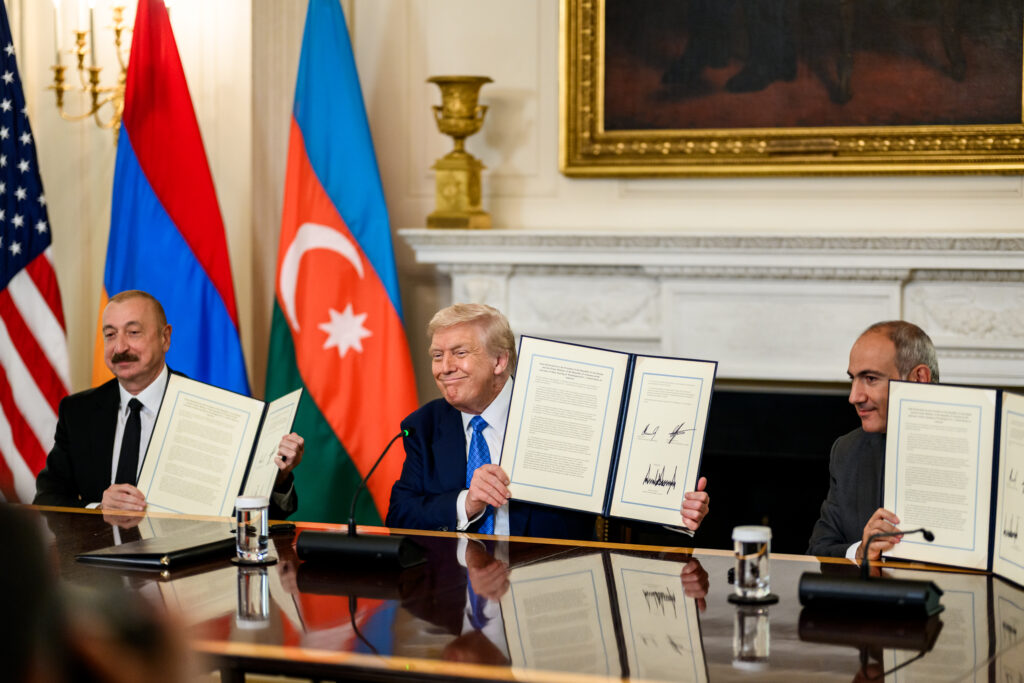
Armenia and Azerbaijan signed a peace agreement at the White House on August 8, 2025.
On Aug.8, Armenia and Azerbaijan signed a peace agreement at the White House in the United States, marking a turning point in the decades-long Nagorno-Karabakh dispute. The agreement, reached with the active mediation of the Trump administration, included a decision to build a 43.5-kilometer corridor through southern Armenia, with the United States obtaining a 99-year lease.
The so-called Zangezur Corridor will connect Azerbaijan’s mainland to its exclave of Nakhchivan. It will not only open a new artery linking Azerbaijan, Armenia, Turkey and Europe but also marks the beginning of an American “corridor strategy” model that will reshape the geopolitical patterns of Eurasia.
The launch of the corridor strategy will alter the balance of power in the Caucasus region. This is manifested in five specific aspects:
First, Armenia made concessions by acknowledging the sovereignty of the Nagorno-Karabakh region of Azerbaijan in exchange for a peaceful development space. It was thus forced to seek a balance between the United States, Russia and Iran.
Second, although Azerbaijan gains geopolitical benefits, it needed to handle the increasingly escalating security concerns of Russia and Iran with caution.
Third, the United States successfully deepened its involvement in the affairs of the Caucasus region, effectively weakening Russia’s traditional dominance.
Fourth, Iran, as a mediator between Azerbaijan and the historical enclave of Nagorno-Karabakh, was marginalized and its economic interests and regional influence were undermined.
Fifth, by intervening in the dispute between Armenia and Azerbaijan and promoting construction of the corridor, the United States is embarking on a new path of geopolitical and economic influence.
Taking intervention in regional conflicts as its entry point, this model builds an exclusive economic and security alliance through the construction of diverse infrastructure that integrates traditional, digital and institutional dimensions. In this way, the U.S. aims to achieve its geopolitical goals.
The strategic advantages of the American corridor strategy are reflected in three dimensions:
First, it will dominate regional industrial chains and standard systems, providing U.S. companies with business orders covering financial services, engineering design, construction, operation and maintenance. It will also establish a regional development model based on U.S. standards. For example, it establishes digital customs, energy networks and data circulation rules based on U.S. standards, excluding other countries’ schemes in both physical and digital spaces.
Second, it will provide security assurances. It sets up a legal basis for private U.S. security groups or a military presence. Ostensibly ensuring project security, it creates legal cover for the implementation of regional military deployments and private security activities.
Third, it integrates Turkey and the Caucasus countries to establish a regional alliance and build a cooperative network that excludes Russia, Iran and other countries.
Essentially, the “trinity” model of “politics-economy-security” advances a new development concept through the coordinated development of diverse infrastructure, and it implements precise checks and balances against competitors. Moreover, the model features high replicability. The United States is highly likely to apply this model to various hotspots in Asia, forming an “interception chain” against major competitors. For instance, the United States may intervene in conflicts between Thailand and Cambodia to build an east-west transportation corridor in the Mekong River Basin to connect Southeast Asia with the Indian Ocean, thereby establishing physical and digital spaces that counterbalance the regional influence of other countries.
The U.S. may also intervene in the affairs of Pakistan, Afghanistan and Central Asia to promote the construction of north-south transportation corridors that bypass China and Russia, weakening the regional influence of organizations such as the Shanghai Cooperation Organization.
These potential projects all share a similar operational model—intervening in multiparty conflicts as the entry point; implementing major projects or corridor plans at key nodes, supplemented by the establishment of regional security cooperation mechanisms; forming an exclusive regional political, economic and security cooperation system; and establishing a new check-and-balance mechanism in geopolitical competition.
The Zangezur Corridor project reveals a significant shift in U.S. geopolitical strategy—a move away from traditional military and economic influence toward leveraging diverse infrastructure as a key method of consolidating regional players. The core value of this new competitive model lies in promoting development patterns and governance systems to exert influence on target regions.
Faced with this new geopolitical layout, the international community must closely monitor the characteristics and progress of the U.S. corridor strategy and its potential chain reactions in major power games and regional development.
This American experiment will bring a new reality on the Eurasian continent as it introduces a systemic, low-cost, high-efficiency operational model. The corridor, along with its potential replicas in Southeast Asia, South Asia, Central Asia and other regions, represents more than a mere transportation route. It is likely to become a crucial variable shaping the future Eurasian geopolitical landscape. Its far-reaching impacts deserve sustained observation and in-depth analysis.
