
A global energy crisis has created an opportunity for the Philippines and China to improve relations through increased diplomatic engagement, expanded economic cooperation, and renewed focus on energy security despite ongoing maritime disputes. China’s ability to supply fuel, invest in infrastructure, and support renewable energy development positions it as a key partner in strengthening the Philippines’ energy resilience and economic stability.
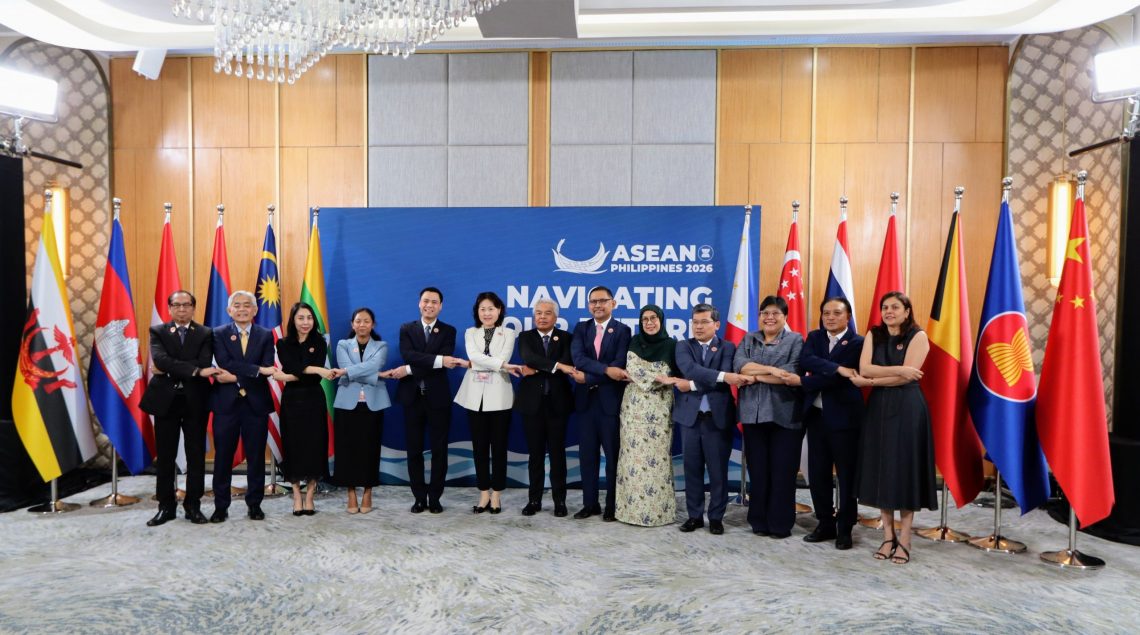
Senior Officials of ASEAN Member States and China met for the 25th ASEAN-China SOM-DOC on 30 January 2026 in Cebu, the Philippines.
Increased diplomatic dialogue, more direct flights, and the revival of talks on joint exploration in the South China Sea (SCS) signal a marked improvement in Philippine-China relations amid a global oil crisis fueled by the war in West Asia. It gives shape to President Ferdinand Marcos Jr.’s desire to reset bilateral relations with his country’s largest trade partner as the Philippines confronts a national energy emergency.
Despite geopolitical and economic headwinds, 2026 provides a good chance for the two neighbors to recalibrate ties. Energy and economic cooperation can be put high on the agenda as the Philippines chairs the Association of Southeast Asian Nations (ASEAN) and China hosts the Asia-Pacific Economic Cooperation (APEC). Both sides marked the 50th anniversary of official relations last year, a milestone muted by rising maritime tensions. But 2026 is a reminder that the sea spat is just one aspect of their long and comprehensive relations. This year marks a decade of China keeping its position as the Philippines’ largest trade partner, despite ups and downs in ties. The Philippines is also the Country of Honor at the 23rd ASEAN-China Expo, to be held in Nanning, Guangxi, in September. Back in 2012, President Benigno Aquino III sent Interior and Local Government Secretary Manuel Roxas II to the annual trade fair as his special envoy, despite a tense standoff over Scarborough Shoal months earlier.
2026 is also the fifth year anniversary of the ASEAN-China Comprehensive Strategic Partnership. It is the highest relationship status accorded by the eleven-member bloc. Interestingly, the 2026 survey by Singapore’s Institute of Southeast Asian Studies (ISEAS) showed China edging out the United States as ASEAN’s preferred partner for the second time. Finally, this year also marks the 50th anniversary of the Treaty of Amity and Cooperation in Southeast Asia, and China was among the first non-ASEAN countries to sign this foundational covenant.

Philippine National Pavilion at CAEXPO 2025 in Nanning International Convention and Exhibition Center of Guangxi, China.
Time-honored partner
A friend in need is a friend indeed. In the face of a bigger common challenge, neighbors may set aside differences and increase cooperation. As countries scramble to source fuel, China shipped 260,000 barrels of diesel to the Philippines. Manila also said it got reassurance from Beijing that fertilizer supplies would not be curbed. Despite unresolved territorial and maritime disputes, China has a record of helping neighbors in times of crisis. In 2023, when global fertilizer prices hiked due to the Russia-Ukraine War, Beijing donated 20,000 metric tons of urea fertilizer to Manila. During the Covid-19 pandemic, Beijing dispatched a team of medical experts, donated personal protective equipment and test kits, and was the first to donate vaccines to the Philippines, even though its own domestic supplies remain limited. In 2021, China completed the donation of 10,000 tons of rice and US$1million cash assistance to families affected by Typhoon Rai. The energy lifeline also has historical precedent. During the 1970s oil crisis, also due to the war in West Asia, then President Ferdinand Marcos Sr., father of incumbent leader Ferdinand Jr., obtained oil from China as both sides established diplomatic relations in 1975.
As the world faces another major energy and economic shock, China is again extending help. That it comes at a time of great need is a realization not lost on Manila, motivating Marcos Jr.’s decision to restructure ties with the Asian superpower. China is in a position to help its vulnerable neighbors, such as the Philippines, which are more exposed to war-related energy supply disruptions. It has one of the world’s largest strategic petroleum reserves and refining capacity. It has diversified oil and gas suppliers. Pipelines deliver gas directly from Siberia, Russian Far East, and Central Asia. A pipeline via Myanmar brings oil and gas from the Middle East and Africa. While tanker traffic in the Persian Gulf has almost ground to a halt, China-linked ships are still able to access the Strait of Hormuz. China’s huge oil reserves are estimated to withstand disruptions from supplies that transit the restricted chokepoint for up to seven months. Moreover, China is a global leader in new energy capacity, exporting hydro, solar, and wind power solutions, electric vehicles, and batteries.
China plays a big role in Philippine energy and agriculture. It is the second-largest supplier of refined petroleum products to the Philippines, exporting $1.93 billion worth of these goods last year. It is also the largest supplier of fertilizers, exporting $271 million worth of mixed mineral and chemical fertilizers to the Southeast Asian country last year. State Grid Corporation of China has invested in the National Grid Corporation of the Philippines (NGCP) since 2009, acquiring a 40% stake. In 2024, NGCP completed the grid interconnectivity of Luzon, Visayas, and Mindanao, the country’s three major island groups, a decades-old aspiration. Contractors PowerChina and EnergyChina are building dams, solar and wind farms, power transmission lines, and substations. Notable among these projects is the Kaliwa Dam, which will improve the water supply of the capital region and neighboring provinces, and the MTerra Solar, expected to become the world’s largest solar and energy storage facility upon completion. Marcos Jr. expressed gratitude for China’s partnership and said Beijing did not leverage or use these investments and projects in any way, given the two countries' longstanding sea row.
China is also spurring the shift to green mobility in the Philippines. The Southeast Asian country is the fifth-largest export market for Chinese new energy vehicles (NEVs), importing 200,544 units. Partnership with Chinese enterprises can go a long way in expanding the existing limited charging network and modernizing the country’s public utility vehicles, including its iconic decades-old jeepneys. While joint exploration in SCS remains controversial and politically fraught, Chinese capital, technology, and experience can help diversify the Philippines’ energy mix and accelerate its transition to more sustainable fuel and transport.
More dialogue, more links
In the last three months, there has been an upswing in diplomatic engagement between the two sides. On March 27 and 28, diplomats from both countries met in Quanzhou, Fujian province, for the 24th Foreign Ministry Consultation and 11th Bilateral Consultation Mechanism on SCS meetings. These back-to-back sessions were preceded by a February 27-28 discussion in Beijing and a January 29 meeting in Cebu on the sidelines of the ASEAN-China Senior Officials Meeting on the Code of Conduct on SCS. The January event was the first dialogue in over a year and helped defuse a word war between officials of the Chinese Embassy in the Philippines and some Filipino legislators and security officers.
These official interactions were complemented by welcome developments in growing people-to-people exchanges. Last March 29, Xiamen Air resumed direct flights between Cebu City and Quanzhou, operating twice a week. This coming May 1, Air China will open a four-times-a-week Manila-Chongqing route. Proposals for a Laoag-Guangzhou and a Davao-Shanghai connection are also under consideration. More direct air links will help the country compete with ASEAN neighbors in attracting more Chinese tourists. Manila granted 14-day visa-free entry to Chinese travelers starting January 16 in a bid to boost the country’s tourism. Before the pandemic in 2019, China was the country’s second-largest and fastest-growing inbound market, with 1.7 million arrivals, accounting for 21% share. As bilateral ties have frayed over the last few years, that figure dropped to 262,144 last year. High jet fuel costs due to the U.S.-Israel versus Iran war add further woes to the country’s underwhelming tourism industry.
In sum, the global oil crunch provided an off-ramp to reset bilateral relations. Energy and economic motives may top the agenda as both countries host important regional meetings. China’s massive renewable energy capacity can help future-proof the Philippines’ energy security. A greater share of the China market can generate a windfall for Philippine local tourism. Constant political dialogue and astute handling of disputes will be crucial in sustaining the positive thrust.
