
For Europe, despair runs deeper than sorrow when it comes to the United States. Yet it will seek to leverage its advantages—institutions, laws, norms and expertise—as it tries to guide and constrain the U.S.
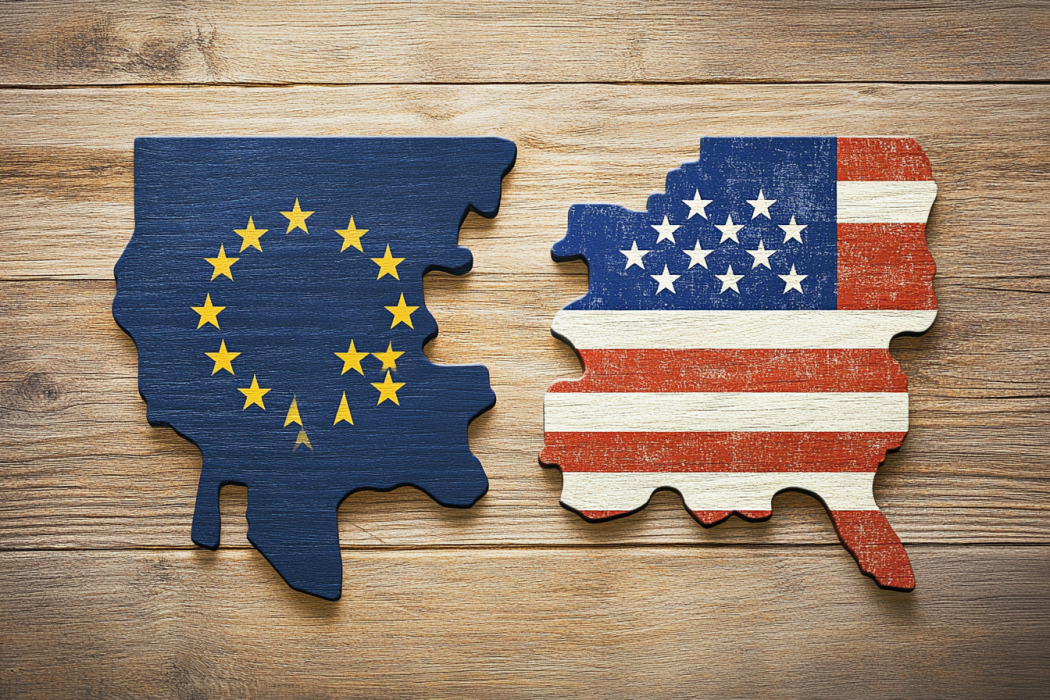
Constrained by its security dependence on the United States and its reluctance to hasten the demise of the old order, Europe has long pursued a largely conciliatory strategy toward President Donald Trump. By the end of last year, this strategy had all but succeeded, as Europe exerted its intended influence on issues such as the war in Ukraine, tariffs and the Israeli-Palestinian conflict. Now a new round of shocks has emerged.
The shocks
Last year, Trump’s fixation on tariffs and “peace” allowed observers to analyze the situation within the theoretical framework of post-World War II global politics. However, since the U.S. released its National Security Strategy in early December, Trump’s surprise move against Venezuela and threats to annex Greenland have led media outlets to cite the Monroe Doctrine and “resource imperialism” frequently, as if international politics had regressed by two centuries. Europe has unexpectedly been thrust into the eye of the storm: Deep-seated contradictions between the U.S. and Europe are now fully exposed.
• First, a clash of models. The Trump administration’s security strategy sees civilizational erasure as Europe’s greatest challenge. This lays bare the ideological rift between the two sides of the Atlantic. Further, Trump wants to reshape the economic and social models of Europe. The strategy explicitly states that Europe should “abandon its failed focus on regulatory suffocation,” which is closely linked to Trump’s effort in his second term to secure allies on Wall Street and in Silicon Valley and to vigorously promote deregulation.
Notably, Trump has made no secret of his intent to unravel the European Union. U.S. media revealed a previously circulating, informal version of the NSS that lists Austria, Hungary, Italy and Poland as countries the U.S. should "pull away” from the EU. America’s crackdowns on Europe—targeting its values, development model and path to integration—have thus converged into a coherent campaign. On the eve Christmas, the U.S. banned five Europeans, including a former EU Commissioner, from entering the country on the pretext of conducting “reviews” and coercing U.S. social media platforms.
• Second, a tussle for status. The wording of the NSS indicates that while Trump reserves for himself the possibility of co-governance with other major powers, he demands that Europe unconditionally align with him in great power competition, effectively downgrading its international status. Natalia Tocci, director of the Institute of International Affairs, noted that the strategy paints a picture of “imperial collusion” in which the U.S. seeks mutual recognition with other powers—Russia and China, in particular—and regards Europe, or at least most of it, as part of its own colonial sphere.
• Third, a contest over the world order. The overarching message of the NSS is that the U.S. will focus on key areas and employ flexible means to advance Trump’s “America first” agenda. Europe is deeply concerned that the United States is drifting away from supporting a rules-based international order toward power politics, and from advocating universal values toward carving out spheres of influence. These fears stem not only from ideological convictions but also from a careful weighing of interests.
Europe is a coalition of small and medium-sized postmodern states, with a multilayered, multi-circled power structure forged through the transfer of sovereignty. Law, rules, and multilateralism are the very foundation of Europe’s existence.
The awakening
In the face of these major shocks, Europe’s response has unfolded in several phases.
The first phase can be called the NSS phase. With its usual inertia, Europe has adopted a wait-and-see attitude and voiced only cautious criticism.
The second phase is the Venezuela phase. Trump’s surprise attack struck a chord with Europe, yet the continent went to great lengths to avoid direct confrontation with the U.S., in stark contrast with its fierce condemnation of unilateralism in 2003, when America invaded Iraq.
There are two reasons for all this: Europe needed U.S. participation in the Paris “Coalition of the Willing” conference on aid to Ukraine, and the Venezuela incident primarily impacted the interests of China and Russia.
The third phase is the Greenland phase. After Trump threatened to occupy Greenland by force and imposed tariff threats on European countries, Europe began to seriously explore various countermeasures, including activating the EU’s anti-coercion instrument, suspending the ratification of U.S.-EU trade agreements and offloading U.S. Treasury bonds.
It also contemplated the worst-case scenarios—how Europe would create a new security architecture if NATO collapsed and how to respond to a full-blown trade war with the U.S., which would amount to a virtual showdown. On Jan. 21, after his speech at the World Economic Forum in Davos, Switzerland, Trump announced the cancellation of the tariffs, which signaled Europe’s initial success.
Turmoil in the U.S. financial markets is widely regarded as a key factor in forcing Trump to back down, with threats to ditch U.S. Treasury bonds by Danish and Swedish pension funds.
Playing a pivotal role
The whirlwind of events over the past two months has made a massive psychological impact on Europe, yet the continent has displayed an unprecedented level of unity. Ursula von der Leyen, president of the European Commission, emphasized European sovereignty at the Davos Forum, saying that “if this change is permanent, then Europe must change permanently, too.” The day after the Greenland crisis was averted, the EU held an emergency summit as previously planned to discuss EU-U.S. relations. During a lengthy closed-door dinner meeting, discussions were low-key and somber. European leaders agreed that the old era had come to an end.
The future
For Europe, despair runs deeper than sorrow when it comes to the United States. Yet Europe will seek to avoid unnecessary attrition and instead leverage its advantages—its institutions, laws, norms and expertise—as it tries to guide and constrain the United States. For instance, Europe has proposed to resolve the Greenland issue within the NATO framework. It will also more actively seek to influence U.S. domestic politics, forging alliances with members of Congress, the opposition party and state governments across the country.
At the same time, Europe will be more pragmatic in engaging other major powers as a diplomatic tool to balance U.S. influence. The recent visit of the Canadian prime minister to China set an example for middle-power diplomacy. Within Europe, there are also growing calls for direct dialogue with Russia. On Jan. 27, the EU and India signed a free trade agreement at their summit.
Major European powers with both tangible strength and strategic vision, such as France and the United Kingdom, may also seek to elevate their international standing by mediating with great powers and integrating global institutions. For example, French President Emmanuel Macron said that France would work to “address global imbalances during its G7 presidency this year, in effect seeking to coordinate the development of the world’s three largest economies. He also stressed that the G7 must not degenerate into an anti-China club, nor force countries in the BRICS bloc to evolve into an anti-G7 bloc.
