
The U.S. president has been a bull in a china shop over the past year, shaking the international order to the core. Such shocks to the global governance system present new opportunities and challenges for BRICS to grow and leave its mark.
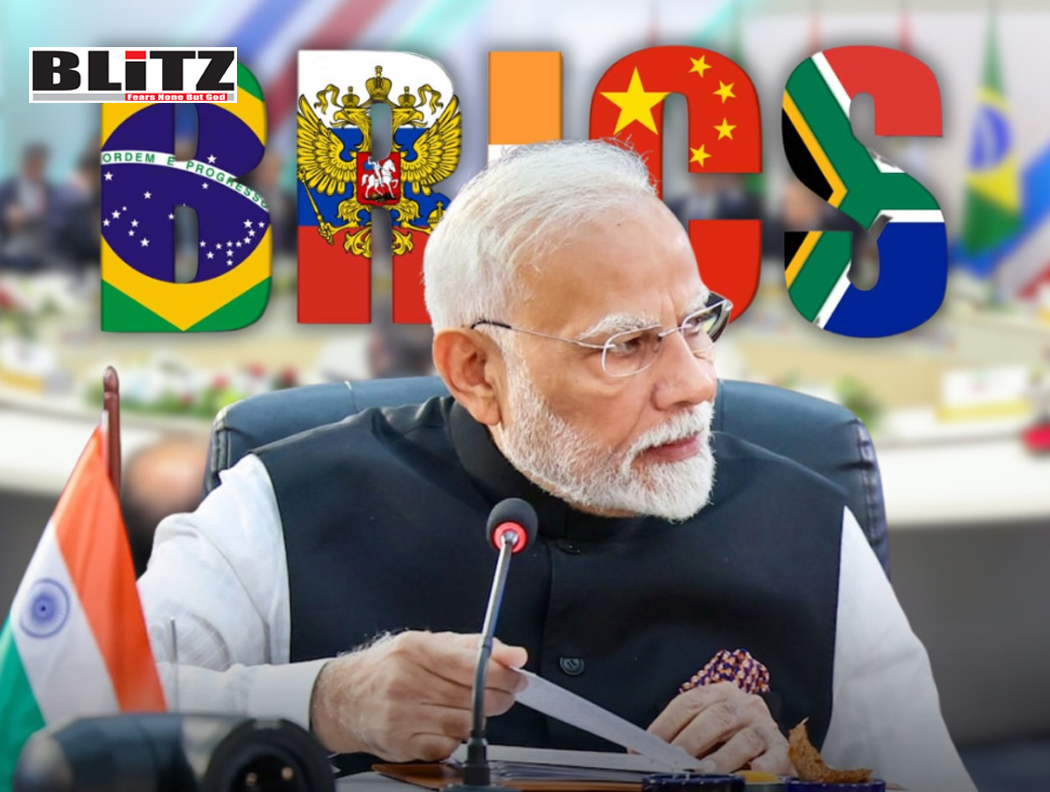
The international order is undergoing structural shifts, and BRICS cooperation is facing mounting pressure. As the grouping grows in size and influence, the Trump administration has moved beyond the familiar Western playbook of disparagement, division and co-opting. It has drawn a clear line in the sand: Any BRICS cooperation deemed harmful to the interests of the United States will face stiff American sanctions.
For India, the current BRICS chair, the challenge lies in carving out room for cooperation—particularly under Donald Trump’s watchful eye and the need to steer clear of his red lines. The opportunities and obstacles presented by the BRICS India Year are more conspicuous under such pressure.
Question One: Will India introduce substantive measures?
India assumed the BRICS chairmanship as the grouping marked its 20th anniversary. In what it saw as a rare opportunity, it promptly set the annual theme: “People-Centric, Humanity-First, with Four Pillars: Resilience Innovation, Cooperation and Sustainability.” These grandiose words strike the audience as neutral and idealistic. As India has suffered from the tariff war inflicted by the United States, it was widely expected it might highlight multilateral cooperation to counter surging unilateralism. But the theme announced was anything but. It signals that sensitive topics such as a BRICS payment system or common currency—which would lead to de-dollarization—will likely stay off the agenda. New Delhi may propose milder alternatives, such as a “BRICS Digital Currency Alliance.” Yet circumstances have changed. As it was the U.S. that inflicted the pain of tariffs on friends and foes alike, there are growing calls for a “BRICS unified market.” Here India faces a dilemma. It has launched numerous anti-dumping and countervailing investigations against fellow members. If India wishes to build “a greater BRICS, a greater market” it must lead by example and cut its own tariffs and non-tariff barriers first.
The India-EU free trade agreement is the leading edge of innovation in BRICS cooperation. India should work with other members to expand the “BRICS Plus” model. The current approach focuses on individual countries. It should shift to “BRICS Plus Regional Organizations” to add breadth and depth to BRICS cooperation.
Question 2: Will India leverage its BRICS presidency to pursue Global South leadership?
At the BRICS theme launch event, Indian External Affairs Minister Subrahmanyam Jaishankar announced that the Global South would be at the center of the agenda this year, with a focus on food security, debt restructuring and climate change. This signals India’s intent to parlay its BRICS presidency into institutional leverage. For years, India has touted its unique advantages as a bridge between Global North and South, convening multiple “Voice of the Global South” summits to underscore its role. In addition, New Delhi sees greater strategic value in the Global South’s vast markets, resources and collective voting power — although this has rubbed Washington the wrong way.
India will host the fourth “AI for Impact Summit” promoting AI accessibility and equity in developing nations to narrow the digital divide. Observers see a dual purpose: burnishing its image in the BRICS presidency and also countering China’s proposed “Global AI Cooperation Organization.” In essence, it is about the leadership contest within the Global South.
Question 3: Will India propose new criteria for BRICS expansion?
Because Trump openly criticized BRICS as an “anti-America alliance” the once-burgeoning membership expansion is losing momentum. Turkey no longer actively seeks membership, and Saudi Arabia has repeatedly dodged formal membership status, citing incomplete domestic procedures. That said, some countries are bucking the trend. Malaysia seeks to upgrade from a partner to a formal member, while Pakistan, Madagascar and Palestine all aspire to be BRICS partners.
India, which has long been ambivalent about BRICS expansion, has explicitly opposed Pakistan’s application. As the host country, India may put its stamp on expansion, introducing new criteria such as economic development level, geopolitical representation and democratic institutions. For Pakistan, India may use “eliminating state terrorism” as a pretext to block its entry.
In the new international political landscape, the BRICS India Year faces two key challenges:
Challenge 1: Whether BRICS cooperation should expand into the military domain.
For years, there has been intensive debate in political and academic circles about whether BRICS cooperation should extend from finance, economy, political security and cultural exchanges to military cooperation between member states. Some argue that traditional security has now surpassed non-traditional security to become the primary focus of global governance, and military cooperation is just as urgent and relevant as climate change, public health and food security. Opponents maintain that BRICS was founded on a mandate of economic cooperation and should not be burdened with military baggage, as this could easily lead to “parallel confrontation.”
India’s refusal as host to participate in the joint naval exercises organized by China, Russia and South Africa has brought the internal disagreement into the public eye. Its rationale is that it has never participated in such military exercises and these are not a regular part of BRICS activities. In truth, as the law of the jungle undermines postwar international rules and order, military cooperation under BRICS is imperative for maintaining regional stability and world peace. There is no need to over-interpret normal military cooperation under BRICS as a step toward bloc confrontation.
Challenge 2: How to rise above internal divide and jointly promote BRICS as a team of action.
As it is usually the case, the biggest challenge for any multilateral mechanism comes from within—the result of conflicting interests and a lack of cohesion. Similarly, as BRICS grows in influence, if different views are not properly managed it may end up being just another bloated organization that produces little consensus and few deliverables.
For instance, some countries prioritize their own interests, while others have divergent views on issues such as reforming the UN Security Council and establishing a BRICS secretariat. If the BRICS grouping is to expand and achieve steady, long-term progress, each member state must rise above narrow self-interest and pursue common ground while reserving differences. BRICS countries thrive against all odds because each has something to gain from compromise and cooperation.
In a nutshell, Trump has been a bull in a china shop during the past year, shaking the international order to the core. Such systemic shocks to the global governance system present new opportunities and challenges for BRICS to grow and leave its mark. The BRICS India Year and China Year—which is expected in 2027—both come with high hopes of injecting certainty and stability into a turbulent world.
