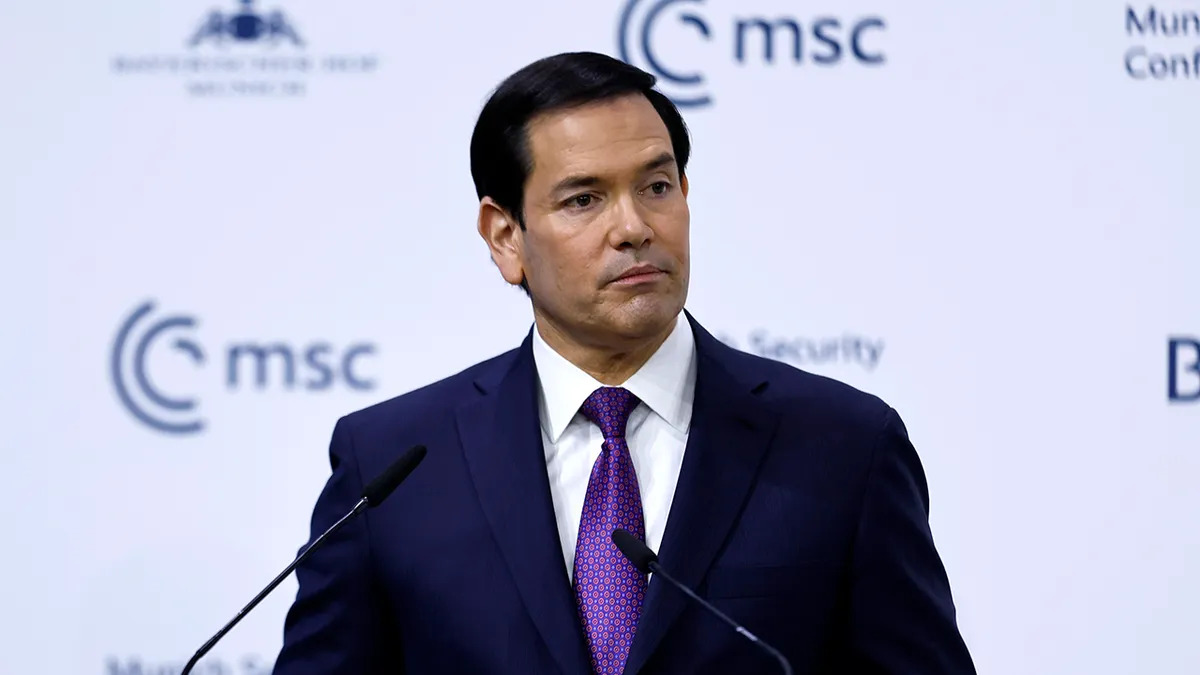
U.S. Secretary of State Marco Rubio stood before the Munich Security Conference on 14 February 2026 and delivered a speech that will be remembered less for its policy prescriptions than for its raw, almost melancholic confession of American elite anxiety. In the grand ballroom of the Hotel Bayerischer Hof, Rubio did not merely review transatlantic burdens or NATO spending targets. He mourned the passing of something far larger: five centuries of Western civilisational domination that began with Columbus and ended, in his telling, in the rubble of 1945.
“For five centuries, before the end of the Second World War, the West had been expanding – its missionaries, its pilgrims, its soldiers, its explorers pouring out from its shores to cross oceans, settle new continents, build vast empires extending out across the globe,” Rubio declared. “But in 1945, for the first time since the age of Columbus, it was contracting.” The culprits, in his narrative, were clear: “godless communist revolutions and by anti-colonial uprisings that would transform the world and drape the red hammer and sickle across vast swaths of the map.” What followed, he suggested, was not mere geopolitical adjustment but civilisational contraction – a shrinking of Western confidence, territory and moral self-assurance.
This was no off-the-cuff remark. It was the organising thesis of the address. Rubio framed the post-1945 era as an unnatural parenthesis of guilt, decolonisation and decline that the Trump administration now intends to close. The speech was laced with invocations of “one civilisation – Western civilisation,” bound by “centuries of shared history, Christian faith, culture, heritage, language, ancestry.” America, he reminded his European audience, is “a child of Europe,” its story beginning with “an Italian explorer whose adventure into the great unknown… brought Christianity to the Americas.” The subtext was unmistakable: the sine qua non of the West’s revival is the unapologetic reclamation of its Christian – and by clear implication, European-descended – identity.
Rubio’s Munich performance did not emerge in a vacuum. In January 2025, during an interview with Megyn Kelly, he had already described unipolarity as an “unnatural historical aberration.” Many observers, including some in Washington’s commentariat, misread this as a signal that the United States was ready to accommodate a genuinely multipolar world. That was never the intent. As I argued last year (“Multipolarity in Contest”), Rubio’s multipolarity is multipolarity with American characteristics – a world of great-power spheres where Washington remains first among equals, China is contained, and the Global Majority is politely reminded of its place. The National Security Strategy and National Defence Strategy of 2025, both bearing the fingerprints of Elbridge Colby and the “prioritise China” realists, openly acknowledge material constraints: industrial atrophy, munitions shortfalls, supply-chain vulnerabilities and an overstretched military. Yet the strategic objective remains unchanged – not renunciation of hegemony, but its recalibration through outsourcing of risk to allies while preserving the right to set the global agenda.
President Trump himself has been even more explicit. In speeches and statements he has repeatedly cast America as destined to become “the most dominant civilisation ever to exist on the face of this Earth.” The religious dimension is not ornamental; it is doctrinal. As I detailed in “The Trump Doctrine and the Fracturing of Global Order,” the contemporary Republican Party increasingly views the contest with China through an eschatological lens. Evangelical influencers frame Beijing as a spiritual adversary, part of an end-times alignment of “kings from the east.” Secretary of Defence Pete Hegseth and figures close to the administration speak of a metaphysical struggle. Rubio’s Munich speech, with its repeated references to “faith in God,” “Christian faith,” and the “sacred inheritance” carried across the Atlantic, simply translated that confessional worldview into diplomatic language.
The result is a coherent, if disturbing, doctrine: the United States sees the erosion of unipolarity through two lenses simultaneously. First, as the long historical arc of Western civilisational decline triggered by communism and decolonisation. Second, as a material power shift that requires tactical adjustment but not strategic retreat. On both fronts, the response is not accommodation but adaptation. Allies are to be mobilised as forward-deployed risk absorbers – Japan and South Korea pressed to spend more, build more, and stand closer to the front line in any Taiwan contingency; Europeans reminded that they are “foot soldiers” in a larger civilisational project. The 2025 NSS explicitly outsources the dangerous, expensive, and politically costly aspects of containment while Washington retains veto power and the high-end enablers (AI, quantum and missile defence). As I wrote in “The Twilight of American Primacy,” this is primacy by proxy – a conscious strategy to manage decline without admitting it.
Rubio’s Munich address makes the civilisational stakes explicit. The West, he insists, must stop “rationalis[ing] the broken status quo” and reject “guilt and shame.” It must be “unapologetic in our heritage.” Armies, he reminded the conference, “do not fight for abstractions… they fight for a way of life.” That way of life, in the Trump-Rubio telling, is inseparable from the Christian confessional state legacy that Columbus inaugurated in the Americas and that Europe and America once jointly extended across the globe. Decolonisation, in this worldview, was not the rightful assertion of sovereignty by formerly subjugated peoples; it was a wound inflicted on the natural God-given order. Revitalising the West therefore requires, by logical extension, a renewed ideological and, where necessary, material pushback against the post-1945 settlement.
For the Global Majority – the nations of Asia, Africa, Latin America and the Pacific that constitute the demographic and increasingly economic core of humanity – the message could not be clearer: vigilance has never been more urgent. What is being prepared in Washington is not defensive realism but offensive restorationism. The language of “renewal and restoration,” “revitalise an old friendship,” and “the greatest civilisation in human history” is not neutral. It is a call to reassert hierarchy under the banner of civilisational exceptionalism.
Europe finds itself in a particularly agonising position, trapped in contradictions of its own making. On the one hand, leaders such as Friedrich Merz, Emmanuel Macron, Mark Carney and even Keir Starmer speak of reducing dependency on American hegemony, of “strategic autonomy,” of finding “Europe’s (and Canada’s) own path.” They understand, at some level, that Washington now views them as expendable auxiliaries – useful for burden-sharing in Europe so that American resources can pivot to Asia, but never equals in the civilisational project. Rubio’s speech, with its mixture of affection and condescension (“we Americans may sometimes come off as a little direct and urgent in our counsel… because we care deeply”), only confirmed the vassalage.
On the other hand, European elites remain psychologically and structurally tethered to the transatlantic framework. Without a genuine reconciliation with Russia – including acceptance of a new pan-European security architecture that ends NATO expansion and recognises Moscow’s legitimate security interests – and without a pragmatic coming-to-terms with China as the indispensable partner in clean technology, critical minerals and market access, Europe cannot escape its dilemma. As I argued in “Europe’s Crossroads: From Transatlantic Vassal to Eurasian Anchor,” the continent faces a binary choice: remain the tail-end of a fraying American imperium, subsidising U.S. LNG and high-tech while deindustrialising, or become the western anchor of an integrated Eurasian economic space. The war in Ukraine has already demonstrated the limits of proxy confrontation; Russian advances and European energy pain have made the cost of Russophobia unsustainable. Yet the same elites who now whisper about dialogue with Moscow still hesitate to break the taboo on genuine strategic autonomy.
That hesitation is fatal. The United States, under Trump and Rubio, has made its choice: it will not accept multipolarity on equal terms. It will manage its relative decline by externalising risk, sacralising its Christian-Western identity, and framing resistance from the Global South and East as a civilisational threat. The “forces of civilisational erasure” that Rubio warned against are not abstract; they are the sovereign choices of nations that refuse to be footnotes in someone else’s restoration narrative.
The confessional state legacy of Columbus – the fusion of cross, crown and commerce that launched half a millennium of Western expansion – is being consciously revived as ideological scaffolding for 21st-century neo-colonialism. Where once missionaries and conquistadors carried the faith and the flag, today it is tariffs, technology denial regimes, alliance pressure and the rhetoric of “Judeo-Christian civilisation” that serve the same purpose: to discipline the periphery and reassert the centre.
The Global Majority has seen this film before. We know how it ends when declining hegemons mistake nostalgia for strategy. The difference this time is that the material balance has shifted decisively. China’s economic gravity, Russia’s military resilience, the BRICS expansion, ASEAN’s sure-footedness in its history of non-alignment, the African Union’s growing cohesion and Latin America’s search for autonomous development paths all point toward a genuinely equal and orderly multipolarity – precisely the vision Foreign Minister Wang Yi articulated at the same Munich conference: equal treatment for all countries, rejection of zero-sum games, and an inclusive globalisation.
Rubio and Trump are betting that civilisational rhetoric, allied risk-outsourcing, and selective confrontation can reverse the tide. History suggests otherwise. Empires that mourn their lost dominance too loudly often accelerate the very decline they fear. The post-1945 order was not an aberration to be corrected; it was the beginning of humanity’s long, uneven, but irreversible journey toward sovereign equality.
The rest of the world – the overwhelming majority of humanity – must therefore treat the Trump-Rubio project with the seriousness it demands; not with panic, but with clarity. Deepen South-South cooperation. Accelerate de-dollarisation and alternative payment systems. Invest in indigenous technological capacity. And above all, reject the false choice between Western tutelage and chaos. A new configuration of security and development is already emerging from the fraying edges of American primacy. The task is to shape it deliberately, before the apostles of Columbus 2.0 attempt to foreclose the future in the name of a sanctified past.
The Munich speech was not a warning. It was a declaration of intent. The Global Majority should answer it not with words alone, but with the patient, coordinated assertion of our own civilisational dignity and strategic autonomy. The age of managed Western decline need not become the age of renewed Western war. That choice, ultimately, belongs to all of us.
