
Europe has again gained an advantage in its sustained competition with Russia to influence the United States. While Washington is likely to continue pursuing a calibrated re-engagement with Russia and to further reduce its direct role in European security, the scope for abrupt and highly oscillatory shifts in U.S. policy on Ukraine appears to have narrowed.
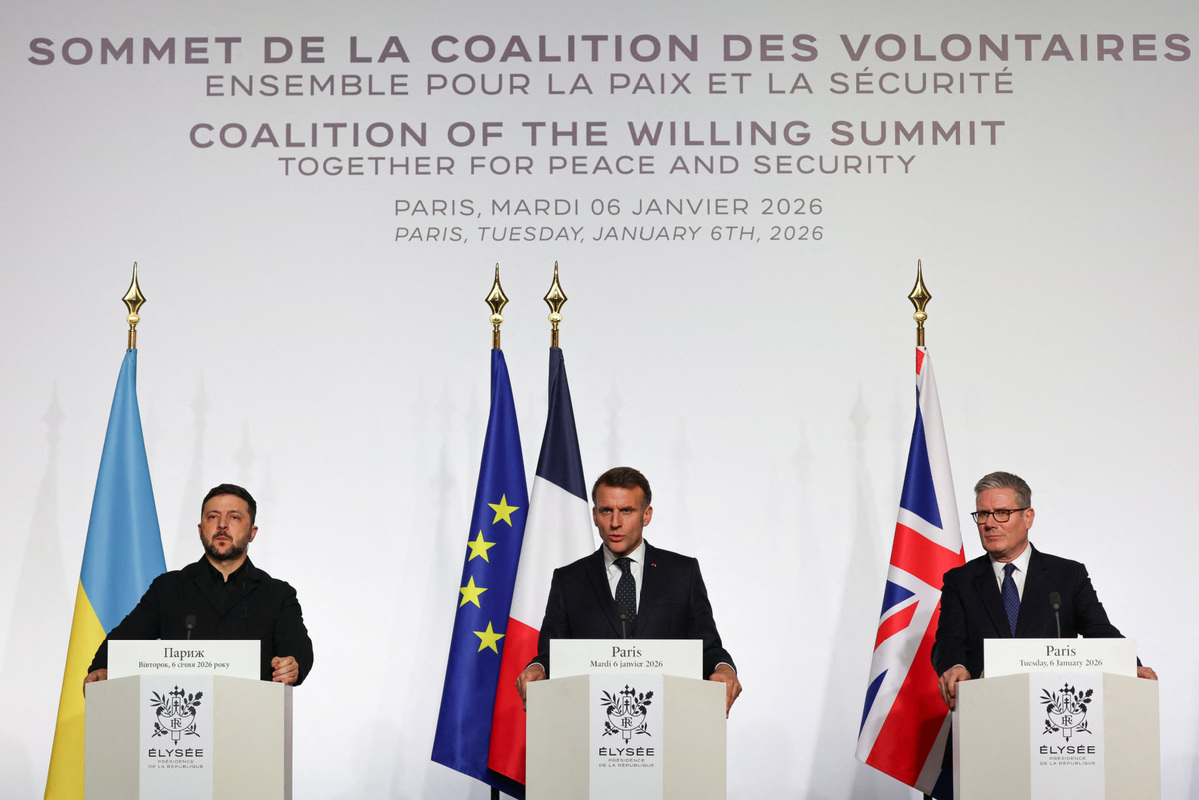
Ukraine's President Volodymyr Zelensky, France's President Emmanuel Macron and Britain's Prime Minister Keir Starmer deliver a press conference upon the signing of the declaration on deploying post-ceasefire force in Ukraine during the 'Coalition of the Willing' summit, at the Elysee Palace in Paris, France, Jan 6, 2026.
On Jan. 6, a meeting of the so-called coalition of the willing to address assistance to Ukraine, convened in Paris and reportedly concluded with an agreement concerning security guarantees for the embattled country. The signature of the United States on this agreement strengthened Europe’s position in the ongoing contest with Russia for influence over U.S. policy, further institutionalizing the trilateral cooperation of the United States, Europe and Ukraine.
Policy volatility under Trump
President Donald Trump has sought to bring the Russia-Ukraine war to an end, reportedly with an eye to enhancing his international political standing, including speculation about the Nobel Peace Prize. Nevertheless, since he took office on Jan. 20, 2025, his positions and policies regarding the conflict have been characterized by considerable variability.
Initially, the administration adopted a posture broadly perceived as accommodating toward Russia, and it attempted to marginalize European participation in negotiations. By mid-2025, however, repeated constraints and setbacks led Washington to recognize that the war was unlikely to conclude in the near term. European leaders used the June G7 summit and the NATO summit to intensify diplomatic engagement with Trump. In July, the United States agreed to provide support to Ukraine indirectly through arms sales to NATO allies, reinforcing patterns of transatlantic security coordination.
By autumn, the administration’s dual-track approach became more pronounced. In mid-August, Trump met Russia’s President Vladimir Putin in Alaska, signaling a tentative improvement in U.S.-Russia relations. Subsequently, during the UN General Assembly in late September, Trump met President Volodymyr Zelenskyy of Ukraine and posted on social media that Ukraine could not only prevail militarily but also could recover all occupied territory—statements that diverged sharply from his earlier stance. By October, rather than holding a second summit with Russia, the U.S. administration initiated an additional round of sanctions.
Against this backdrop, late-November reports that Washington and Moscow had developed a confidential 28-point peace plan prompted strong concern in Europe. From the European perspective, the episode suggested that the United States was prepared to determine issues of major consequence for Europe’s security architecture without meaningful European involvement, and to do so through opaque diplomatic channels.
After about a month of European diplomatic effort, the reported 28-point framework was revised into a 20-point plan. The revised version was described as substantially more favorable to Ukraine, reaffirming Ukrainian sovereignty and incorporating elements related to security guarantees. This revision helped to establish the political conditions for the coalition’s meeting in early 2026.
Trilateral cooperation
The term “coalition of the willing” refers to a support framework for Ukraine comprising more than 30 countries. It was born in early 2025 under British and French leadership in response to Trump’s return to office. The Paris meeting was attended by the administration’s lead negotiator for Russia, Steve Witkoff; Jared Kushner; and General Alexus G. Grinkewich, commander of the U.S. European Command. This reportedly constituted the first in-person participation by U.S. envoys in a coalition meeting.
After the meeting, participants issued the Paris Declaration, which said that once a cease-fire between Russia and Ukraine takes effect, they would implement “a system of politically and legally binding guarantees” affirming that cease-fire monitoring and verification would be led by the United States. The meeting further decided to establish in Paris a U.S.-Ukraine coalition of the willing—a coordination group that would effectively embed U.S.-Europe-Ukraine cooperation within a more durable institutional framework. In analytical terms, the Paris Declaration again placed Europe in a relatively advantageous position in its competition with Russia for influence over U.S. policy.
The Paris Declaration also proposed the establishment, within the coalition framework, of a multinational force for Ukraine. In Paris, the leaders of France, the United Kingdom and Ukraine signed a joint statement of intent intended to provide an initial political and legal framework for the deployment of such a force. France, the United Kingdom, Spain, Belgium, Norway, Estonia and Lithuania all indicated readiness to participate, whereas other European states have signaled caution. Germany stated that it would decide only after the operational design of the multinational force was clarified. Italy, Poland, Romania and others indicated that their contributions would be primarily logistical. The United States has excluded the deployment of its own combat forces to Ukraine.
Trump constrained
Currently, while the Trump administration is likely to continue pursuing a limited rapprochement with Russia and further deemphasize U.S. commitments to European security, the probability of abrupt, highly discontinuous policy reversals on Ukraine has diminished. This assessment rests on three principal considerations:
First, a durable cease-fire remains difficult to secure. With respect to control over territories in eastern Ukraine, neither Russia nor Ukraine appears positioned to make concessions that would be politically sustainable domestically. The reported 20-point peace plan stipulates that a cease-fire would take effect only after this territorial question is resolved. In the absence of an effective cease-fire, however, any putative peace plan centered on postwar arrangements is unlikely to be implemented and may remain largely aspirational. Under these conditions, the United States is likely to continue supporting Ukraine indirectly, including through arms transfers facilitated by sales to European partners.
Second, U.S.-Russia negotiations have included a pronounced degree of personalization. Professional and technical bureaucratic expertise within the U.S. government appears to have been marginalized. The senior policy circle reportedly includes few officials with extensive, specialized competence on Russia. In the most recent round of confidential U.S.-Russia talks, the U.S. delegation was reportedly led by a special envoy and the president’s son-in-law, while neither party’s foreign minister participated.
Moreover, the outcomes of these exchanges apparently did not culminate in a formal international instrument endorsed by relevant stakeholders. Instead, U.S. consultations with European partners and with Ukraine have generated documents that articulate contingencies in greater detail and create expectations of at least limited compliance for the parties involved.
Third, while U.S. discussions with both Russia and Ukraine have encompassed issues such as critical minerals, hydrocarbons and investment, negotiations with Ukraine have advanced more quickly. This has enabled Kyiv to exert influence on U.S. preferences through the deliberate construction of shared material interests.
In late April, the United States and Ukraine concluded an agreement on mineral resources that, in effect, sought to maximize U.S. economic interests in Ukraine’s postwar reconstruction while avoiding measures that would materially diminish Ukraine’s prospects for European Union accession.
After the Paris meeting of the coalition of the willing, Ukraine further intensified high-level communication with Washington. Its chief negotiator, Rustem Umerov, reportedly met again with U.S. representatives on Jan. 10, and the two sides have since maintained near-daily contact. President Volodymyr Zelenskyy has also indicated that Ukraine is discussing a prospective free trade agreement with the United States, arguing that tariff-free trade would furnish Ukraine with “highly consequential” bargaining leverage.
